The Law, Weakened By The Flesh

Untitled-3

Today’s readings (click below to open in new window/tab):
Psalms 84; 150, Genesis 44:1-17, Romans 8:1-10, John 5:25-29

Paul’s letter to the Romans builds a complex theological argument slowly and at length, so examining a small piece of it doesn’t give us a flavor of the whole text. That disclaimer aside, let’s consider the following (half) verse: “For God has done what the law, weakened by the flesh, could not do.” Paul was talking about Christ fulfilling the law in a spiritual way that no mere human ever could. Notice Paul does not judge the law itself, which was given by God, but on how humans managed to corrupt it.

If human beings can corrupt God’s law, imagine what we’ve done with man-made ones.

How many laws and institutions have we elevated to nearly sacred status, only to abuse them from the inside out? Most major Christian denominations we know today exist because people insisted agreement on a specific human interpretation of God’s will was more important than learning to live as Christ’s one body. History has borne bloody witness to the corruption and danger of religions seeking to govern rather than serve.

For many Americans the ideas of democracy and capitalism have mingled with Christianity in an unhealthy way, much like divine right of kings and feudalism have been rationalized in the past. Faith has been used to justify democracy and tyranny, capitalism and socialism. God’s law – fulfilled in Christ – is beyond limited political and economic definitions.

We want Jesus to be on our “side” and can’t imagine that he’s not, but whenever we splice the flesh of  political and economic philosophies onto our faith, we weaken it. When we conflate human laws, constitutions, authorities, and systems with faith in Christ, we tend to mold our Christianity to fit our politics – liberal or conservative – when we should be doing just the opposite. Christian faith must stand outside any government or economy, because we are called to challenge them when they are unjust – and they are all eventually unjust.

All human laws and institutions will fade. The ones we support right now are no exception. If we are going to campaign for something, let it be God’s eternal Kingdom.

Comfort: Jesus has freed us from the obligations of perfection.

Challenge: Work hard to read the Gospel for what it is, not what you’d like it to be.

Prayer: God of justice, I dedicate myself to you before any human institution. Guide my thoughts and actions to serve you and not my own limited perspective. Thank your for the eternal gift of salvation through Jesus Christ. Amen.

Discussion: What political, economic, legal, or other beliefs have you spliced onto your faith? In what ways does that keep you from being open to God’s larger law of love?

Join the discussion! If you enjoyed this post, feel free to join an extended discussion as part of the C+C Facebook group. You’ll be notified of new posts through FB, and have the opportunity to share your thoughts with some lovely people. Or feel free to comment here on WordPress, or even re-blog – the more the merrier!

Technical Difficulties

MINOLTA DIGITAL CAMERA

Today’s readings (click below to open in new tab/window): 
Psalms 27; 147:12-20, Genesis 42:29-38, 1 Corinthians 6:12-20, Mark 4:21-34


“All things are lawful for me,” but not all things are beneficial.

Paul wrote these words to the Corinthian church because its members were twisting his message. They believed they were permitted to sin with abandon because Christ had paid the price to free them from the law, and Corinth was the place to sin big – think New Orleans during Mardi Gras, minus the restraint. Paul had painted himself into a bit of a theological corner; he couldn’t reprimand the people for breaking the law, but would be remiss to let them off on that technicality. So when the Corinthians claimed “all things are lawful” Paul countered with “not all things are beneficial.” If the driving force in our choices is not Christ, we are lost.

We face the same moral perils if we think of salvation in purely personal terms. Right belief does not excuse wrong behavior, even when that behavior is within the law. Throughout history, many legal but immoral things have been practiced by Christians: spousal abuse, genocide, child exploitation, Jim Crow, reparative therapy, etc. We may try to excuse terrible legalities by claiming they were a product of ignorance and era, but Christ’s teachings are timeless. For example, while neither Paul nor Jesus condemned slavery, both spoke against mistreating slaves, who were equally beloved children of God.

And there’s the key: salvation is not just about me, but about Christ’s love for everyone. I may be within my legal rights to exploit a vulnerable person or community. I may call it good business and pat myself on the back for my savvy. I may even sleep soundly in the blanket of my salvation … but have I served Christ as he has commanded me to? Have I willingly sacrificed my own wealth and comfort to serve those who have less than I do – even those I despise? Have I let civil law excuse vice and suppress virtue?

Christ did not have kind words for people who built their faith around legal technicalities. Let’s concentrate on what we can give, and not what we can get away with.

Comfort: Christ has freed us from the law so we can better love.

Challenge: The golden rule is “Do unto others as you’d have them do unto you.” The platinum rule is “Do unto others as they’d have you do unto them.” Let’s follow the priceless rule: “Do unto others as Christ would have you do unto them.”

Prayers: God of grace, thank you for the priceless gift of salvation through Jesus Christ. Make me strong enough to live beyond the law, and to love as you have asked me. Amen.

Discussion: Have you ever gotten away with something on a technicality? How did it feel?

Join the discussion! If you enjoyed this post, feel free to join an extended discussion as part of the C+C Facebook group. You’ll be notified of new posts through FB, and have the opportunity to share your thoughts with some lovely people. Or feel free to comment here on WordPress, or even re-blog – the more the merrier!

Just Deserts and Just Desserts

1455376584499

Today’s readings (click below to open in new tab/window):
Psalms 43; 149, Ezekiel 39:21-29, Philippians 4:10-20, John 17:20-26


Have you heard the term “food desert?” A food desert is generally understood as an area – usually urban, usually economically distressed – where circumstances limit people’s access to affordable, nutritious food. Picture an inner city neighborhood loaded with overpriced convenience store snacks, but no groceries with fresh produce. Because the available food is junk, people living in food deserts are commonly both overweight and undernourished.

Paul had never heard of food deserts when he told the Philippians he had “learned the secret of being well-fed and of going hungry, of having plenty and of being in need” (Phil 4:12).  He did recognize that we never have so much abundance that we don’t still need Jesus. We can grow fat on the riches of the world, but they will never give us true life. Yet even a small taste of the Bread of Life will leave us satisfied. Like Paul, we will “[learn] to be content with whatever [we] have” (v 11).

We’re all familiar with the practice of giving something up for Lent, a symbolic fast demonstrating our solidarity with Christ’s forty days in the desert. An equally important but less frequently observed tradition is almsgiving, or giving to people in need. Our Lenten sacrifice has more meaning when these practices go hand-in-hand. It’s not our business to judge anyone’s sacrifice, but there is a qualitative difference between giving up chocolate because it dovetails with weight loss goals, and giving up a daily five-dollar latte and donating the money to a food bank instead.

Our wilderness fast with Christ is a time of spiritual growth. The deeper we sink our roots into that desert, the more Living Water we will find.  Desert plants are biologically efficient and waste little energy on unnecessary processes, yet when resources allow they produce stunning blooms. Which of our resources could be put to better use in deserts both spiritual and nutritional? What sacrifices can we make so others might blossom in the love Christ calls us to share? Time and again the prophets remind us God loves mercy above sacrifice, but sometimes we must sow sacrifice to reap mercy.

Comfort: Like Paul, you can learn to be content under all circumstances.

Challenge: Learn more about food deserts and how you can help. What sacrifices of time and money might you be able to make to help people with little access to nutritional food?

Prayer: Gracious and merciful God, I thank you for all things you have given me. Help me understand which are mine to use, and which you have entrusted me to share with others in need. When my hunger for food is satisfied, may I feel even more strongly a hunger to share the Bread of Life with the world. Amen.

Discussion: On what do you spend a lot of time and energy which gives you little to no nourishment in return? Do you think it would be possible to reprioritize that time and energy?

Join the discussion! If you enjoyed this post, feel free to join an extended discussion as part of the C+C Facebook group. You’ll be notified of new posts through FB, and have the opportunity to share your thoughts with some lovely people. Or feel free to comment here on WordPress, or even re-blog – the more the merrier!

Barnacle-Free Faith

barnacles and crustations

Today’s readings (click below to open in new tab/window):
Psalms 104; 149, Genesis 29:1-20, Romans 14:1-23, John 8:47-59


One characteristic of an effective movement, whether religious or secular, is an ability to stay focused. Unfortunately, the older and larger a movement grows, the more likely it is to lose focus. We need look only as far as the church to see a primary example. Early Christians were focused around the idea that Jesus was the savior, and through him all sin was forgiven. They had de facto leaders but no real bureaucracy, and were more focused on freedom than restriction.

Is that what the church looks like today? Can we imagine Peter poring over investment policy revisions, or Paul reading the latest theories on why you should have one third more seats than you do members? These activities aren’t wrong in and of themselves, but if we’re not careful we may start thinking and behaving as if the point of church is to perpetuate church, rather than to serve God.

One of Paul’s purposes in writing to the Roman (and other) churches was to encourage them to stick to the basics of the faith. Like present-day churches, the simple ideas and practices that bound them as a community began to accumulate individual and cultural restrictions. Like barnacles on a ship – sometimes known as fouling organisms – these additions adversely impacted the performance and structure of the church. Paul told the Romans they needed to scrape off “fouling” ideas.

Today’s church can be just as prone to fouling ideas. Most of the time we can recognize them because they separate us from each other or the world around us. Any time we decide someone who professes dedication to Christ is not a “real” Christian because their denomination, practices, or identity don’t fit our mold, we are probably victims of fouled faith. Rifts have developed over everything from whether coffee is allowed in the sanctuary to politically correct language in hymns to the proper order of a liturgy. As Christians, we are called to find ways to rise above such trivialities and unite rather than divide.

Paul adds a wrinkle though: we can’t just write off people with sincerely held belief in more rules than we believe as silly or misguided. In Paul’s example, the “strong” who believed no food was unclean didn’t need to make a show of eating certain foods to the “weak” who clung to prior practices. Relationship with Christ and God is central to faith and community, so causing someone to feel they were undermining that relationship was not “walking in love;” if someone believed something was unclean, it was indeed unclean to them. Your stumbling blocks and someone else’s may differ.

Of course, if it’s our belief-barnacle we will struggle to recognize it as such, and the older and bigger it is, the more difficult it will be to scrape off. Then there’s the danger that in our zeal to tear off the non-essentials we carelessly go too far and scrape away part of the hull; we don’t want to damage or discard what is necessary and true. And there’s the balance of community: learning to respect each other’s sincerely held beliefs and practices without imposing them on each other – and over time stripping away all that is not part of Christ.

Faith is not always simple, but let’s resist the temptation to complicate it unnecessarily. If we focus on winning souls instead of winning arguments, the barnacles on our faith fall away much more easily.

Comfort: Christ is the lens that focuses our faith.

Challenge: What barnacles have you accumulated? Scrape them off.

Prayer: God of Abundance, I will keep my eye on Christ. Amen

Discussion: If you’re not a sailor, barnacles may not mean much to you. What are some other metaphors for religious or spiritual “clutter?”

Join the discussion! If you enjoyed this post, feel free to join an extended discussion as part of the C+C Facebook group. You’ll be notified of new posts through FB, and have the opportunity to share your thoughts with some lovely people. Or feel free to comment here on WordPress, or even re-blog – the more the merrier!
Sticks and Stones

4th-grade-word-magnet-board-1562771-1279x939

Today’s readings (click below to open in new tab/window):
Psalms 103; 150, Genesis 24:50-67, 2 Timothy 2:14-21, Mark 10:13-22


We all grew up hearing some variation on “sticks and stones may break my bones but words will never harm me.”

Turns out life is more complicated than childhood nursery rhymes.

Words are paradoxical things. While they are little more than scribbles or puffs of air we agree have certain meaning, they can actually contain immense power and create considerable harm. Laws and their consequences hinge on the order of words and the punctuation between them. Contracts can bind or fail based on a comma or its absence. Some words expressed too freely threaten the powers that be and become cause for censorship and prosecution.

Classes of people can be created simply because we impose upon them a word that describes a single one of their characteristics. Take for example the idea of people being “black” or “white.” We all started out the same color and became more varied through circumstances of time, climate, and genetics. Before we started to travel and become reacquainted with each other, we didn’t think of ourselves as white or black – we were just people. It’s such an inexact distinction that over time we had to invent yet more words (and legal categories) to describe people who didn’t fall neatly into one of those two categories. Yet those words – arbitrary and inaccurate as they are – have had a real and tremendous harm on the history and freedom of millions.

It seems the more we insist on parsing words, the less we agree on them. Take for example the phrase “Black Lives Matter.” It’s a simple statement in response to a documented and ongoing history of disproportionate violence against black people by authorities, yet many insist on reading something anti-white into it. We see an “only” at the beginning where there is none. We insist a “too” at the end would clear things up. We want to overwrite it with the essentially meaningless “All Lives Matter” because then we don’t have to face actual and specific problems.

In 2 Timothy, Paul advises the church to “avoid wrangling over words, which does no good but only ruins those who are listening.” In other … words … getting caught up in semantics does no service to the church. Rather, it creates false divisions and distracts us from the central message of the Gospel. Schisms have occurred over such unnecessary distinctions. Scholars and theologians in their ivory towers may wage battles (both well intentioned and prideful) over such matters, but the rest of us could pretty comfortably stick with The Word of God – the Logos, the Christ – and loving God and loving our neighbors. Insisting on the “right” words – such as the Sinner’s Prayer to accept Jesus, or a specific Bible translation – alienates us both from each other and from unbelievers who look upon the petty squabbling (and therefore the faith) with justifiable skepticism.

Sticks and stones can break bones, but they can also build shelters. Are we using words to harm or heal? Are we twisting other people’s words to fit our own agendas and assumptions? When we speak, do people hear Jesus … or hear us trying to prove we hear Jesus (and forcing them to also)?

Let us pray for discernment about which words to embrace and which to let go, which to support and which to oppose. Let us be humble in wielding their power, as Christ calls the last to be first. Let our yes be yes, our no be no, and all our other words authentic and carefully considered.

Comfort: When words hurt, Christ is there to heal.

Challenge: Precise use of language is important for communication, but avoid nitpicking and dismissing people over semantics when you know their intent.

Prayer: God, may I be quick to listen and slow to speak. Amen.

Discussion: “Black Lives Matter” is often portrayed as an anti-authority movement because of a few sensationalized stories of people behaving radically under its banner. Early Christianity had the same reputation, and in later years after becoming the authority had a history of violence and oppression. How is any movement different from its best and worst examples?

Join the discussion! If you enjoyed this post, feel free to join an extended discussion as part of the C+C Facebook group. You’ll be notified of new posts through FB, and have the opportunity to share your thoughts with some lovely people. Or feel free to comment here on WordPress, or even re-blog – the more the merrier!
The Cloud

image

Today’s readings (click below to open in new tab/window):
Psalms 116; 147:12-20, Genesis 23:1-20, Hebrews 11:32-12:2, John 6:60-71


Pauls’s letter to the Hebrews describes the faith of many heroes of the Old Testament, including Abel, Noah, Abraham, Moses and others. None of them were perfect, but by faith they did amazing things. They are examples and inspirations that endure. Paul describes them – and all the faithful departed – as a “great cloud of witnesses” that surrounds us always.

Over the years the cloud has only grown larger.

From the 20th century alone we might add names of heroes like Martin Luther King, Jr., Edith Stein, and Dietrich Bonhoeffer. Or minds like C.S. Lewis, Thomas Merton, and Dorothy Day. Still more are less well known, but influential in our lives. When we struggle we can look to their lives, works, and words for strength.

Yet during difficult times, many of us insist on toughing it out alone. We convince ourselves no one has experienced the pain, grief, loss, or doubt that we endure. We isolate ourselves because no one could possibly understand us, relate to our situation, or stand to be around us. The beauty of leaning on the cloud of witnesses is that they are beyond feeling burdened by us. And they have so much to teach us.

Feeling despair? Crack open The Dark Night of the Soul by Saint John of the Cross, and you’ll probably start to feel like an amateur. Not much of a reader? Listen to recordings of the Psalms – number 137 reveals anguish at its purest. We don’t seek out these works to wallow in misery like a jilted lover listening to break-up songs, but because they offer wisdom from others who have overcome similar trials. Otto von Bismarck wrote: “A fool learns from his mistakes, but a truly wise man learns from the mistakes of others.” We can also learn from their triumphs.

Despite our occasional insistence to the contrary, we are never alone. Those witnesses who have gone before us, and those who stand beside us today, are a mortal manifestation of the strength and hope that come from faith. No matter where we are in life, we can plug into The Cloud.

Comfort: The entire history of God’s people is available to support you.

Challenge: Next time you feel compelled to isolate yourself because you think others wouldn’t understand, get in touch with someone to share your story.

Prayer: Thank you, Lord, for the legacy of all who have come before me. Help me to be a worthy heir and addition to the great cloud of witnesses. Amen.

Discussion: In times of difficult, are you more likely to go it alone, or ask for assistance? What do you think that reveals about your attitude toward those who need help?

Join the discussion! If you enjoyed this post, feel free to join an extended discussion as part of the C+C Facebook group. You’ll be notified of new posts through FB, and have the opportunity to share your thoughts with some lovely people. Or feel free to comment here on WordPress, or even re-blog – the more the merrier!

Get Fruity

1454216755992

Today’s readings (click below to open in a new tab/window):
Psalms 108; 150, Genesis 18:16-33, Galatians 5:13-25, Mark 8:22-30


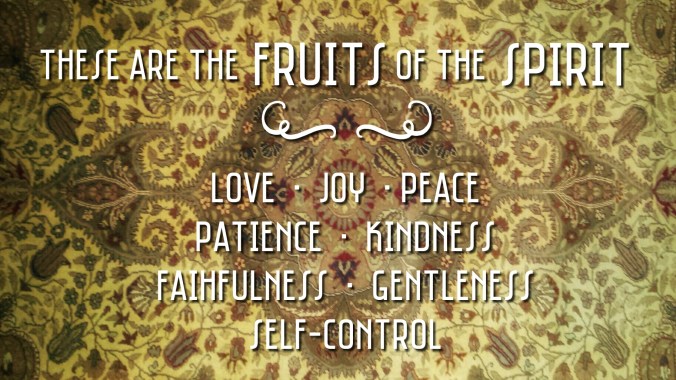
Paul’s letter to the church in Galatia introduced the phrase “fruits of the spirit.” He wrote this letter to the mostly Gentile church because they had fallen under the influence of Jewish evangelists who were persuading them they needed to observe Mosaic law to be good followers of Christ. Paul reminded the Galatians that salvation through Christ leads to changes in attitude and behavior, not the other way around. Over the centuries some Christians have ironically twisted Paul’s insights into a new set of rules and subverted his intent.

Why are we tempted to treat Paul’s list of the fruits of the Spirit and the works of the flesh like a checklist of do’s and don’ts, as though we are wrangling a spot on Santa’s Nice List? It’s always easier to follow specific rules than to do the hard work of learning how to truly love our neighbor. So we substitute a (rather subjective and conveniently curated) list of virtuous activities and evil vices and convince ourselves we are good because we do or don’t do them. We are right back to living for the law, and a second-rate law at that.

Performing good deeds to prove the Spirit is within us is like laying a bunch of apples on the ground and hoping a trunk forms in the middle to raise them all up; they are just going to lay there and eventually rot. Instead we must open ourselves to the Spirit as saplings open to the sun. As we mature in its presence, the resulting fruits – love, peace, generosity, kindness, self-control, etc. – sprout naturally and abundantly. We will act in love and joy because they grow from the inside out.

One last, important feature of fruit: when someone picks it, the branch is not diminished but freed up to create more. Fruit left to rot on the vine does no one any good. Life in the Spirit is not self-centered, but generous. True fruits of the Spirit not only nourish us, they contain the seeds that create a cycle of faith and growth. Our best testimony is the fruit we bear.

Comfort: God’s love for you does not depend on your ability to follow arbitrary rules.

Challenge: Learning to love our neighbors as Christ teaches us to love them takes dedication and hard work.

Prayer: Lord, I will treasure and share the fruits your Spirit has trusted to me.

Discussion: What kinds of rules are important to you? What are not?

Join the discussion! If you enjoyed this post, feel free to join an extended discussion as part of the C+C Facebook group. You’ll be notified of new posts through FB, and have the opportunity to share your thoughts with some lovely people. Or feel free to comment here on WordPress, or even re-blog – the more the merrier!
Dress for Spiritual Success

1451793751266

Today’s readings (click below to open in new window/tab):
Psalms 111; 150, 1 Kings 3:5-14, Colossians 3:12-17, John 6:41-47


Whether you leave your house dressed in a bathrobe, a suit and tie, or a wedding dress, it’s the same you underneath. Despite employer dress codes, you are no less competent on casual Friday than you are when dressed for a board meeting at 8:00 a.m. on Tuesday. However there are times when what you wear is crucial. A nurse treating infectious patients must wear protective clothing. Hikers need footwear to provide both comfort and stability. Dancers are hindered if their clothes do not allow freedom of movement.

In his letter to the Colossians, Paul says they should clothe themselves “with compassion, kindness, humility, meekness, and patience” and “love, which binds everything together in perfect harmony.” Some clothes communicate how we intend to interact with the world. Opposing teams and referees all wear different uniforms for a reason. Someone can say “I’m a professional football player” but until they’re suited up and on the field, they’re not playing professional ball. We can quote scripture and doctrine all day long, but if we haven’t put on a Christian attitude, why would anyone believe us?  Sure, meekness might itch a little and sometimes we can’t wait to slip out of that patience at the end of the day, but they are part of the dress code for the best job in the world.

The good news is, once you’ve broken them in, they are pretty comfortable. Kindness feels less like a tie choking off your breathing and more like a scarf keeping you warm. Humility changes from a girdle squeezing in your less virtuous bulges to a support that helps you keep your back straight and head high. None of us are able to display Paul’s list of virtues all the time, but the more conscious we are about putting them on, the more they become part of us, and the more prepared we feel.

These garments will protect you. They will provide comfort and stability. They will give you confidence to move freely in a world that doesn’t always understand what you’re doing. Dressing for success doesn’t have to cost a dime.

Comfort: Love of God and neighbor is the most beautiful thing you can wear.

Challenge: As you are getting dressed for the day, be intentional about putting on your garments of faith as well.

Prayer: Loving God, I will clothe myself in faith to please you and serve your world. Amen.

Discussion: What’s your favorite item of clothing and why?

Join the discussion! If you enjoyed this post, feel free to join an extended discussion as part of the C+C Facebook group. You’ll be notified of new posts through FB, and have the opportunity to share your thoughts with some lovely people. Or feel free to comment here on WordPress, or even re-blog – the more the merrier!
Love Better

1449419762969

Readings: Psalms 24; 150, Amos 6:1-14, 2 Thessalonians 1:5-12, Luke 1:57-68


Traditionally the theme of the second week of Advent is Love. Often “love” evokes warm feelings of family, friends, and romance. However, depending on a person’s life circumstances, those feelings may be mixed with longing, loneliness, hope, and other emotions.

Sorting out feelings about feelings? Well, love is complicated. Advent adds yet another wrinkle: love as the world falls apart.

The prophet Amos and the apostle Paul both share harsh words about the future. Amos tells the people of Israel they have offended God so mightily that He is “raising up against you a nation, O house of Israel, […] and they shall oppress you from Lebo-hamath to the Wadi Arabah.” Paul in his second letter to the church in Thessalonica tells them they who do not obey the Gospel “will suffer the punishment of eternal destruction, separated from the presence of the Lord and from the glory of his might.” While these passages definitely drive home the message that God desires righteousness, they don’t much describe a God who define Love as a gooey confection of simple affection.

Except in these examples, God’s anger exists because people are too focused on false righteousness and not enough on love. The people of Israel were making ritual sacrifices like clockwork, but ignoring and exploiting the poor. “Obeying the Gospel” wasn’t about rules but about loving God and loving our neighbors as ourselves. These prophets warned us separation from God occurs when we fail to love God and each other.

Throughout the Bible, God sends warning after warning about the consequences of failing to love. He sends us Jesus so we may be reconciled to him in love, and before that sends us John the Baptist to tell us Jesus is on the way. Love is complicated. Think about your own relationships where love has been broken: it’s rarely a sudden snap, but a slow dissolution with opportunities for one or both sides to repent. God begs us to love better.

Advent is a season for reflecting on how well we love God and each other. Before the world falls apart, God call us to love. Afterward, it is the only thing that saves us.

Comfort: God loves us even in anger.

Challenge: Work on a relationship where love has been broken.

Prayer: Make me to know your ways, O LORD; teach me your paths. Lead me in your truth, and teach me, for you are the God of my salvation; for you I wait all day long. (Psalm 25:4-5)

Discussion: How has your understanding of love changed over time?

Join the discussion! If you enjoyed this post, feel free to join an extended discussion as part of the C+C Facebook group. You’ll be notified of new posts through FB, and have the opportunity to share your thoughts with some lovely people. Or feel free to comment here on WordPress, or even re-blog – the more the merrier!

Master Plan

1457065280277

Today’s readings (click below to open in new tab/window):
Psalms 27; 147:12-20, Exodus 1:6-22, 1 Corinthians 12:12-26, Mark 8:27-9:1


The story of Joseph, his many brothers, and his father Jacob is very near its end with today’s reading. The journey to Egypt for Jacob (also called Israel) and his sons has been a long and twisted one.While Joseph and Pharaoh’s favor allowed the fledgling nation of Israel to settle freely in the Egyptian land of Goshen with all the food they needed, the other residents of Egypt were not so lucky during this seven years of famine. After giving Pharaoh all their money one year and their livestock the next, they had nothing left but their land and bodies. In exchange for food, they offered themselves up as Pharaoh’s slaves and had to pay a tribute of a fifth of all they harvested. Continue reading