Sorry, not sorry.

lovesorry

Today’s readings (click below to open in new tab/window):
Psalms 119:73-80; 145, Jeremiah 7:1-15, Romans 4:1-12, John 7:14-36


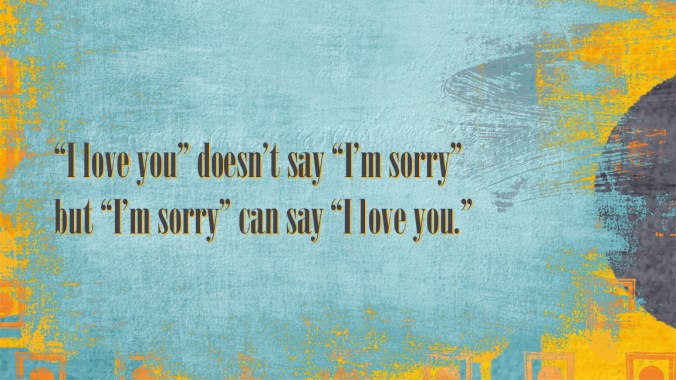
Have you ever tried to apologize by telling someone: “I love you?” Has anyone ever tried that with you? It’s a terrible way to end a dispute, because it resolves nothing. “I love you” is not an apology. It is not an admission of guilt. It is not a promise to change one’s ways. At best it is an attempt to appease someone by exploiting their emotional vulnerability in order to avoid conflict. “I love you” may precede or follow an apology; it does not replace it. Trying to do so is merely lip service.

The prophet Jeremiah addresses the Israelites about how they have been paying spiritual lip service to God. They have been profaning the Lord’s name and committing all kinds of crimes and sin, but on the Sabbath they enter the temple and proclaim “This is the temple of the Lord, the temple of the Lord, the temple of the Lord.” Like a lover who has had enough of hearing all the right words but observing all the wrong deeds, the Lord declares the words deceptive. They are not sincere enough to wipe clean the offenses of a people who utter faithful words to cover their bases, but live otherwise unfaithful lives.

Love, whether of God or of a person, requires sincerity. When we betray that relationship repeatedly, declarations of “I love you” or “This is the temple of the Lord” do nothing but undermine and cheapen the meaning of those words. They are like pretty paper wrapped around a gift of yesterday’s moldering trash. Eventually the contents leak through and the paper itself is fouled by contamination; the pretty words become an ugly stench. Only when we have demonstrably repented – when we no longer try to excuse our wrongdoing with hollow sentiment – can we expect the relationship to mend. Over time we have to rebuild the trust that our words reflect the state of our heart.

Actions really do speak louder than words. If the only proof of our love and devotion is a bouquet of desperate words which have already begun to stink, we must repent until words are unnecessary.

Comfort: God’s love for you does not change.

Challenge: When you apologize, mean it.

Prayer: My God, I am heartily sorry for all my sins. Amen.

Discussion: What is the worst or best apology you’ve received or given?

Join the discussion! If you enjoyed this post, feel free to join an extended discussion as part of the C+C Facebook group. You’ll  have the opportunity to share your thoughts with some lovely people. Or feel free to comment here on WordPress, or even re-blog – the more the merrier!

Sense and Ostensibility

20170727_233818-01

Today’s readings (click below to open in new tab/window):
Psalms 36; 147:12-20, 1 Samuel 28:3-20, Acts 15:1-11, Mark 5:1-20


Ostensible:
adjective, outwardly appearing as such; professed; pretended:
an ostensible cheerfulness concealing sadness.

Quite often people conceal the reasons for their actions from other people (and possibly also from themselves) by offering reasonable-sounding explanations to cover their tracks. One such example is the history of Jim Crow laws enacted after the Civil War. Ostensibly, literacy tests and proof-of-residency requirements were instituted in many states to make sure voters could comprehend the ballot and were qualified to vote. Of course the real reason was to disenfranchise black voters who prior to emancipation had often not been allowed to learn to read, and whose residency documentation was at best a bill of sale. The true intentions were revealed when the voting rights of illiterate white voters were grandfathered in. ‘

The legacy of Jim Crow continues today, as evidenced when the Supreme Court overturned recent North Carolina voting laws which were ostensibly about preventing voter fraud but blatantly targeted African-American and Hispanic voters.

This kind of behavior is neither particularly modern nor particularly American. As more and more gentiles began to convert to Christianity, many of the Jews who became the first followers of Christ didn’t believe they were legitimate. They began to demand that gentile converts be circumcised, as Jews were. After some deliberation, Peter said: “[I]n cleansing their hearts by faith [God] has made no distinction between them and us. Now therefore why are you putting God to the test by placing on the neck of the disciples a yoke that neither our ancestors nor we have been able to bear?” On the surface their concerns may have sounded legitimate, but scrutiny revealed them to be little more than cultural bias against the gentiles.

Part of being “innocent as doves and wise as serpents” is knowing when reasonable explanations like tradition, cost, loyalty, or practicality hide unsavory motives. One big clue is when a group who has been historically marginalized – particularly if they have been gaining ground – suffers disproportionately as a result. The Pharisees had “good reasons” to crucify Christ; let’s be wary of smooth talkers who are readying the nails.


Additional Reading:
Read more about today’s passage from Acts in Entrance Exams.
For additional thoughts on Mark, see The Devils You Know.

Comfort: You’re smart enough to figure out what’s really going on.

Challenge: Don’t play dumb.

Prayer: Lord, teach me to see hard truth and resist attractive lies. Amen.

Discussion: What are some examples of good reasons for not-so-good actions?

Join the discussion! If you enjoyed this post, feel free to join an extended discussion as part of the C+C Facebook group. You’ll be notified of new posts through FB, and have the opportunity to share your thoughts with some lovely people. Or feel free to comment here on WordPress, or even re-blog – the more the merrier!

The Sarcasm Chasm

sarcasm-2015186_1280

Today’s readings (click below to open in new tab/window):
Psalms 12; 146, Deuteronomy 30:11-20, 2 Corinthians 11:1-21a, Luke 19:1-10


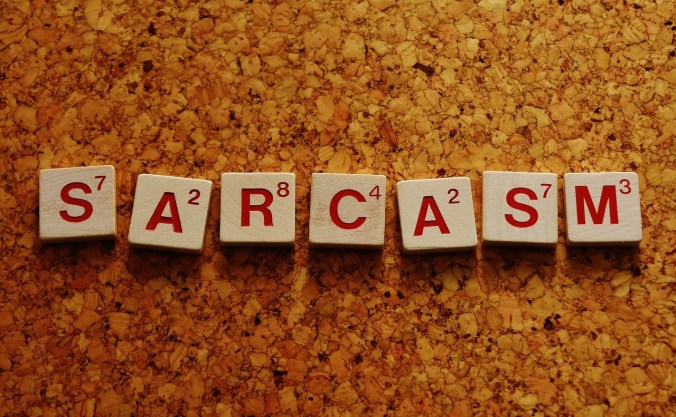
Do you have any friends who describe themselves as “fluent in sarcasm?” It’s a popular phrase. Some people describing themselves this way  do indeed understand the definition and subtleties of sarcasm, but others use it to excuse a general attitude of – for lack of a better term – meanness. Sarcasm, irony, and snark seem to have become the default mode of communication for many people, often as a substitute for wit – which itself has become more of an end than a means. All these tools can be used to make effective points and observations, but only when they are used strategically. We may enjoy rough and tumble banter with our friends, but constant, almost competitive sarcasm erodes actual communication and civility. Sincerity has almost become countercultural.

Paul was not afraid of employing sarcasm, but he did it sparingly and effectively. When members of the church in Corinth started falling for flashy and gimmicky preachers claiming to represent Christ but really representing their own self interests, he sarcastically referred to himself as a fool.

For you gladly put up with fools, being wise yourselves! For you put up with it when someone makes slaves of you, or preys upon you, or takes advantage of you, or puts on airs, or gives you a slap in the face. To my shame, I must say, we were too weak for that!

Imagine how the people of Corinth must have sensed his frustration in these biting words! Paul can get away with it because most of the time he is sincere – almost painfully so.

Proverbs 15:4 tells us “The soothing tongue is a tree of life, but a perverse tongue crushes the spirit.” Ecclesiastes 10:12 says “Words from the mouth of the wise are gracious, but fools are consumed by their own lips.” Perhaps the key to effective sarcasm is recognizing the difference between using it to make an actual point, and using it to make ourselves seem clever at another’s expense.

The capacity for language is a gift from God. So is humor. Let’s use them both in ways that build each other up.

Comfort: You don’t have to be clever to be loving.

Challenge: Go on sarcasm fast for a day. Or, if you are not prone to sarcasm, think about constructive ways to respond to it.

Prayer: God in my mind, God in my heart, God on my lips. Amen.

Discussion: Do you have any thoughts on the use of sarcasm in our current culture?

Join the discussion! If you enjoyed this post, feel free to join an extended discussion as part of the C+C Facebook group. You’ll be notified of new posts through FB, and have the opportunity to share your thoughts with some lovely people. Or feel free to comment here on WordPress, or even re-blog – the more the merrier!