Invitation: Cardinals

1466959090517.jpg

This morning I was sitting on the front porch watching the rain. A cardinal who regularly makes his rounds among the trees and shrubbery of our yard – and occasionally leaves evidence that he visits the porch – was flitting about to find dry shelter. Several times he landed on the porch railing, which was fairly well protected, but was not content to stay. I wanted to take a picture of him with my phone, but he never stayed put long enough or got close enough for a good shot. I tried to be still, to make the dry porch seem less threatening, but once the camera was out, he kept his distance. After I finished my coffee I went inside, and hoped he felt safe to land on the porch.

My eagerness to intrude on his life felt threatening to Mr. Cardinal. Some people are like that, too. An extrovert like me assumes I’m making friendly overtures when I engage someone in conversation or repeatedly remind them how welcome they are. A more introverted person may in fact find these behaviors quite off-putting. When a new person shows up at church, it might seem natural to find out whether they are interested in the choir or fellowship groups or Bible studies; we want them to stay and so many of the popular church-growing guides says groups are the way to do it. It might seem like a gesture of welcome to tell the entire congregation to be sure to welcome our guest. All of this is well intentioned.

But it isn’t necessarily what everyone needs from church. My front porch feels safe and dry to me, but Mr. Cardinal is wired to avoid attention (except from a potential Mrs. Cardinal). If I’m there waving him in, no matter how much he’d like to be dry, he’s never going to land. If my concern is truly for Mr. Cardinal’s well-being, the best way to invite him into a safe space is to first understand what it is makes that space feel safe for him. Now with Mr. Cardinal that means abandoning my porch, but that’s not feasible for church. We can, however, let visitors and new arrivals set the tone for their own type of participation. When we meet someone new, instead of assuming they will love the things we love and demonstrate their feelings the way we do, we can observe what draws them in and what prompts an anxious flutter. Some people want to chirp in the choir, and some people want to nest in the audience.

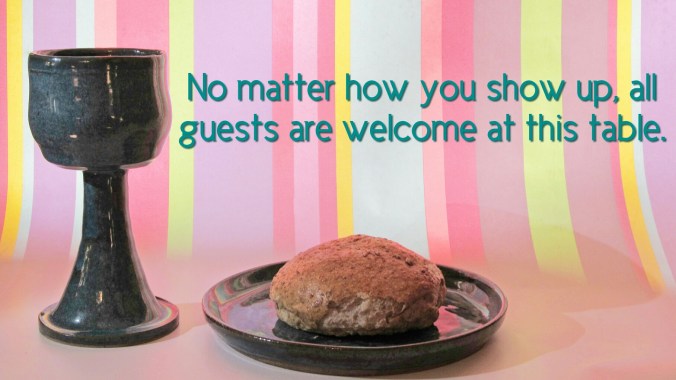
The church is big enough to accommodate all kinds of personalities. The trick of community is to find the commonality that binds us, and allow people to support it and be supported by it in ways that make sense to them. In the Christian church, the communion table is one of those commonalities. Some of us like to write long-winded invitations. Some of like to use the time for contemplation. Some of us like to bake the bread. We do all these things to honor and serve Jesus Christ, the one who truly invites us to the table. Let us follow his lead, and build relationships that let us meet people where they are, instead of where we think they should be. That is how we let people know the table is safe for all.

May the peace of our Lord Jesus Christ be with you all.

Invitation: Forks and Elbows

1454855006658

Etiquette.

Now there’s a concept that’s become twisted over the centuries. A couple years ago I attended a class that was supposed to be on workplace etiquette,  but turned out to be mostly about table manners: what to do with your napkin and your elbows and your bread plate and all that jazz. The presenter insisted breaches of etiquette could seriously limit your career. This view of etiquette as a set of arcane rules the elite use to distinguish the worthy from the unworthy warps the true purpose of etiquette, which is kindness.

The classic etiquette dilemma when presented with a very formal table is: “Which fork do I use?” The implication is that using the wrong fork would signal your lack of class. Do you know why the general rule is “start from the outside in?” A good host sets a place with only the utensils that will be needed, in the order they will be needed. This way, a guest does not need to understand the difference between a fish fork and a fruit fork. The formal setting was designed to minimize the embarrassment of guests, not to create it.

My mother-in-law had a rule of thumb about decorating: no matter how good it might look, never put anything where someone may accidentally break it, because you don’t want to set anyone up for embarrassment. As far as I know, you won’t find that in a book on manners, but it is an excellent example of etiquette. Etiquette should always be about making someone feel comfortable and welcome, not about belittling them.

What is the proper etiquette for a faith community? In many instances, it has been as warped at the communion table as at the dinner table. We develop rules about language, behavior, and belief that may seem completely arbitrary to an outsider (and frankly to many insiders as well): what to wear, how to pray, where to sit, when to stand. When we set up insider rules then judge people for not following them, we are not being at all Christ-like. Sadly, we are too often more concerned with calling someone out for using the wrong fork or hymnal than with creating an environment that helps people learn and grow in ways that foster harmony. In a faith community and all other matters, etiquette is not about looking outside ourselves for reasons to be offended, but about looking inside to ask if we are genuinely caring about others. Jesus wasn’t concerned with arbitrary rules imposed by polite society, but he was interested in creating a just society where all were valued. At the last supper he didn’t worry whose elbows were on the table; he was preparing for the ultimate sacrifice to make sure everyone was welcome to the feast.

May the peace of our Lord Jesus Christ be with you all.
Invitation: Interlopers Welcome

1452436642538

A couple years ago, this little gray striped cat started hanging out on our back porch. If you sat on the steps, she would lie next to you and scoot closer until you petted her. She was pretty and friendly and maybe most importantly she didn’t trigger any of the allergies that prevented us from keeping a cat in the house.

One afternoon she was purring with a little more urgency than usual and looking into the kitchen. Both of us had Italian grandmothers, so naturally we fed her. We emptied a can of tuna into a bowl and set it out. She wolfed it down. After that, Miss Susan Moochie (yep that’s what we call her) was a  daily visitor. We started buying tuna and cat food to be ready for her visits. We even rotated brands and flavors when she seemed to lose interest.

After a while, a couple other cats started showing up. These two were a little more wild and had no interest in meeting us. One was white with gray markings. We called it The Nemesis. The other was almost all black and we just called it The Other One. Together they were… The Interlopers. Miss Susan Moochie didn’t like to eat when The Interlopers were around. We didn’t want them around harassing our Miss Susan, so we’d shoo them away. As soon as she was done eating we brought her leftovers into the house.

Little by little, Miss Susan started skipping a day here or there, or leaving more than half the food untouched. The Interlopers were persistent, and seemed hungry. When the weather started to turn cold, we felt a little bad for them, and stopped taking in the leftovers. The Nemesis and The Other One consistently finished off whatever was in the bowl. Gradually, Miss Susan weaned herself off our company and generosity. We can only assume it was because she didn’t care for the continuing presence of The Interlopers.

Now we feed the Interlopers when they show up. The Nemesis will let me pet it once in a while, but never for long. The Other One has never even been close enough to bite the hand that feeds it. They aren’t the cats we wanted, but they are faithful and in need. Probably they are faithful because they are in need.

I don’t particularly like The Interlopers, but that felt like a pretty darn hypocritical reason not to feed them. After all, in Matthew and Luke Jesus says: “If you love those who love you, what credit is that to you? Even sinners love those who love them.” That got me thinking about people and church and communities. We are sad when the “right” people move on because the “wrong” people — usually people who have less than we do or are unfamiliar to us — have invaded our church, or neighborhood, or country.

We are called to love the people who do not love us. Christ invites everyone to the table, and we’re not going to love them all. Some people may harass us and others may not speak to us. Some may seem like they’re only showing up to take and not to give. We don’t get to pick and choose who Christ feeds. Jesus is the host and whether we showed up to the party first or last, dressed to the nines or looking like we don’t care, we are his guests and arrive on equal terms. We are all interlopers to someone. How fortunate for us Jesus is the one with the can opener.

The Peace of Christ be with you.