Ineffable

in-ef-fa-ble *
adjective
1. incapable of being expressed or described in words
2. not to be spoken because of its sacredness; unutterable

Applying words to God is a tricky business. Since God is infinite, any definition we construct is by definition insufficient. We write and speak about God, and around God, but the words we use are not God. Not surprisingly, some of the most powerful and revealing writing about God is not descriptive but poetic.

The psalmists and prophets were particularly gifted at painting their experience of God in vivid metaphors, some so strange as to be dreamlike. When discussing God as a saving force, Isaiah described a warrior with a breastplate of righteousness, a helmet of salvation, garments of vengeance, and a mantle of fury. God is infinitely more than a warrior, but for Isaiah this was an image that addressed the needs of the time. When we contrast that picture with Matthew’s picture of God as a mother hen gathering her chicks, it is apparent different metaphors for God serve different purposes.

One danger of metaphors is that we allow them to solidify into definitions. For example, God as “Father” is one of the most common metaphors, so common that many people take is as a firm definition. Many find this image strong and comforting, but to others who have not had good paternal experience it can be jarring, even alienating. While we should welcome the potential for growth that exists in grappling with challenging notions of God, when we insist on our own image of God is the sole defining one, we do a disservice to the God who is present for all people in all times and all places. Furthermore, we hamper our opportunity to experience God in ever richer ways by considering how God manifests to others.

The good news is that if no words are sufficient – all words are on the table. We may not be able to define God, but we can express our understanding of God in words and images that reflect our own experiences. We are not limited to existing, traditional terms that we find alienating or meaningless. To some people – people who feel the need to control the uncontrollable experience that is God – this notion is dangerous and heretical. But if our goal is truly to better understand God and not just to create a God in an image that is convenient for us, the work of doing so is holy.

Comfort: God can be present to us in many ways…

Challenge: … so we should stay alter to how God is present for other people.

Prayer: Ever-present God, though I may never succeed I strive to experience you as you are, not just as I would have you be.

Discussion: Are they any ideas of God you have abandoned or embraced?


* ineffable. (n.d.). Dictionary.com Unabridged. Retrieved January 08, 2013, from Dictionary.com website: http://dictionary.reference.com/browse/ineffable

Stewards

goodwine

Today’s readings:
Psalms 46 or 97; 149, Isaiah 52:3-6, Revelation 2:1-7, John 2:1-11


Jesus performed his first public miracle at a wedding he attended with his mother. When Mary told him the wine ran out, at first Jesus replied it was none of his concern. Still Mary told the servants, “Do whatever he tells you.” After that, Jesus turned over a hundred gallons of water into surprisingly good wine. The servants who drew the water knew what happened, but the wine steward assumed the bridal party had been holding back.

A lot of the world is like that wine steward, ignorant of how Christ and his church are at work in the world, yet benefiting just the same. Christians hear a lot of criticism about the church. Some is justified, but a lot of people refuse to see the good the church does because they are committed to viewing it only through the lens of lurid stories of abuse and corruption. Others make over-simplified claims like “religion is responsible for more wars … blah blah blah.” We must be honest with ourselves about our flaws, but we should not be shamed about what the church is and what it does when we are actually following Christ.

Faith-based organizations feed, shelter, clothe, heal, rebuild, resettle, and otherwise positively impact the lives of hundreds of millions of people in need every year. The stereotypical “sermon before soup” model is not the norm for most of these institutions; we meet needs regardless of the particulars of someone’s faith. We should avoid engaging in pointless (and impossible to settle) debates about whether religious people are more or less generous than non-religious people, because we aren’t in competition. Our efforts, imperfect though they may be, help people who would otherwise suffer with no hope of relief.

The church’s primary business is spreading the Gospel, but the Gospel directs us toward service. That service benefits communities in ways many never (or refuse to) recognize. They focus on scandals and frauds rather than shelters and food pantries because not seeing the homeless and hungry begging on the streets doesn’t make news. We may be servants, but we can spread the Good News about where our good wine comes from.

Comfort: You and your church are not defined solely by your faults.

Challenge: Visit the web-sites of Church World Services, Heifer InternationalCatholic Charities, or Week of Compassion to read about the good work the church does, and how you might participate in it.

Prayer: God, may your people and church ever grow in love and generosity. Amen.

Discussion: Do you have a favorite faith-based organization to donate to or volunteer for?

Join the discussion! If you enjoyed this post, feel free to join an extended discussion as part of the C+C Facebook group. You’ll  have the opportunity to share your thoughts with some lovely people. Or feel free to comment here on WordPress, or even re-blog – the more the merrier!

Epiphanies

CnCEpiphany

Today’s readings:
Psalms 72; 148, Isaiah 52:7-10, Revelation 21:22-27, Matthew 12:14-21
Epiphany readings:
Isaiah 60:1-6, Psalm 72:1-7, 10-14, Ephesians 3:1-12, Matthew 2:1-12


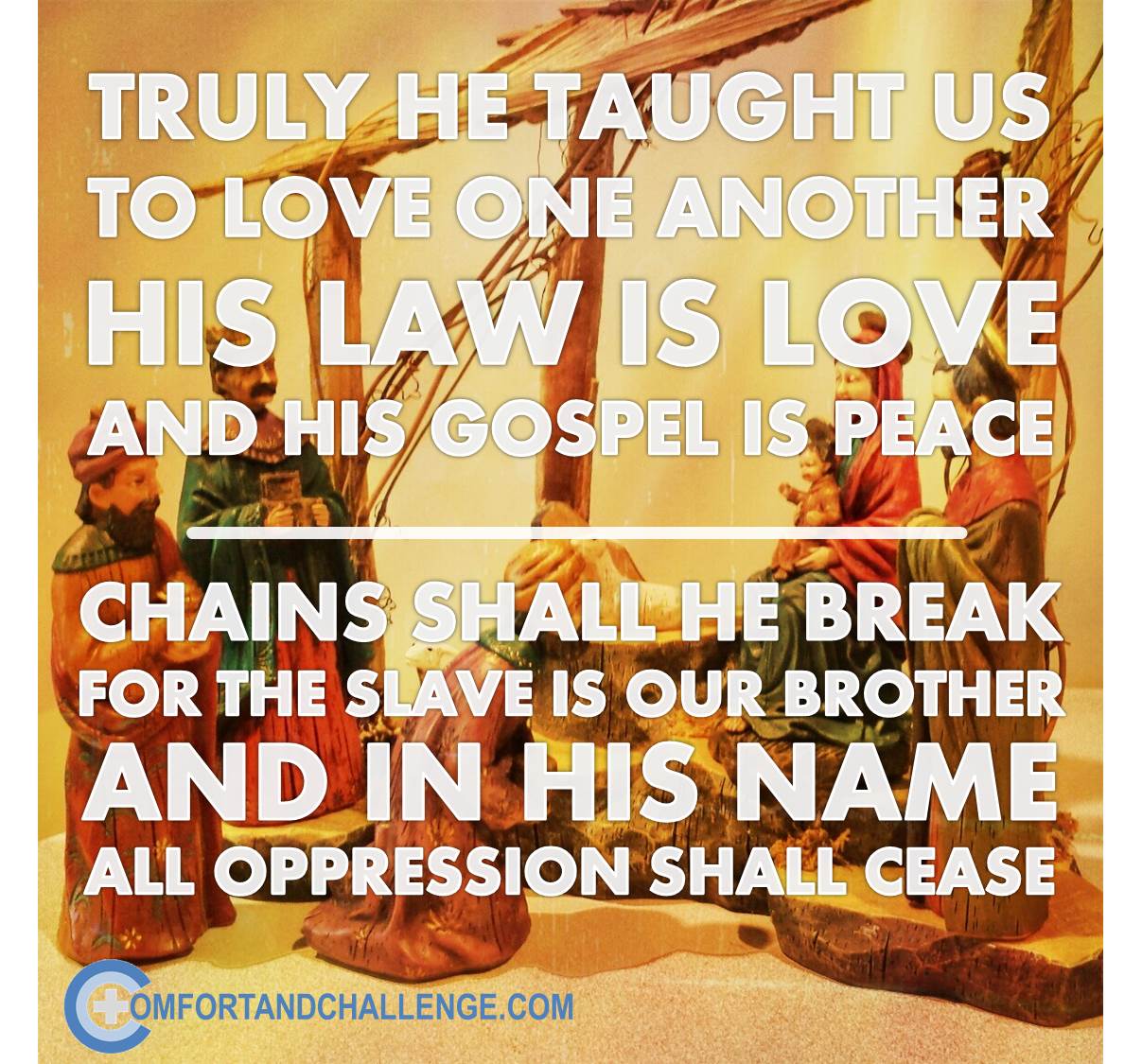
Happy Epiphany! Today is the last day of the Christmas season. Our traditional reading is about the Magi: wise men who – led by a prophecy and a star – traveled from far lands to honor the infant Christ with gifts of gold, frankincense, and myrrh. Some people wait until today to add the Magi to complete their nativity scenes and continue to display it until February 2nd, the feast of the Presentation of the Lord.

If you haven’t yet listened to “We Three Kings” this season, today’s your day!

But the story of the Magi has a darker side. On their way to Bethlehem, the Magi visited King Herod to ask where the newborn King of the Jews might be found. Herod, jealous and fearful, met with the chief priests and scribes to learn all he could about the prophesied messiah, and tried to pump the Magi for information. He told them “when you have found him, bring me word so that I may also go and pay him homage.” In truth, he was less interested in homage than homicide. The Magi, warned in a dream not to return to Herod, went home by another route.

In our daily readings, the same crowd– still fearful of Jesus and all he represents – is conspiring to destroy the adult Jesus. For a time he goes underground, but continues his ministry of healing and justice. Jesus always is who he says he is; his enemies (and some of them claim to serve him) are not.

What exactly does “epiphany” mean? It is a moment of insight or revelation. One of the most important epiphanies in this story is when the Magi realize Herod’s intent differs from his words. We would be wise to follow their example. Often those who govern – religiously or civilly – publicly promote one agenda but follow another. From slapping misleading titles on legislation, to unnecessarily “protecting” a powerful group in order to suppress another more vulnerable one, to rewriting history that judges them unfavorably, people tell us what they think we want to hear in order to lull us into going along with something else. In his novel Nineteen Eighty-Four, George Orwell called it doublethink, and it empowered tyranny.

Some epiphanies are spontaneous. Others are the product of critical thinking. As followers of Christ, let’s strive to be like the Magi and stay ready for both.

Comfort: Jesus is always who he claims to be.

Challenge: Maintain a healthy skepticism of those in power, especially those who tell you what you want to hear.

Prayer: God of truth and light, I will seek to follow you always! Amen.

Discussion: What’s the last epiphany you had?

Join the discussion! If you enjoyed this post, feel free to join an extended discussion as part of the C+C Facebook group or follow @comf_and_chall on Twitter. You’ll  have the opportunity to share your thoughts with some lovely people. Or feel free to comment here on WordPress, or even re-blog – the more the merrier!

Branching Out

vinebranches

Today’s readings:
Psalms 99; 147:12-20, Joshua 1:1-9, Hebrews 11:32-12:2, John 15:1-16


I am the vine, you are the branches. Those who abide in me and I in them
bear much fruit, because apart from me you can do nothing.
– John 15:5

This passage from John beautifully illustrates our relationship with Christ; he is central not only to our beliefs, but to our very lives. Separated from Christ, we wither and die. The passage goes on to describe branches that wither and are burned, and branches that thrive and bear fruit.

Yes the vine is central, but this metaphor also reminds us of the importance of Christian community. After all, when’s the last time you saw a healthy vine with only one branch?

It’s no coincidence that Jesus immediately follows the image of the vine and branches with a commandment for the disciples to love one another so much that they would lay down their lives for each other. Branches are interdependent; the health of each one positively or negatively impacting the health of the others. Apart from community, we are like single branches trying to survive on our own: it’s remotely possible, but the fruit we bear will likely be sparse and limited … and even then only if we can bear any at all before collapsing under our own weight or drying out from overexposure to the elements. A community of many branches anchored together in Christ provides the support and shelter to bear good fruit.

Our reading from John is paired with a passage from Hebrews that refers to a “cloud of witnesses” who fought, won, suffered, and died for their faith so that future generations would see God’s promise fulfilled. Not everything we plant is meant for immediate benefit. A grapevine can take up to three years to produce grapes, but those years without fruit are not without purpose. Roots must grow deep and the plant must mature. Older branches are pruned so the vine may thrive. By participating in the life cycle of a community we contribute not only to its present health, but help provide for the health of future branches.

Let us work toward the health of all branches, supporting each other and bearing the sweetest fruits together.

Comfort: We are not alone.

Challenge: Think about whether you are a positive or negative influence on your own spiritual community.

Prayer: Loving God, thank you for the many branches and witnesses who have made your church possible. Amen.

Discussion: What kind of community do you prefer? For example, blending into a large congregation, being part of small groups, online groups, mission teams, etc.

Join the discussion! If you enjoyed this post, feel free to join an extended discussion as part of the C+C Facebook group. You’ll  have the opportunity to share your thoughts with some lovely people. Or feel free to comment here on WordPress, or even re-blog – the more the merrier!

The Impotence of Power

Today’s readings:
Psalms 20; 147:1-1, Exodus 3:1-5, Hebrews 11:23-31, John 14:6-14


“By faith Moses, when he was grown up, refused to be called a son of Pharaoh’s daughter, choosing rather to share ill-treatment with the people of God than to enjoy the fleeting pleasures of sin.”

– Hebrews 11:24-25

Injustice demands reaction.

Do we pray about it? Discuss it with friends? Ignore it?

Or like Jesus and Moses, do we actively confront it?

Most approaches fall into one of two camps: working within the system, or working outside it. Depending upon the unjust “system” – which may be a government, church, business, or culture – our circumstances may determine which path is available to us. However, as a Hebrew adopted by Pharaoh’s daughter into the Egyptian ruling class, Moses had choices. He could have lamented but otherwise ignored injustice that didn’t affect him directly. He could have lived a comfortable “insider” life and used his influence with Pharaoh’s family to incrementally ease the injustice suffered by his people. Wisely, he chose to act as an outsider.

People in positions of power – boards, elected offices, etc. – often seek that power to change unjust systems. However, insiders can influence change only to the extent that those controlling the system will tolerate it. The more one works to change the system, the greater the risk of being ejected from it.

Even those uncorrupted by power frequently find themselves maneuvered into working to retain that power more than actually using it. The more they hold, the more reluctant they are to lose it. Can the rich and powerful promote justice? Only if it is more important to them than the wealth and power the possess. To truly use power to fight injustice, one must be willing to lose it completely.

What if we are on the outside? If we feel helpless because we lack institutional power, let’s look to Moses, Jesus, and the prophets as inspiration for the ability of outsiders to effect change. Having nothing freed them to say everything. Because they didn’t dedicate their resources to maintaining wealth and power, they could dedicate them to justice. Do our own attachments hinder our willingness to do justice?

Let’s remember, Moses had to descend from the mountain of power before he climbed the mountain of the Lord.

Comfort: You don’t have to be powerful to be full of power.

Challenge: List three ways you can influence the world around you.

Prayer: Merciful God, teach me to exercise power mercifully and for justice. Amen.

Discussion: Have you ever solved a problem by giving up control?

Join the discussion! If you enjoyed this post, feel free to join an extended discussion as part of the C+C Facebook group. You’ll  have the opportunity to share your thoughts with some lovely people. Or feel free to comment here on WordPress, or even re-blog – the more the merrier!

Homeland

1483412681900-01.jpeg

Today’s readings:
Psalms 111; 146, Genesis 28:10-22, Hebrews 11:13-22, John 10:7-17


“All of these died in faith without having received the promises, but from a distance they saw and greeted them. They confessed that they were strangers and foreigners on the earth, for people who speak in this way make it clear that they are seeking a homeland.”

– Hebrews 11:13-14

Do you feel like you have a homeland? For most of us, it’s the nation we live in. Or maybe, if you were born in a different land, it’s your country of origin. Some people feel an affinity for places they’ve only ever visited, or perhaps never been. For the faithful described in today’s passage from Hebrews, the homeland was a place which didn’t exist except as a promise from God.

As citizens of the Kingdom of God – a place which is very real yet not found on any map – perhaps we should always feel a little displaced. When we are too comfortable in an earthly kingdom (or republic or federation or whatever form that “kingdom” may take), we may confuse it with God’s Kingdom and begin to equate patriotism with fidelity to Christ. As a result we look at other nations – also full of God’s children – as morally inferior, and think of our own institutions as somehow divinely ordained.

Yes, there are a few Biblical passages that can be interpreted to mean worldly authorities have been ordained and placed by God, but that doesn’t mean they can’t be corrupted. Even the United States, which prides itself on religious freedom, was founded in rebellion against existing authorities, and is itself subject to very un-Christ-like behavior.

Any government claim to divine authority is dangerous propaganda created to convince us we shouldn’t question all-too-human authority.   When, during the Civil War, Abraham Lincoln said, “my greatest concern is to be on God’s side,” he wasn’t claiming God would back the winner, but that God’s purposes are greater than we can imagine. Though they may occasionally overlap, the concerns of an earthly nation are not equivalent to the concerns of Christ.

Our homeland is nowhere – and everywhere. We find it wherever we are by following Christ. Our responsibilities to God’s justice , peace, and love don’t fluctuate with the whims of nations, but our commitment (or lack thereof) to those responsibilities may be revealed when those whims are at odds with discipleship. Our flag is the coat we give to our neighbor, our anthem the words of forgiveness spoken to our enemies, our border the limitless reach of God’s love.

For additional thoughts on today’s reading from John 10, see Our Shepherd’s Voice

Comfort: Your citizenship in the kingdom of heaven is constant.

Challenge: Pay attention to discern when someone is trying to exploit your faith for personal or nationalistic purposes.

Prayer: God of all creation, my allegiance is to your Kingdom. Amen.

Discussion: What are the dangers of mixing national identity with religious identity?

Join the discussion! If you enjoyed this post, feel free to join an extended discussion as part of the C+C Facebook group. You’ll  have the opportunity to share your thoughts with some lovely people. Or feel free to comment here on WordPress, or even re-blog – the more the merrier!

Reasonable Faith

reasontogether

Today’s readings:
Psalms 48; 145,g Genesis 12:1-7, Hebrews 11:1-12, John 6:35-42, 48-51


 “Now faith is the assurance of things hoped for, the conviction of things not seen.”

– Hebrews 11:1

“Faith” is a loaded term. We can’t quite agree on its meaning, at least not like we can agree on the definitions of “waffle” or “goldfish.” Even when we use it in the sense of “Christian faith” or “Muslim faith” we can disagree on the very foundations of those phrases. Instead we tend to pack it with our own assumptions and experiences, often so much so that conversation about it may become practically impossible.

As long as we have it, is there any pressing need to define “faith?” Perhaps not in a manner that we would use to persuade someone, but there is benefit to at least giving it some thought. Otherwise we run the risk of letting others define it for us, possibly to the point of undermining it. Seminary is all about the foundations of faith yet pushes quite a few people from blind faith to no faith. One reason is because they’ve allowed others to define their faith in terms of Biblical literalism, unexamined mythologies, or other beliefs that simply refute reality. When those beliefs are challenged, faith in them crumbles.

Critics of religious faith have used Hebrews 11:1 (“the conviction of things not seen”) to portray Christians as deniers of fact and believers in fairy tales. These are not the qualities and essence of faith. Faith is a surrender, not of reason, but of the need to build a sense of purpose on nothing but what we can prove. Even the scientific method requires faith that the laws of the universe are, on some level, reliable and predictable. Human beings can’t function without faith in something.

Does your faith hinge on something that could be disproved? Then it is not faith. Does it require you to deny reality? Then it is not faith. Does it provide you with the assurance that – no matter what evidence you must accept, nor hardship you must endure – your life and all lives have meaning as part of a greater reality beyond immediate comprehension? Then it is faith. But don’t take my word for it.

Comfort: Faith is both personal and universal, something to treasure and something to share.

Challenge: Don’t be afraid of things that challenge your faith, but use them as opportunities to grow it.

Prayer: God of infinite imagination, teach me to see the deep truths of your amazing world. Amen.

Discussion: What challenges your faith?

Join the discussion! If you enjoyed this post, feel free to join an extended discussion as part of the C+C Facebook group. You’ll  have the opportunity to share your thoughts with some lovely people. Or feel free to comment here on WordPress, or even re-blog – the more the merrier!

Quantum Leap of Faith

Today’s readings:
Psalms 98; 146; Genesis 17:1-12a, 15-16; Colossians 2:6-12; John 16:23b-30


Birthdays. Anniversaries. New Years.

Certain annual events just seem to invite us to simultaneously reflect on the past and dream about the future. Other unexpected, less celebratory events such as the death of a parent or the loss of a job, may trigger similar feelings for us. Anticipated or not, these times leave us in a sort of “in-between” state when we are not necessarily in motion but contemplating where have been and where we are going. They can be fertile times for resolutions, plans and convictions – some which will stick, and some which won’t.

While periods of planning and intention often serve a purpose, sometimes we settle for intentions rather than actual change. If we are really going to grow as people, eventually we need to stop planning … and start changing.

Other than the TV show, what do you think of when you hear the phrase “quantum leap?” Many people think it means a large change, but it’s actually a term from physics that means an immediate change from one state to another with no intermediate phases – no “in-between” time. The phrase also describes a phenomenon in thought where we jump from Point A (perhaps a problem we are trying to solve) to Point B (its solution) without discernible steps and connections.

Spiritual growth can occur like a quantum leap. When Abram accepts God’s promise to become the father of the future nation of Israel, he is immediately transformed into Abraham. Paul tells the Colossians that when they were baptised they were raised from death along with Christ – a change in state if there ever was one. The psalmist tells us “The Lord sets the prisoners free” and “opens the eyes of the blind.”

Abram to Abraham. Dead to living. Imprisoned to free. Quantum leaps.

There’s nothing wrong with making plans, but often when we are called to act in faith, plans mean very little. Abraham’s wife (who leapt from Sarai to Sarah) planned to grow old and die childless, and laughed when God told her otherwise. We all should be careful not to let our plans become impediments to our faith.

The psalmist warns us not to place our trust in mortal plans that perish but in God alone. It may be wise to look before leaping, but if we can’t … maybe God is calling us to make a quantum leap of faith from blindness to sight.

Comfort: With God’s strength, you can keep moving forward in ways that may surprise you.

Challenge: Pick something you’ve been planning to change, and actually do it.

Prayer: Wise and Loving God, I will trust in your ways.

Discussion: Can you remember any times you had an unexpected shift in attitude, belief, or habits?

Join the discussion! If you enjoyed this post, feel free to join an extended discussion as part of the C+C Facebook group. You’ll  have the opportunity to share your thoughts with some lovely people. Or feel free to comment here on WordPress, or even re-blog – the more the merrier!