
Learning from Fools

share_listen_talk

Today’s readings (click below to open in new tab/window):
Psalms 5; 145, Numbers 9:15-23, 10:29-36, Romans 1:1-15, Matthew 17:14-21


After Israelites fled Egypt, the Lord instructed them to build a tabernacle (a tent or dwelling place) where he could reside with them. During the day the Lord appeared above the tabernacle as a pillar of clouds, and in the evenings he appeared as a pillar of fire. When the cloud moved, the people knew it was time to pack up the tabernacle and the rest of the encampment and follow it to the next destination.

The Lord knew it was important to be visible to the people of Israel all the time; they were frightened and fickle and needed reassurance of his constant presence. As God he owed them nothing, but as a creator loving his creatures, he chose to be present in ways they could understand.

In Paul’s letter to the Romans, he writes: “I am a debtor both to Greeks and to barbarians, both to the wise and to the foolish.” Paul also understood the importance of tailoring his approach to the realities of a situation. In his case though, it was a two-way exchange. To share the gospel he adapted his style (but not his message) to reach his listeners, but he also understood the gospel more deeply as a result of listening to them. Admitting he owed something to fools took real humility.

How flexible are we when attempting to share the gospel? Is our approach more an agenda or an invitation? How about when we evaluate the quality of a worship service that doesn’t align with our preference in musical or pastoral style? Do we try to learn from the differences, or do we work on justifying our preconceptions? Are we at all willing to hear the wisdom of those we consider foolish?

Too often the church approaches evangelism like colonialism, where we play the “advanced” civilization forcing a particular vision on  ignorant barbarians. If Paul was flexible enough to learn from those he sought to teach, we should be too. Whether communicating inside the walls of the church, or taking the gospel to the streets, humility is the key to living the message.

Comfort: You don’t have to have all the answers to share the good news.

Challenge: Listen to some religious music that’s in a style you don’t especially like. Try to transcend the style to hear the message.

Prayer: God of the living gospel, I humbly seek to share Christ’s message of salvation, and to listen to the needs of your children. Amen.

Discussion: In what ways do you find it difficult to be flexible?

Join the discussion! If you enjoyed this post, feel free to join an extended discussion as part of the C+C Facebook group. You’ll be notified of new posts through FB, and have the opportunity to share your thoughts with some lovely people.

Fear of Success

MuchRequired

Today’s readings (click below to open in new tab/window):
Psalms 103; 150, Numbers 6:22-27, Acts 13:1-12, Luke 12:41-48


“Fear of success” doesn’t sound like something that should happen, but it’s a common psychological challenge. Success represents change, and there are numerous reasons we consciously and subconsciously fear change. In many ways failure can be less fearful because it means remaining in familiar territory.

In the Gospel of Luke, Jesus touches on what it means to succeed: “From everyone to whom much has been given, much will be required; and from the one to whom much has been entrusted, even more will be demanded.”

Does that kindle a little fear in your heart?

When we do well personally and professionally, we say we have been blessed. While that’s true, we also need to realize we have been burdened. Though it’s cliched, we need to ask ourselves whether we are paying it forward. The motto of the National Association of Black Accountants (NABA) is: “Lifting as We Climb.” This organization focuses its efforts on a specific community and profession, but  it embodies the responsibilities that come with success.

There’s nothing wrong with enjoying a wealth of money, time, or talent, but we must not get caught in the trap of thinking what we have earned is what we deserve. No matter how much success we earn, we fall short of “deserving” God’s love and mercy, yet God gives them to us freely. If Christ is our example, and he gave up his life for the salvation of our undeserving souls, how can we claim the right to hold on to anything we’ve earned? How can we look down on those who have not “earned” what we hold but they need?

Personal accountability is not something we impose on strangers (though we should expect and encourage it), but a standard to which we hold ourselves. It’s not measured by what we’ve socked away for retirement, but by how proportionately we’ve used what’s been given and entrusted to us to meet the requirements and demands of faithful service.

Success means change. If that change happens, and much is demanded of us, will we be more afraid of being broke or being broken?

Comfort: How you account for your generosity is between you and God.

Challenge: “Responsibility” can become an excuse for mean-spiritedness. When you are deciding whether to give time, money, or talent to those in need, consider what it says about your character as least as much as you consider theirs.

Prayer: God of mercy, teach me to use my gifts wisely and generously.

Discussion: How do you arrive at a balance between generosity and practicality? How concerned do you think Jesus is with the practical?

Join the discussion! If you enjoyed this post, feel free to join an extended discussion as part of the C+C Facebook group. You’ll be notified of new posts through FB, and have the opportunity to share your thoughts with some lovely people.

Why Thee?

countdays

Today’s readings (click below to open in new tab/window):
Psalms 63; 149, Numbers 3:1-13, Galatians 6:11-18, Matthew 17:1-13
Evening Psalms 125; 90


Psalm 90 – the only psalm attributed to Moses – is written from the perspective of someone trying to make sense of it all at the end of a long life. The psalmist doesn’t sugar coat life’s difficulties. He prays the good days might at least outnumber the bad, and acknowledges that the lucky get 80 years of toil and trouble. Yet he prays for God’s work and its meaning to be manifest in the community.

The wise do not wait until the end of their lives to contemplate the meaning of work and suffering, nor do they wait until suffering is upon them. It’s tempting to keep the suffering of others at a certain emotional distance because identifying with it too closely forces us to admit it could happen to us. Distance feels safe, but leaves us ill prepared when God does not exempt us from disease, infidelity, loss, or other tragedy. Suddenly what we saw as part of God’s plan for another person becomes a crisis of faith in our own lives.

If we spend time now asking “Why them?” and “How would you have me respond?” we are less likely to be spiritually devastated when it’s inevitably time to ask “Why me?”

The psalmist doesn’t offer concrete answers to his questions, but the context gives us some clues about where those answers may lie. The questions are universal, and he asks them not about anyone in particular, but about the community. The work is not the work of any one person, but of the community. The meaning of the work transcends any single life or generation. Despite all Moses did to lead the Israelites, he never set foot in the promised land. Any satisfaction Moses gained from his efforts came from the knowledge he had played his role in the greater plan.

When it’s our turn to suffer – and we’ll all have our turn – the question “Why me?” overwhelms us if we can’t see ourselves as but one part of the whole of creation. If we’ve lived a self-centered life divorced from the story of the community, meaning will be difficult to find. Like words chosen by a skillful poet, each of us is complete, important, and beloved by God, but part of a greater work.

Comfort: You are an important piece of your community, supported by and supporting all the other pieces.

Challenge: See above.

Prayer: Loving God, grant me the patience and wisdom to encounter suffering with a heart of mercy and solidarity. Amen.

Discussion: What types of suffering do you identify with? What types do you find difficult to deal with?

Join the discussion! If you enjoyed this post, feel free to join an extended discussion as part of the C+C Facebook group. You’ll be notified of new posts through FB, and have the opportunity to share your thoughts with some lovely people.

Feedback Loop

bear burdens

Today’s readings (click below to open in new tab/window):
Psalms 84; 148, Ecclesiastes 11:9-12:14, Galatians 5:25-6:10, Matthew 16:21-28


A few days ago we considered how we might be receptive to criticism. Today let’s flip that script and think about how we can most constructively give feedback.

In his letter to the Galatians, Paul wrote: “[I]f anyone is detected in a transgression, you who have received the Spirit should restore such a one in a spirit of gentleness.” He also said we are called to bear each other’s burdens. As a culture we seem to have grown increasingly comfortable with providing immediate feedback via social media, comment boards, and even in person to strangers. Unfortunately, we are less adept at the “gentleness” part. Name calling, snap judgments, and attention-grabbing vitriol fill our internet, television screens, newspaper pages, and radio waves.

These types of reactions aren’t really about the other person; they are about satisfying our own sense of righteousness.

There are times when firm reactions are called for. When Peter tried to discourage Christ from his journey to the cross, Jesus responded with: “Get behind me, Satan! You are a stumbling block to me; for you are setting your mind not on divine things but on human things.” This may sound harsh, but he spoke with unmistakable intent because what Peter was tempting him to do was unmistakably in error.  He explained what needed to happen in order to reconcile his disciples to the necessary future.

A single incident or flaw almost never defines a person. Peter was still Jesus’s rock. We need to remember that so we don’t seek mercy for ourselves but punishment for others. Bearing each other’s burden includes making an effort at reconciliation. Character assassination is not part of that process. Can we imagine Jesus launching a Facebook dogpile designed to publicly humiliate Peter? Naming hurtful behaviors is necessary, creating more of them is not part of the reconciliation formula. That may not seem “fair” by worldly standards, but Jesus teaches forgiveness and self-sacrifice, not retaliation.

If we aren’t in a position to offer restoration, we aren’t in a position to offer rebuke. Perhaps we can better use that time pulling the logs from our own eyes.

Comfort: Compassion and rebuke can coexist.

Challenge: If you have social media accounts, try not expressing negative opinions for a week.

Prayer: God of restoration, help me bear the burdens of my community with the help of your Spirit. Amen.

Discussion: When have your received or offered constructive criticism?

Join the discussion! If you enjoyed this post, feel free to join an extended discussion as part of the C+C Facebook group. You’ll be notified of new posts through FB, and have the opportunity to share your thoughts with some lovely people.

Doubt, Pray, Love

1465504231571.jpg

Today’s readings (click below to open in new tab/window):
Psalms 26; 30, Ecclesiastes 11:1-8, Galatians 5:16-24, Matthew 16:13-20


No matter how strong our faith, we eventually have a day – or perhaps an achingly long series of days – when God seems far away. We don’t talk about those days much. Rather, we feel pressure to put on a brave face. Expressions of doubt during a Bible study prompt our friends to offer arguments for belief which are probably more about their reassurance than ours. A minor breakdown during prayer time is viewed as unseemly and inappropriate, maybe even fodder for parking lot gossip.

Loss and weakness are fine to discuss if we’ve already overcome them, but no one likes to watch the sausage being made. A story of beating a gambling addiction? Testify! A confession about how your ongoing blackout drinking leads to promiscuity? Better save it for the 12-step meeting. We talk a good game about brokenness, vulnerability, and healing but we really want to skip right to the “after” photo because the “before” mugshot is too upsetting.

The Psalms tell a different story. Many of them describe how we can be simultaneously faithful and in a wretched state. The author of Psalm 130 is crying out to God from the depths of despair. He recognizes his own failings and shortcomings. He finds himself unable to do anything but wait for the Lord and hope for the best. He still puts his trust in God but he’s not putting up a brave front.

Questions, moments of weakness, and despair do not demonstrate a lack of faith. They are the times that tell us whether we had any faith in the first place. Like the psalmist, sometimes the best we can do is beg God to get us through the darkness while we hunker down and hang on until daylight.

A healthy faith community will offer a safe space to rail against injustice, struggles, and the seeming distance of God. It will face darkness head on but shine a light into it. Since communities are made of people, the responsibility of creating such space then falls on each of us. We can be ourselves when we allow others to do the same.

Comfort: God is big enough to love you through your anger and doubt.

Challenge: It can be difficult to navigate when to express our pain and when to keep it to ourselves. Read this piece on how not to say the wrong thing.

Prayer: Loving God, my source of strength and security, thank you for weathering my doubts and fears. I will trust you to see me through this and all days. Amen.

Discussion: Have you ever found relief after sharing something you had been keeping to yourself?

Join the discussion! If you enjoyed this post, feel free to join an extended discussion as part of the C+C Facebook group. You’ll be notified of new posts through FB, and have the opportunity to share your thoughts with some lovely people.

A Little Yeast

solve through love

Today’s readings (click below to open in new tab/window):
Psalms 96; 147:1-11, Ecclesiastes 9:11-18, Galatians 5:1-15, Matthew 16:1-12


Paul fought diligently to bring the gospel to the Gentiles. He argued with Peter and James that there was no need for Gentiles to observe Jewish laws, since Christ had fulfilled the law and freed us of its chains. Imagine his dismay when certain members of the church at Galatia –which he founded! – began teaching circumcision was a requirement.

Paul’s response may be summed up as: “You were fine when I left you – what happened?! If you require this one law for justification, you will effectively bind yourself to all of them, and Jesus’s sacrifice becomes meaningless for you. Stop listening to these bad apples; they are spoiling the bunch!” More specifically: “A little yeast leavens the whole batch of dough.”

Jesus also compared bad teachings to yeast.  To appreciate the analogy, we must remember that during Passover Jews ate only unleavened (yeast-free) bread to commemorate their flight from Egypt; even a tiny bit of yeast could rapidly grow to contaminate the whole batch and  make it unusable. At first Jesus was irritated because the disciples thought his words about yeast were a rebuke because they forgot to bring the bread, so he explained exactly what yeast – the contaminated teachings of the Pharisees and Sadducees – they needed to be wary of.

What varieties of yeast threaten our faith communities today? What elements which start out tiny can – if left unaddressed – spread to ruin the whole batch? They are numerous and extend beyond bad doctrine. Bullies become more bold when we fail to address them. Cliques can form almost undetected until they are exclusive enough to be hurtful. Apathy toward justice issues saps the sense of mission. Political litmus tests (spoken and unspoken) may start to send messages about who the “real” Christians are. Left unchallenged, expressions of bigotry taint the character of the congregation.

Ignoring a problem when it’s small so we can “keep the peace” only allows it to fester and spread. Peace is not the absence of conflict. It is the ability to resolve conflict through love. Let’s diligently pursue true peace before it becomes impossible to do so: once the bread is baked, the yeast can’t be removed.

Comfort: Conflict does not have to lead to division.

Challenge: When unhealthy behaviors threaten your community, speak up but speak up with love.

Prayer: Loving God, grant me the wisdom to know which battles to fight for the good of your gathered people. Amen.

Discussion: Are you helping spread any yeast by ignoring it?

Join the discussion! If you enjoyed this post, feel free to join an extended discussion as part of the C+C Facebook group. You’ll be notified of new posts through FB, and have the opportunity to share your thoughts with some lovely people.
Feedback


improve

Today’s readings (click below to open in new tab/window):
Psalms 36; 7, Ecclesiastes 8:14-9:10, Galatians 4:21-31, Matthew 15:9-39


Imagine you are going to ask your employer for a raise or a promotion. You’ve prepared a list of all the reasons you think you deserve it. Are you also prepared to hear your boss share any reasons she or he feels you don’t deserve it?

What about when we decide to offer unsolicited criticism to a friend or coworker? Are we ready for them to return the favor?

Real-life conversations are not like those in a movie or television episode where someone gets to say their piece without interruption and leave the scene with a dramatic exit. When we initiate a challenging or difficult conversation, we should be prepared to hear what the other party has to say. Sometimes that means things won’t turn out the way we want.

The author of Psalm 7 knew this. When asking the Lord to save him from his enemies, he must have been certain of his own blamelessness to say:

O LORD my God, if I have done this,
if there is wrong in my hands,
if I have repaid my ally with harm
or plundered my foe without cause,
then let the enemy pursue and overtake me,
trample my life to the ground,
and lay my soul in the dust.

Fortunately for those of us less confident in our own righteousness, Christ teaches us that we are not caught in a cycle of tit for tat – that God’s mercy isn’t contingent on our blamelessness, but on our own willingness to show mercy ourselves. Unlike asking for a raise, when we ask God for forgiveness, we don’t need to build a case for it so much as humbly acknowledge and repent of our wrongdoing. When we feel convicted of our sins and failings, the Spirit isn’t trying to beat us down into a place of guilt, but to lift us up to a place of renewal.

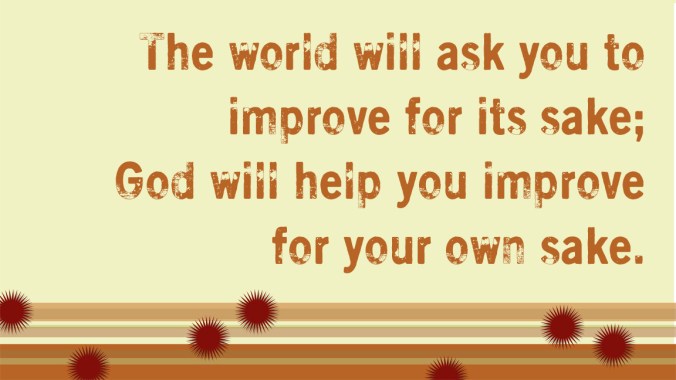
Eventually we all need to face difficult truths about ourselves. The difference between the world and God is that the world wants you to improve before it can love you, and God loves and forgives you so that you can improve.

Comfort: God loves us despite our flaws.

Challenge: Ask a trusted friend to suggest a way you could improve, then pray about it.

Prayer: Merciful and loving God, thank you for loving me where I am today, and loving me enough to lead me somewhere better tomorrow.

Discussion: What flaw do you struggle to change?

Join the discussion! If you enjoyed this post, feel free to join an extended discussion as part of the C+C Facebook group. You’ll be notified of new posts through FB, and have the opportunity to share your thoughts with some lovely people.

So You Had a Bad Day

badday

Today’s readings (click below to open in new tab/window):
Psalms 62; 145, Ecclesiastes 7:1-14, Galatians 4:12-20, Matthew 15:21-28


This quote from Marilyn Monroe is all over social media: “If you can’t handle me at my worst, then you sure as hell don’t deserve me at my best.” It’s frequently used out of context when someone wants to deflect criticism of  their own bad behavior. We don’t like someone telling us our behavior is bad, or even unhealthy. We might think other people need to hear criticism (again, reference social media for scathing comments about the scandal du jour) but when it’s leveled against us we call it “judging.” Since Jesus told us “judge not” we toss that out as a conversation stopper.

Except we take that out of context too: Jesus didn’t render us incapable of moral evaluation, but reminded us to be merciful to others because we want God to be merciful to us. We are allowed to call out injustice, and to be called out for committing it. While how we behave on our worst days isn’t the standard by which others should judge us, it’s also not above legitimate criticism.

When Paul wrote to the Galatians about the importance of including Gentiles in the Christian community, he reminded them they’d met him during some of his worst days, a period when he suffered from an unidentified ailment. The specifics are unknown, but it seems his condition was, at the very least, unpleasant. He wrote: “though my condition put you to the test, you did not scorn or despise me, but welcomed me as an angel of God, as Christ Jesus.” Was this because Paul told them: “If you can’t handle my worst you don’t deserve my best?” No. It was because even at his lowest points, Paul focused first on delivering the gospel message. His weakness was not a source of shame, nor an excuse for behaving badly, but evidence that Christ helps us endure all things.

No matter what, the world will find reasons to criticize us. We all have weak moments and bad days, so sometimes the world will be right to do so. How we handle criticism of our worst days tells people more about our character and our faith than a hundred of our best days.

Comfort: Your worst days are some of faith’s greatest opportunities.

Challenge: It can be tempting and easy to use stress as an excuse to be dismissive or abusive. Remember that your bad day does not give you latitude to ruin someone else’s.

Prayer: God of mercy, teach me to be merciful. Amen.

Discussion: Are you able to take constructive criticism?

Join the discussion! If you enjoyed this post, feel free to join an extended discussion as part of the C+C Facebook group. You’ll be notified of new posts through FB, and have the opportunity to share your thoughts with some lovely people.
Ordinary Blessings

reachesclouds

Today’s readings (click below to open in new tab/window):
Psalms 108; 150, Job 38:1-11, 42:1-5, Revelation 19:4-16, John 1:29-34


Divine intervention. We are taught in Sunday School to believe it looks like great reward or great punishment defying the laws of nature – like the parting of the Red Sea or the walls crumbling around Jericho; like the resurrection of Lazarus or the destruction of Sodom and Gomorrah. In the case of Job, divine intervention felt both like punishment and reward: God stripped everything he loved and valued from him, then restored his fortunes because he remained faithful. Behind the scenes, the motivations for divine intervention in Job’s life weren’t really about him at all.

We should call God’s involvement in the life of John the Baptist a blessing – after all, he had the privilege of preparing Israel for the arrival of Christ – but his reward for faithfulness was execution. When we hear examples like this, does it diminish our enthusiasm for a divine hands-on management style?

What if divine intervention wasn’t always quite so … obvious? It seems counter-intuitive that God would create a universe in need of constant tweaking, but might it be possible that interaction with God is built into the fabric of creation? That we go through each day touched by God in small ways we may or may not notice? Not that the Spirit is some cosmic personal assistant saving us a good parking space or sparing us from the same financial woes someone else is suffering (though there’s nothing wrong with expressing gratitude for these situations).  Every experience we have is an opportunity to connect with God, but we must choose to make that connection.

When we don’t get that parking space or pay raise, are we just as grateful? When we compare our lives to peers we consider more successful than ourselves (never a good idea, but inevitable), do we acknowledge the blessing of an ordinary life?

Maybe divine intervention doesn’t look like God altering the world for us, but God altering us for the world.

We can’t all be leaders and prophets. We can all be followers of Christ. Surrendering our lives to God makes us the very instruments of divine intervention. If we want to see God at work in the world, let’s look inside first.

Comfort: God is available to us always…

Challenge: … but insisting on our own way can make God seem distant.

Prayer: Holy God, thank you for being present in my life even when I don’t feel you. Amen.

Discussion: In what ways do you feel God has changed you to better serve the world?

Join the discussion! If you enjoyed this post, feel free to join an extended discussion as part of the C+C Facebook group. You’ll be notified of new posts through FB, and have the opportunity to share your thoughts with some lovely people.

Washing Our Hands of Mercy

hands-809870_1920_edit

Today’s readings (click below to open in new tab/window):
Psalms 122; 149, Ecclesiastes 5:8-20, Galatians 3:23-4:11, Matthew 15:1-20


Christianity has existed for almost two thousand years. Over the centuries it has evolved in some ways into something Jesus might barely recognize. Or maybe it evolved into something he would find all too familiar: an institution whose highest priority is too often its own preservation;  an institution that claims a scriptural basis but predictably twists that scripture to justify human preferences and biases. If that criticism sounds harsh, consider today’s reading from Matthew.

The Pharisees and scribes criticized Jesus and his disciples for not performing the traditional hand-washing before meals. Jesus countered by condemning them for using man-made conventions to help people shelter their money through the temple when they didn’t want to “waste” it taking care of their aging parents. The letter of the law permitted this practice, but undermined the spirit of the commandment to “honor thy father and mother.” When the disciples later expressed concern he’d offended the Pharisees, he said:

Do you not see that whatever goes into the mouth enters the stomach, and goes out into the sewer? But what comes out of the mouth proceeds from the heart, and this is what defiles. For out of the heart come evil intentions […] These are what defile a person, but to eat with unwashed hands does not defile.

Twenty centuries have accumulated a lot of traditions which obscure the message of Christ. Many of them were intended to guide us, but often we have let them come to define us. Rules and practices specific to a time or culture are revered like commandments not because they honor God, but because they honor our self-righteousness.

“We take communion the proper way. We baptize the proper way. We say the proper Sinner’s Prayer. We don’t do X, Y and Z…” Jesus does not ask us only to avoid sin, he asks us to love proactively. What good is not taking the Lord’s name in vain if we don’t speak that same glorious name in love to others? How well do we serve God by condemning abortion but neglecting the hungry children of single mothers?

Law and ethics are separate fields of study partly because you can observe the first without having any concern for the second. Our duty as Christians is to love God and our neighbors. Often our disagreements about how to execute that duty are based more in traditions and biases than in love. When we are quick to discipline or enforce in God’s name, but slower to demonstrate mercy, we disrespect God’s character. As Psalm 103:8 tells us, “The LORD is compassionate and gracious, Slow to anger and abounding in lovingkindness.”

Let’s demonstrate our love for God – and by extension each other – with both our lips and our hearts.

Comfort: God’s love is bigger than our traditions.

Challenge: Sometimes to love, we must unlearn.

Prayer: Loving God, teach me the humility necessary to follow your will instead of human laws.

Discussion: Have you had to discard any traditions or customs to better follow your faith?

Join the discussion! If you enjoyed this post, feel free to join an extended discussion as part of the C+C Facebook group. You’ll be notified of new posts through FB, and have the opportunity to share your thoughts with some lovely people.