Invitation: Chunk

1474225611872.jpg

Several weeks ago I was having dinner with friends and the conversation turned to childhood memories, specifically memories of dinner time. Our experiences were somewhat different. One of my friends explained how in his large family the younger children were lucky to get much, as the father took his food first, and then the oldest children, and so on. By the time the youngest ate, there was always something left, but it could be pretty meager. My own experience was different. We did not think of ourselves as wealthy – my father brought home a teacher’s salary and worked part time in a grocery store – but whether we ate at home or out, we three children were served or could order portions equal to that of the adults. I remembered it being the same way at my grandparents’ table, and with my aunts, uncles, and cousins as well. This, I said, seemed much more fair. Then my friend explained that in his family if his father didn’t keep up his strength and ability to work, there wouldn’t have been food on the table at all. Suddenly I was confronted by the reality of my own privilege, and reminded how wealth is always a relative condition.

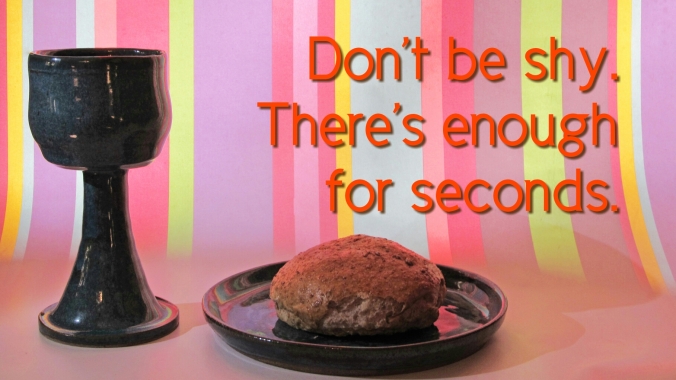
In my term as an Elder of my church, I had the privilege of serving communion many times to many people. With another elder I would hold bread or the cup as people walked up to break off a chunk and dip it in the juice. One thing that always amused me was how ninety percent of the people always seemed to tear off the smallest possible piece of bread. I was never sure why this was: we always had plenty left over, and the tiny pieces were obviously difficult to manage based on the number that ended up floating in the cup. If the bread was especially crusty and wouldn’t tear easily, some people shrugged and smiled apologetically for not being able to rip off a smaller portion.

After my dinner conversation, I now wonder if people’s idea of how much communion bread they’re entitled to reflects the abundance or scarcity of their life experience, or if maybe it reflects their perception of what they bring to the table relative to others. The next time I invite people to Christ’s table for communion, I want to tell them Jesus wants them to help themselves to a big ol’ chunk of his grace. At Christ’s table we are all equal, and there’s enough to go around. Don’t be shy – be hungry. Hungry for love. Hungry for forgiveness. Hungry for mercy. Jesus wants us to be stuffed to the gills with all these things. The less you think you deserve them, the more you should consume. Tearing off a morsel that you might actually have to chew on a while isn’t an indulgence … it’s the whole point. Christ didn’t die for us so we could live on crumbs; he died so we could feast on grace.

May the Peace of our Lord Jesus Christ be with you all.

Invitation: Garlic Bread

1473008663798.jpg

Several years ago I was part of a mission trip to New Orleans, where we helped with the rebuilding effort in the Ninth Ward after Hurricane Katrina. A few Northern Indiana area churches drove down together, and we stayed at a mission station with another, larger group from Tennessee. The different churches rotated through some of the housekeeping activities: cleaning the bathrooms, preparing meals, doing laundry, and evening worship. Worship always involved communion, so the meal shoppers made sure bread was available.

Even the best schedules can fall apart, and one day the worship team members (all youth) were stuck at a work site an hour longer than they had planned. As the lasagna finished baking, they quickly pulled together a short but meaningful order of worship and selected some hymns. While we were cleaning up after the meal, a whisper traveled from table to table: there had been a mix-up, and all the bread had been basted in garlic and butter for the meal. There was no time to run to the Winn-Dixie before worship. What to do?

One of the young people suggested using the garlic bread. “Hey, Jesus used what was on the table,” he said. So that was what they did. Now in the Disciples of Christ we often distribute communion by intinction, which means the person takes bread and then dips it into the cup before eating it. At youth camp they call it rip-and-dip, or chunk-and-dunk.

As it turns out, garlic bread dipped in grape juice is less than appetizing. Not terrible, but weird and mildly unpleasant. Not things one generally associates with communion. No one said anything at the time, but as the evening wore on, several people began to grumble about how “disrespectful” it had been for the worship group to use garlic bread. One of the adults decided they needed to have a “talk” with the youth about how inappropriate their selection had been. As he offered his opinion, the kids looked deflated and started to apologize until one of the pastors interrupted him. “Excuse me,” she said, “these kids worked really hard today to make sure someone could get back in their home as early as possible. Not everything has to be someone’s fault. The communion wasn’t ideal, but perhaps we should focus on why we’re all here. And make sure we have bread for tomorrow.”

We have this idea that the holy should be pretty and palatable. But the sweaty work those kids did that day was holy. The stink they gave off because they decided to use their limited time to plan worship instead of showering … was holy. When we commune, all we can ever bring is what’s available to us. Some of us have the luxury of buying new whatever we need, and others find the holy in what is on the table, because God has provided it. When we say: “what you have to bring isn’t up to snuff,” what we are really saying is: “I refuse to see the holy in you.”

I’ll take weird garlicky communion that’s offered in love, over bland chunks that confuse respectability for holiness, every time. When we come to Christ’s table, we bring our holy and unholy selves. Maybe some of us do a better job of keeping the holy out front where everyone can see it, but that’s just window dressing. When we don’t like what someone brings to the table, that’s not a challenge to change them – it’s a challenge to change ourselves. And if meeting the needs of a community means we sometimes taste and smell bad … perhaps we should focus on why we’re all here. And make sure we have bread for tomorrow.

May the Peace of our Lord Jesus Christ be with you all.

Invitation: Extrapolation

1472392781083.jpg

Years ago I worked at a small computer services company. The environment there was pretty informal, and the conversations wandered everywhere. Politics and religion, topics studiously avoided in many settings, were definitely up for grabs, and I was eager to discuss both.

Our new customer service manager – let’s call her Claudia – also liked discussing her faith. She was Mormon, and had loaned me some literature about the church so we could talk about it. The materials were interesting, but left me with a lot of questions, so I did some research on my own. Like any religion Mormonism has a checkered history. One part that bothered me a lot was the church’s history of banning black people from full participation well into the twentieth century (which to be fair has not been a practice since 1978).

When I asked Claudia about her feelings on the matter, I was surprised she didn’t outright condemn the church’s history of racism. Instead, she explained to me that Mormons believe in a pre-existence, and your circumstances of birth are a reflection of how righteous you were in that pre-existence. There was also something about black people being descendants of Noah’s son Ham, who was cursed. “Doesn’t it make sense,” she said, “that you must have done something wrong to deserve to be born into such difficult circumstances?”

I was stunned. “But Claudia … you’re Mexican. By that logic lots of white people would say the same thing about you.”

“That’s different,” she said.

At this point, let’s be clear this isn’t about judging Mormonism or Claudia. It’s about extrapolation.

Extrapolation is an “act or instance of inferring an unknown from something that is known.” All of us have known what it’s like to be part of a group that’s been unjustly excluded. That exclusion can be cultural or generational. Too many times that exclusion has a supposed biblical basis. Yet so often we are unable – or unwilling – to extrapolate from our own experiences to understand the people we choose to exclude are experiencing something similar and predictable. Does it really seem likely that people who exclude you are acting unjustly, but the exclusion you inflict on others is rational?

Over the centuries, we’ve developed lots of “sound” theology to disenfranchise people from Christ’s table. So much so, that every one of us is probably banned from participating fully in one or more denominations, yet welcome in others. Entire denominations have coalesced around left-overs and left-outs. Could this division along the lines of personal prejudices disguised as doctrine really be what Christ had in mind?

Christ knows you. Christ knows your struggles. Not one perfect person has ever been invited to a communion table. And the reasons some churches may not invite you now have less to do with your imperfections than with the church’s own flaws. The people we excluded a hundred years ago, fifty years ago, even ten years ago are now full participants in the life of the church. History will eventually reveal the church’s unjust prejudices against some of the people we exclude today. Maybe it’s you. Maybe it’s your neighbor. Maybe it’s me. Knowing what Christ taught, should we be extrapolating practices of judgment or of mercy? Let’s continue that discussion around Christ’s table, where all are welcome.

May the peace of our Lord Jesus Christ be with you all.

Invitation: Cardinals

1466959090517.jpg

This morning I was sitting on the front porch watching the rain. A cardinal who regularly makes his rounds among the trees and shrubbery of our yard – and occasionally leaves evidence that he visits the porch – was flitting about to find dry shelter. Several times he landed on the porch railing, which was fairly well protected, but was not content to stay. I wanted to take a picture of him with my phone, but he never stayed put long enough or got close enough for a good shot. I tried to be still, to make the dry porch seem less threatening, but once the camera was out, he kept his distance. After I finished my coffee I went inside, and hoped he felt safe to land on the porch.

My eagerness to intrude on his life felt threatening to Mr. Cardinal. Some people are like that, too. An extrovert like me assumes I’m making friendly overtures when I engage someone in conversation or repeatedly remind them how welcome they are. A more introverted person may in fact find these behaviors quite off-putting. When a new person shows up at church, it might seem natural to find out whether they are interested in the choir or fellowship groups or Bible studies; we want them to stay and so many of the popular church-growing guides says groups are the way to do it. It might seem like a gesture of welcome to tell the entire congregation to be sure to welcome our guest. All of this is well intentioned.

But it isn’t necessarily what everyone needs from church. My front porch feels safe and dry to me, but Mr. Cardinal is wired to avoid attention (except from a potential Mrs. Cardinal). If I’m there waving him in, no matter how much he’d like to be dry, he’s never going to land. If my concern is truly for Mr. Cardinal’s well-being, the best way to invite him into a safe space is to first understand what it is makes that space feel safe for him. Now with Mr. Cardinal that means abandoning my porch, but that’s not feasible for church. We can, however, let visitors and new arrivals set the tone for their own type of participation. When we meet someone new, instead of assuming they will love the things we love and demonstrate their feelings the way we do, we can observe what draws them in and what prompts an anxious flutter. Some people want to chirp in the choir, and some people want to nest in the audience.

The church is big enough to accommodate all kinds of personalities. The trick of community is to find the commonality that binds us, and allow people to support it and be supported by it in ways that make sense to them. In the Christian church, the communion table is one of those commonalities. Some of us like to write long-winded invitations. Some of like to use the time for contemplation. Some of us like to bake the bread. We do all these things to honor and serve Jesus Christ, the one who truly invites us to the table. Let us follow his lead, and build relationships that let us meet people where they are, instead of where we think they should be. That is how we let people know the table is safe for all.

May the peace of our Lord Jesus Christ be with you all.

Invitation: Helicopter

image


We live right across the street from a hospital with a helipad. Several times a week – or maybe several times a day on long summer holiday weekends – we can hear the emergency helicopter landing and taking off. From inside the house it sounds no louder than a leaf blower, but outside the protection of our thick walls, on the front porch or in the yard, the deafening sound is a physical presence pushing against your sense of safety.

Every time I hear the helicopter, I am conflicted. The choppy roar of its rotors means someone has been injured severely. But that sound also means there’s a chance that person can be saved, a chance that didn’t exist before air ambulances were available.

This is not unlike the conflict I feel at the communion table.

The Eucharist exists because we, as individuals and a species, suffer from severe spiritual injuries. It is a weekly reminder that we are broken in ways that need serious attention. It is also a reminder that we can be saved. There was a time, the time before Christ offered to love us into wholeness, when we were offered no hope for such injuries. I’m sad it is necessary but so grateful for its presence. What a bittersweet balance.

Inside the walls of the church, the Words of Institution are more comfort than disturbance: “Before Jesus was given up to death, a death he freely accepted, he gave You thanks…” Outside the walls of the church, these words can seem threatening to the injured. Imagine being hurt so badly you need to be airlifted to a hospital. Imagine the overwhelming sound and chaos and immensity of a helicopter descending onto your broken body. That doesn’t feel like hope – that feels like disaster.

When we invite someone to the table for the first time, we need to understand a lifeline sometimes looks like a noose. Where we appreciate the helicopter because it’s already saved us, they may just hear a confusing, even frightening, noise. We don’t fix that by speaking more loudly (or more frequently, or more insistently). We fix it by offering to ride with them, to hold their hand, and to stay by their side until the fear and pain have passed. Until it sounds like hope.

If you are a frequent guest of the table, extend your hand. If you have never come to the table, please accept that hand and try to believe the fear does not outweigh the promise. Our pilot has only your salvation at heart.

May the peace of the Lord Jesus Christ be with you all. Amen.
Invitation: yinzgimmegum

1463341210136.jpg

The ride from New Castle, Pennsylvania to South Bend, Indiana is just shy of six hours – depending on the driver. In August of 1985 I made this trip with my parents so they could drop me off at school for my freshman year. About mid-trip, my mouth started to feel a little dry. My mother always had some mints or gum, so I leaned into the front seat to ask for some. Now I grew up in a Western Pennsylvania area with a very specific dialect popularly known as “Pittsburghese,” so while other people might have asked “May I have some of your gum?” I rapidly blurted: “Hey yinz gimme gum?” Continue reading

Invitation: Locker Room

1462105860761.jpg

Earlier this week, while changing in the locker room, I heard a guy repeatedly cursing repeatedly and making a barking sound which may have been a laugh. Another guy was on his cell phone calling off work. I thought the first guy was rudely interrupting the second, until I turned around and saw they were the same guy. This man was having a particularly bad flare up of Tourette’s Syndrome, and needed time off. A few minutes later I was on my usual elliptical machine and working out with music pumping into my ear buds. When the first song ended, I could hear the barking sound echoing through the gym. Continue reading

Invitation: I Can See Clearly Now

1461528876101.jpg

Lately I’ve been thinking a lot about my eyes. Design-wise they aren’t so great. I am very near-sighted. I’m fortunate that my vision is easily corrected with glasses or contacts, but without corrective lenses my adult vision has landed somewhere between 20/220 and 20/240. Legal blindness is 20/200 in the better eye. I can’t read normal print more than about 6 inches from my face, and headlines are a strain at arm’s length. Since eyeglasses weren’t invented until the latter half of the 13th century, I am grateful to have been born afterward. In the 12th century, despite a pretty capable brain, my options would have been quite limited by my visual impairment. My potential – maybe my understanding of the world – would probably never have exceeded the length of my arm. Ironically, my inability to see would have rendered others unable to see me for who I truly was. Continue reading

Invitation: No Expectations

1460300626388.jpg

You can’t advertise an open house and then be irritated when unexpected guests show up. Several weeks ago I wrote about the interlopers, a couple cats who now eat the food we originally began to set out for one specific cat, who doesn’t visit us much anymore. A couple other cats have joined them and there’s at least one very well-fed squirrel frequenting our back yard. Continue reading

100 Thanks!

image

One week ago today this blog hit its 100th consecutive daily devotional post (though recently some have come in just under the wire). Meant to post something then, but life happens. There are only so many minutes in a day, so I am truly touched and grateful whenever someone spends a few of them reading, liking, or commenting on a post. Looking forward to sharing what I hope will be many posts to come. Peace and thanks!