Invitation: Prodigal

1457295412722

Today’s Sunday readings include the parable of the Prodigal Son. In case you’re not familiar, it is a story about a rich young man who demands his inheritance and squanders it on “dissolute living.” In other words: booze and prostitutes. It didn’t take long until he was broke and starving. He returned home, ready to apologize to his father and beg for forgiveness he knew he didn’t deserve. To his surprise, when he got home, rather than tear into him, his father ran to the gate, tossed a robe on his shoulders, and threw him a party before he could even get the apology out. His brother was unhappy about this turn of events and complained that in all the time he’d dutifully minded his father, he’d never gotten a party. The father told the brother: “Son, you are always with me, and all that is mine is yours. But we had to celebrate and rejoice, because this brother of yours was dead and has come to life; he was lost and has been found.”

Which brother are you? Continue reading

Master Plan

1457065280277

Today’s readings (click below to open in new tab/window):
Psalms 27; 147:12-20, Exodus 1:6-22, 1 Corinthians 12:12-26, Mark 8:27-9:1


The story of Joseph, his many brothers, and his father Jacob is very near its end with today’s reading. The journey to Egypt for Jacob (also called Israel) and his sons has been a long and twisted one.While Joseph and Pharaoh’s favor allowed the fledgling nation of Israel to settle freely in the Egyptian land of Goshen with all the food they needed, the other residents of Egypt were not so lucky during this seven years of famine. After giving Pharaoh all their money one year and their livestock the next, they had nothing left but their land and bodies. In exchange for food, they offered themselves up as Pharaoh’s slaves and had to pay a tribute of a fifth of all they harvested. Continue reading

Invitation: I was hungry.

image

On my first day of freshman orientation at Notre Dame, the opening meeting ended with a mass. My three roommates and I walked up to receive communion together. As I later learned, two of us were practicing Roman Catholics, one was from a Roman Catholic family but going through a “rebellious phase,” and the fourth was a Buddhist whose parents had been born in China. He didn’t know thing one about Roman Catholicism, let alone the Eucharist, but in my naivete I assumed we were all Catholic and didn’t question anything when he stepped up to take communion with us. Afterward he asked: “So what was that bread thing all about?” Slightly scandalized, I gave him a brief outline of the Lord’s Supper and advised him that in the future, he should probably decline partaking. He shrugged and said: “I was hungry. It was bread.” Continue reading

Those Crazy Christians

Earlier this week we reflected on how the world sees Christians as Just. Plain. Crazy. A few years back, Brad Paisley wrote a song about exactly that. It’s an interesting take on what we may look like to those outside the faith, will all our faith and flaws bundled together. Hope you enjoy this video put to his music by the United Church of Ovid. Peace!


Invitation: Say Grace

1455479279579

Mission trips are enriching and humbling experiences. I was 40 years old when I participated in my first one. We went to Lake Charles, Louisiana to help rebuild homes and lives after Hurricane Rita tore through the city. Our leader and trip coordinator was a retired pastor I greatly admired. He had decades of mission experience, and shared wisdom and advice with us in preparation for the trip. One of the the things he told us was that people would be grateful for our help and would offer us food and drinks.

“Accept them,” he said.

He explained there might be a temptation to say no if we thought the person was being generous beyond their means out of sense of obligation. It was not our job to make that decision for them. We might be offered food we didn’t recognize or think we’d like. Barring food allergies or ethical restrictions, we were advised to accept and eat at least a small portion. When someone offered us hospitality, we were to accept it because refusing it would display a lack of respect to the soul and person. The pastor’s advice to drop my paternalistic, privileged attitude (my words, not his) has stuck with me all these years. He taught me to say “yes” was to say grace.

Recently I realized there was even more depth to this lesson.

The people we served had no idea what kind of people we were when we weren’t roofing, repairing fences, or clearing debris. They didn’t see our petty squabbles about church policy, estranged families, drunken self-pity, and criminal records. We were each invited to their table because, at least for that moment, we had all gathered in the name of Christ. And that’s all they needed to know.

We can have a lot of trouble extending the same grace to people we know well. If you knew all my bad behaviors – or thought you did – you might not think I should be accepting communion. You really might think I shouldn’t be offering it. But in that moment, whether we are giving or receiving, we are gathered because of Christ. In that moment, we are what Christ hopes we can be all the time. All the other moments of our lives may range from imperfect to downright wicked, but at Christ’s table we gather for a single, pure purpose. Grace allows us to accept the Bread of Life. Grace allows us to offer the Cup of Salvation.

When Christ invites us, we are to say “yes.” And that’s all we need to know.

May the peace of our Lord Jesus Christ be with you all.

Invitation: Come as You Are

1454252550303

Most of our experience with communion is in a fairly formal setting. The priest or worship leader takes us through a familiar ritual. The bread is dedicated specifically to the purpose of communion. Depending on your tradition and beliefs, it may or may not be considered sacred but, knowing what it symbolizes, we all treat it with reverence and respect. As far as reenactments of Jesus’s last supper go, it’s pretty inaccurate.

The Gospel of Matthew tells us: “While they were eating, Jesus took bread…” No one processed into the room with consecrated wafers or a loaf with a slit in the bottom to make it easier to break. There may have been unleavened bread on the table for a traditional Passover meal, but otherwise it was unremarkable. Jesus used bread that was already present — and possibly half-eaten. The cup was just a cup. The gathered disciples would have washed it up after the meal with all the other cups and by the next morning probably couldn’t remember which one it had been.

Then there’s Judas. In all four Gospels, Jesus is aware his betrayer is at the table. He doesn’t identify Judas by name. He doesn’t exclude Judas from the meal. Instead Jesus shows him the same love and offers him the same blessing as everyone present.

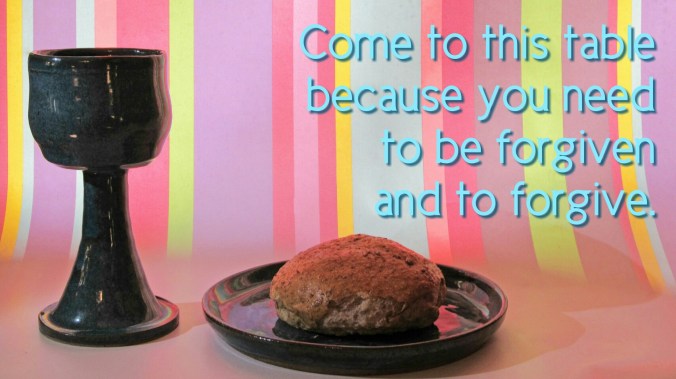
The last supper — or first Eucharist — was made of the ordinary: the half-eaten, backwash-tainted, treacherous things and people at hand. It was sacred not because of the sanctity of the elements, but because Christ’s transformational presence makes the ordinary sacred. Your participation in communion does not require your perfection; it requires humble recognition of your deeply flawed nature. That’s the door through which Christ’s broken body and shed blood enter and transform you. And nobody can shut it but you.

If Christ welcomed even Judas at the first Eucharist, what possible reason could there be for anyone to be excluded? Who can say: “I get to determine who is worthy of the grace Christ gives freely?” We don’t get to decide that about other people, and other people don’t get to decide that about us. We don’t even get to decide it for ourselves. Communion isn’t about the perfect loaf of bread for the perfect people. It’s about Christ turning leftovers into a banquet that feeds the world.

May the peace of our Lord Jesus Christ be with you all.


Invitation: Faith is a Roller Coaster

1453645845969

Who doesn’t love roller coasters?

OK, lots of people don’t, but I sure do. One of my favorites is the Superman ride at Six Flags in Gurnee, Illinois. Once a rider is strapped in, your arms and legs are free, and your torso is harnessed so that your back is to the track and you are facing outward. As the track soars, swoops, and twists you get a superhero-eye’s view of the sky and earth – a childhood fantasy come to life.

The first time I rode it the line was two hours long. The day and the company were pleasant, but still I had a queasy feeling replacing the usual excitement. Part of the fun of a coaster ride is the fear and feeling of survival, but for some reason the fear was more intense than usual. I hadn’t been to an amusement park in years, and had put on a lot of weight since the last visit. Part of me was irrationally convinced I was too heavy for the ride. Voices and visions of snapping gears and the rapidly approaching ground filled my mind. Other people heavier than me were getting on and safely returning, but reality wasn’t reassuring. I considered ditching the line and waiting for my friends.

Unlike Superman, I can’t deflect bullets, but once in a while I can bite them. Sweating and nauseated, I said a little prayer as the attendant secured me into the ride and launched us down the track.

It was the best coaster ride I’ve ever been on, and you can bet I’ve been back. Why the irrational fear? It’s because I wasn’t who I thought I should be, and let my insecurities tell me lies about where I belonged.

Church can be that way.

Some people don’t come to church because they believe they aren’t good enough. Or others come to church and believe the invitation to the communion table couldn’t possibly include them, even when the attendant tells them it does. In their minds, somehow their sins and shortcomings are weightier than the sins of everybody else in the crowd. They may even believe God has forgiven far worse sins than theirs, but for some reason they are still afraid. This attitude may seem like humility, but in truth it requires an enormous ego to believe your burdens are the only ones in creation God can’t lift off you. You just aren’t that special.

But you are beloved by God. Jesus said: “It is not the healthy who need a doctor, but the sick. I have not come to call the righteous, but sinners.” (Mark 2:17 and Matthew 9:12) Your sins and imperfections are not barriers between you and Christ: they are doors. The bigger your issue, the wider your door. You just need to be willing to open it.

Faith has lots of ups and downs, twists and turns. It can be exhilarating and terrifying at the same time. Through it all, no matter your burdens, God will be strong enough to carry you. Strap in and come to the table.

May the peace of our Lord Jesus Christ be with you all.