A Quest for Questions

1484880900683-01.jpeg

Today’s readings:
Psalms 36; 147:12-20, Isaiah 45:5-17, Ephesians 5:15-33, Mark 4:21-34


Human beings like answers. It was true thousands of years ago in the time of the prophet Isaiah, it’s true today, and (if we are still around) it will be true thousands of years from now. Uncertainty vexes us. Sometimes we are more content to grasp at false answers than to have no answers at all. Yet sometimes the answer is simply … there is no answer.

When the exiled nation of Israel cried out because it seemed God had abandoned them, Isaiah challenged their right to take God to task. He compared them to lumps of clay questioning the choices of the potter. The God of Israel declared he “made weal and created woe” as he saw fit, and human beings should not strive to comprehend why.

Like the ancient Israelites, we often want to know why God has allowed bad things to happen to us (and isn’t it funny how we are less likely to wonder why we are deserving of the good things?). Some people’s faith evaporates when it does not protect them from the bad things and the world stops making sense to them. “How can a loving God let evil things happen?” they wonder. That question can feel threatening to people of faith. An entire industry of apologetics, creationist “proofs,” and theological musings has evolved to address that question. In the end, most of them are overly pat and largely unsatisfying. But “we’ll never know” doesn’t exactly sell books and videos.

Questioning is healthy, but some questions will remain unanswerable. Isaiah, Job, Proverbs: these scriptures and others advise us energy spent on unanswerable questions could be put to better use. If we can accept the paradox that God is good and bad things still happen, we can move on to address questions of a faith lived in the world as it really is: Whom shall we serve? How shall we love? Where is God leading us?

Folk wisdom tells us the journey matters more than the destination. If an answer is a destination, perhaps finding the right questions to ask matters more than getting there.

Comfort: Asking the right questions makes all the difference.

Challenge: We must learn to live with the reality that we’ll never have all the answers.

Prayer: God of mystery, may your love be answer enough. Amen.

Discussion: Do any unanswered questions really bug you?

Join the discussion! If you enjoyed this post, feel free to join an extended discussion as part of the C+C Facebook group. You’ll  have the opportunity to share your thoughts with some lovely people. Or feel free to comment here on WordPress, or even re-blog – the more the merrier!

Float

Today’s readings:
Psalms 123; 146, Isaiah 44:9-20, Ephesians 4:17-32, Mark 3:19b-35


Stepping into faith is like walking with fists full of gold coins into a deep lake. The first few steps are invigorating – a refreshing dip for our weary soles. The sand may slip and shift beneath our feet, but if we feel unsteady the familiar shore is only a stumble away. As we go deeper, we feel more buoyant, lifted by a force far greater than ourselves.

But at a certain point, perhaps around the point the water becomes level with our hearts, we begin to notice the drag of those gold coins. And now we have to choose: settle for going no further, turn back in defeat, keep going and drown … or start getting rid of the gold.

Those gold coins have names engraved on them. In his letter to the Ephesians, Paul tells us some of those names: theft, corruption, lust, falsehood, bitterness, wrath, slander, anger, malice. Maybe we’re having difficulty letting go of them; they seemed so valuable so useful! on the shore. We want to hold onto them in case these living waters won’t really support us, but it’s the holding on that makes us seem like we’re slipping under the waves.  Their illusion of safety ultimately leads to the deep, cold darkness.

Maybe we’re feeling foolish for not leaving them on the shore, or for forgetting our hands were not empty. The good news is, we can open our fists at any time. If we let these waters swallow our burdens, we will feel lighter. More free. Risen. Can we let go?

For an instant we let them drag us below the surface. We are suspended between two worlds – one that offers a familiar, inevitable death, and one that promises life if only we grab it … and nothing else. Each finger we uncurl, each coin we release, is a movement toward life. As the last coin slips between our fingers, we break the surface.

Hands free, we can spread our arms, lay back, and relax into the gentle surface of the lake and the certainty it will cradle us … and let the face of the sun shine upon us.

Comfort: The Living Waters of Christ will sustain  you.

Challenge: Grab a handful of coins. Name them for the things you need to let go in order to rest in Christ, and throw them in a lake or fountain.

Prayer: God of the Living Waters, let my spirit rest in you. Amen.

Discussion: What are some things you need to let go of?

Join the discussion! If you enjoyed this post, feel free to join an extended discussion as part of the C+C Facebook group. You’ll  have the opportunity to share your thoughts with some lovely people. Or feel free to comment here on WordPress, or even re-blog – the more the merrier!

Well, well, well…

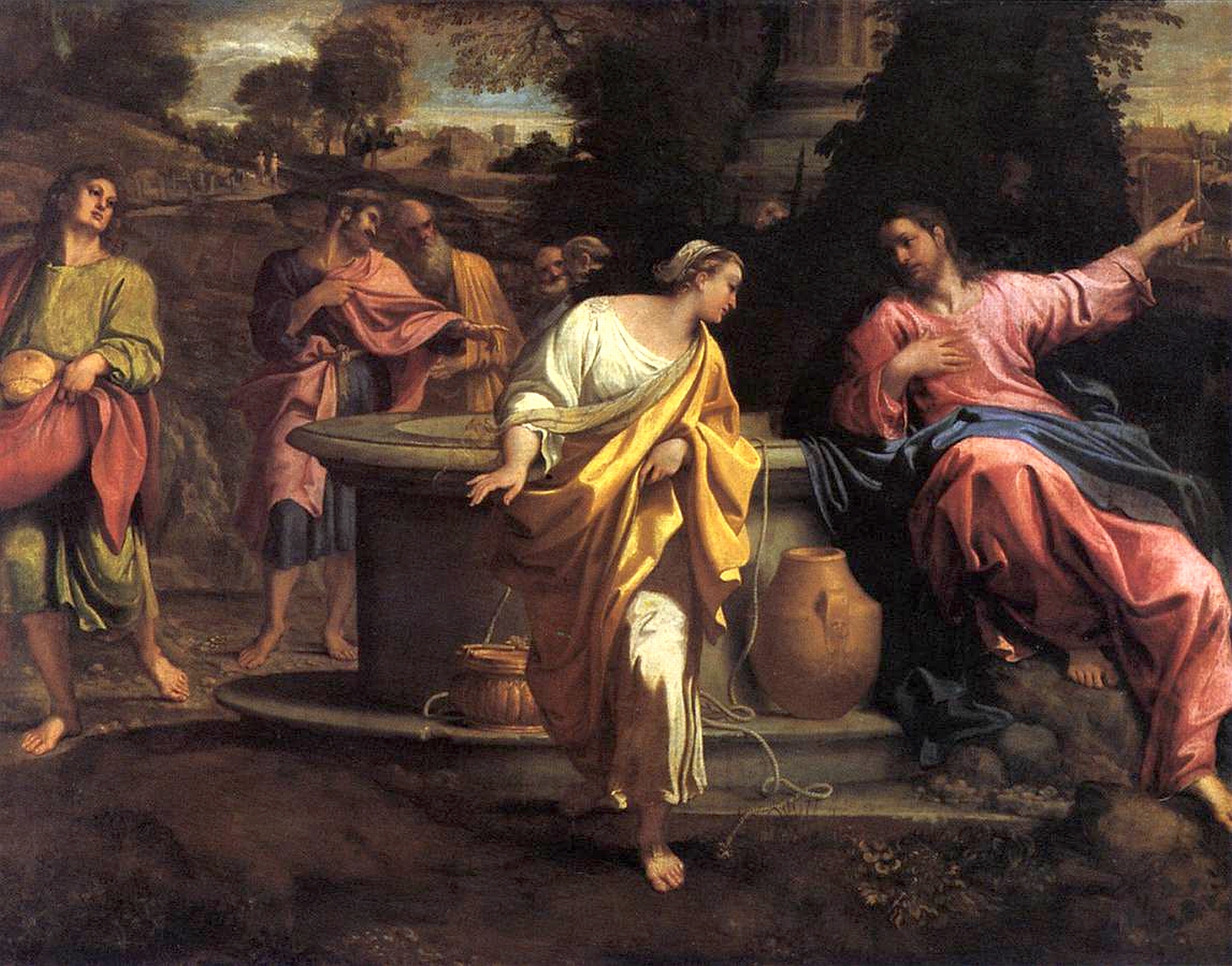
The Samaritan Woman at the Well – Annibale Carracci

Today’s readings:
Psalms 19; 150, Isaiah 43:14-44:5, Hebrews 6:17-7:10, John 4:27-42


The Reverend Martin Luther King, Jr., said “the most segregated hour of Christian America is eleven o’clock on Sunday morning.” Many factors contribute to this phenomenon, including our natural inclination to congregate with people we believe are like ourselves. Almost instinctively we make religious, political, and cultural distinctions. Sometimes we intentionally gravitate toward groups that affirm our beliefs, but more often than not we’re happy to stay put where fate planted us. There is nothing necessarily wrong with being part of a group, but problems start when we are too eager to define who is not in the group.

Jesus was notorious for ignoring such boundaries. Like many famous rivalries, the bitter one between Jews and Samaritans was between relatives. Both tribes claimed a common ancestor in Joseph, son of Jacob, son of Isaac, son of Abraham and Sarah. By Jesus’ time they had nothing to do with each other. When Jesus ignored this history of enmity and spoke with a Samaritan woman at a well, they had a frank conversation that left her wondering if he might be the messiah. When she told her story to her people, they invited Jesus to stay with them and he visited for two days. Upon his departure, many followed him because they recognized the truth in his teachings.

Who are our Samaritans? People we refuse to talk to because they are too different from us? People who are similar in almost all ways except the one we can’t bring ourselves to be flexible about? Or people we can just ignore because our lives are structured in such a way that we never encounter them?

If we are to follow Jesus, we have to follow him into both friendly and unfriendly territories. We must do our best to accept people as Christ did: across ethnic divides, up and down the economic ladder, beyond humanly imposed doctrine. We must welcome rivals into our group, and we must be prepared to be welcomed by our enemies.

A well is a place that draws together people who have a common need. If we can’t find one, let’s start digging.

Comfort: Christ’s family is not defined by anything or anyone but Christ.

Challenge: Everyone is someone’s “Samaritan.”Be honest with yourself about who yours might be, and whose you might be.

Prayer: God of all creation, teach me to love my neighbors even when we don’t like each other. Amen.

Discussion: Could you be somebody’s Samaritan? If so, whose?

Join the discussion! If you enjoyed this post, feel free to join an extended discussion as part of the C+C Facebook group. You’ll  have the opportunity to share your thoughts with some lovely people. Or feel free to comment here on WordPress, or even re-blog – the more the merrier!

Ideology or Idolatry?

idolschooseyou

Today’s readings:
Psalms 104; 149, Isaiah (42:18-25) 43:1-13, Ephesians 3:14-21, Mark 2:23-3:6


Ideology is a sneaky devil. When we are born into one, we usually don’t even think of it as an ideology, but simply as the way things are – or should be. For example, capitalism is the dominant economic ideology of the western world. We talk about it as though it is an actual entity, but in truth it is a collective agreement to adhere to a set of principles. No one still living was party to the original “agreement,” but centuries later we all (for the most part) continue to operate under its rules.

As with any ideology, over time there has been a subtle but consistent shift of how we think about it: those who originally adopted the principles did so to serve society; today we consider those principles essential to our identity, and often behave as though society exists to serve them.

Unadulterated capitalism – like any economic theory – is neither practical nor, in the long term, beneficial so we have tempered it with some socialist practices, yet we can’t even bring ourselves to call them that. To sustain an ideology we must turn a blind eye to its faults, often at our own peril.

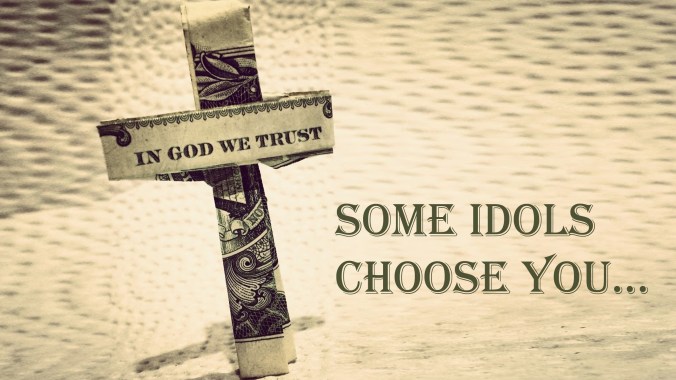
In many Gospel stories, Jesus rejected cultural ideology in order to serve humanity. After he plucked grain and healed a man on the Sabbath, in violation of Hebrew ideology, the Pharisees started conspiring to destroy him. His admonition that “the Sabbath was made for humankind, and not humankind for the Sabbath” did not move them. Jesus knew that their ideology had become idolatry: they placed the letter of the scripture above the intent of God.

What ideologies have we turned into idolatries? The Pharisees were certain of their rigid interpretation of scripture. Should we be as sure of our own? Have we ever defended or attacked an idea simply because the “other side” criticized or promoted it? The worst examples may be when we let political, religious, and economic ideologies blend into an unexamined hodgepodge that corrupts faith into an excuse to neglect and abuse our fellow humans.

When we are most sure of our ideologies, we are least able to consider them wisely, so they are the most dangerous. Wisdom tells us mercy trumps idolatrous laws. By example Christ teaches us to examine them and use them to serve, not to blindly bend to them. God trusts us to think. Let’s trust God enough to do so.

Comfort: It’s perfectly acceptable to question what you’ve been taught to believe.

Challenge: Ask questions.

Prayer: God of truth and mercy, I will serve the law of love and the gospel of peace. Amen.

Discussion: Some people assume questioning something will lead to rejecting it. How do you feel about that?

Join the discussion! If you enjoyed this post, feel free to join an extended discussion as part of the C+C Facebook group. You’ll  have the opportunity to share your thoughts with some lovely people. Or feel free to comment here on WordPress, or even re-blog – the more the merrier!

Chaotic Peace

bruisedreed

Today’s readings:
Psalms 51; 148, Isaiah 42:(1-9) 10-17, Ephesians 3:1-13, Mark 2:13-22


Justice.

To twenty-first century, Western sensibility, that word implies a certain type of order: punishment for wrongdoing, restitution for injury, recovery of one’s property. We use it in an almost exclusively legal sense. Phrases like “economic justice” spark debate and raise complaints about wealth redistribution, entitlements, and merit. We want justice to be blind, orderly, and swift.

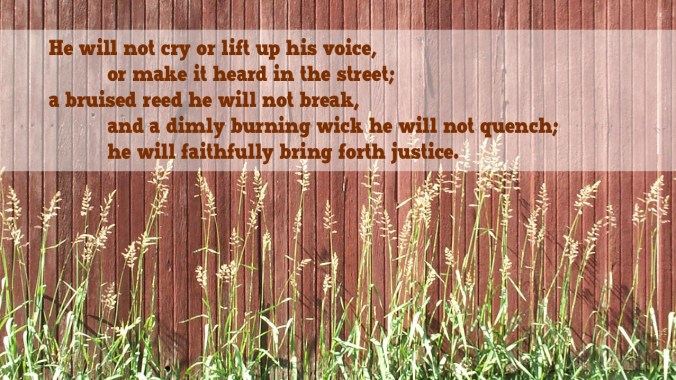
God doesn’t always do “orderly.” When Isaiah describes the arrival of God’s justice, the scene he paints is chaotic. God’s justice lays waste to mountains, cries out like a woman in labor, and turns rivers into islands. Yet his servant doesn’t raise his voice, break a bruised reed, or even snuff a faint wick.

As the embodiment of God’s justice, Christ upends the Pharisees’ expectations about the messiah. He tells crazy stories about patched-up wineskins. He dines with tax collectors and other “undesirables.” He eats and drinks more than they think a messiah should. When challenged about the company he keeps, Christ tells them straight up he is here for the sinners, not the righteous.

If we broaden our definition of justice to include building a world where the most vulnerable are taken care of, do we see justice reflected in our modern world? Do we spend our collective energies and resources primarily on punishing the guilty, or on helping transform desperate communities to foster hope and alleviate the poverty that leads to crime?

The latter often requires acts of civil disobedience outside the realm of the strictly legal. Susan B. Anthony, Nelson Mandela, and Mahatma Gandhi each participated in non-violent protest in the name of justice. Each nudged their corner of the world into slightly better alignment with the kingdom of God, where the last are first and no opportunities denied because of gender, social status, or ethnicity.

We tend to think of blessed lives as quiet and orderly, but God’s justice scrambles our carefully crafted plans and lives. Followers of Christ spend time on the margins of society, living with and working on behalf of the disenfranchised. According to each of our means and talents, we work for the type of justice that seeks to include rather than exclude, to practice mercy rather than revenge, and to raise to messy life systems that are orderly but soulless. Justice does not lock things down; it cracks them open.

Comfort: We don’t have to crack skulls to open hearts.

Challenge: Read some biographical material about people who have engaged in non-violent resistance.

Prayer: God of peace, teach me to serve with love. Amen.

Discussion: Many Christians have differing perspectives on pacifism and non-violence. What’s yours?

Join the discussion! If you enjoyed this post, feel free to join an extended discussion as part of the C+C Facebook group. You’ll  have the opportunity to share your thoughts with some lovely people. Or feel free to comment here on WordPress, or even re-blog – the more the merrier!

Breaking Barriers

1484275765542.jpg

Today’s readings:
Psalms 97; 147:12-20, Isaiah 41:17-29, Ephesians 2:11-22, Mark 2:1-12


What do you get when you cross an argument about circumcision with a paralyzed man lowered through a hole in the roof? You get today’s scripture readings from Ephesians and Mark.

In his letter to the Ephesians, Paul addressed the reconciliation of Jewish (circumcised) and Gentile (uncircumcised) Christians. This was a major controversy within the early church, because Jews considered circumcision a sacred and necessary sign of their covenant with the Lord.  They weren’t yet convinced non-Jews could even be Christians, let alone disregard centuries-old tradition, but Paul taught them about the new life that unites all people who followed Christ.

In Mark, a paralyzed man had friends who wanted him to encounter Christ. They couldn’t get through the crowd surrounding the house where Jesus stayed, so they broke through the roof and lowered the man on a mat. Moved by their faith, Jesus told the paralyzed man his sins were forgiven. When the scribes questioned by what right he forgave sins, Jesus also healed the man of his paralysis as a demonstration of his divine authority (though one suspects the healing was on its way all the while).

And when we cross these stories, we see a consistent theme of how faith in Christ removes barriers between people. Paul said of Christ, “in his flesh he has made both groups into one and has broken down the dividing wall, that is, the hostility between us.” Because of faith, the paralyzed man’s friends broke through a physical barrier, and Christ broke through a religious barrier.

Religion can be the source of a lot of barriers. Jesus, the Apostles, and Paul spent decades tearing down the false barriers religion created between God’s children, but we’ve spent centuries building replacements. We try to wall God inside our creeds, denominations, and dogma. We convince ourselves it’s because we want to preserve something – our version of the circumcision, perhaps? – but in the end we use them to reinforce a tribal mindset declaring who is inside and who is outside.

Relationships – at least the kind Christ calls us to – are a lot messier than religion: they refuse to be defined by walls. All those stones Jesus discourages us from throwing? Let’s use them to build bridges instead of barriers.

Comfort: Christ is breaking barriers for us right now.

Challenge: Meditate on your beliefs. Which ones are walls, and which ones are bridges?

Prayer: God of all creation, let me build no obstacles where you would not have them. Amen.

Discussion: When have you found yourself excluded on “religious” grounds?

Join the discussion! If you enjoyed this post, feel free to join an extended discussion as part of the C+C Facebook group. You’ll  have the opportunity to share your thoughts with some lovely people. Or feel free to comment here on WordPress, or even re-blog – the more the merrier!

Spit It Out

Spit

Today’s readings:
Psalms 46 or 97, 149; Isaiah 66:1-2, 22-23; Revelation 3:14-22; John 9:1-12, 35-38


Is mainstream Christianity too wishy-washy? Media hype about the “Culture War” between the faithful and the secular wouldn’t lead us to believe so. Conservative religious voices speaking out against abortion and same sex marriage are frequent, loud and shrill.

But in a time and nation where Christianity is by far the dominant religion and Christian businesses from dating services to investment firms flourish, are Christians really suffering from any threats or dangers we don’t fabricate ourselves? The only “persecution” we face in the USA is that people are free to speak against us if they so choose. Someone refuting our beliefs or calling us out for behavior they disagree with is in no way equivalent to oppression. Yet somehow we manage to convince ourselves we are victims, perhaps because on some level we know truly living one’s faith does invite persecution, but we don’t have the stomachs for the real thing.

The progressive church is not off the hook. Yes it frowns upon and occasionally speaks out against the more egregious activities of its conservative counterpart, but rarely since the civil rights movement of the 1960s does it insert itself in any meaningful way. Instead, content simply to disclaim the follies of its less sophisticated cousin, it leaves the secular culture to do the heavy lifting on progressive issues. Paralyzed by political correctness, it operates from a generic humanism wherein faith is at best charming, at worst pitiable.

Neither camp, though opinionated, is bold. Mostly they preach to their respective choirs. They are the lukewarm brew spit out by Christ. Passionate Christians cling to neither of these labels (nor a moderate one) because they are too busy feeding the poor, praying for their enemies, spreading the Gospel, and visiting the sick and imprisoned to worry about any politics that don’t hinder those efforts. Dedicating oneself to these works is still considered radical in all quarters because it is an implicit indictment of anyone not doing them. Christianity is the opposite of a cultural affiliation or confirmation (even its own): it is a light and fire that burns such distractions away.

Comfort: If your faith is somewhat lackluster, you’re not alone.

Challenge: Jesus wants you to do something about it.

Prayer: God, fill me with the faith and desire to do your will.

Discussion: Do you feel like you’re answering your Christian call?

Join the discussion! If you enjoyed this post, feel free to join an extended discussion as part of the C+C Facebook group. You’ll be notified of new posts through FB, and have the opportunity to share your thoughts with some lovely people. Or feel free to comment here on WordPress, or even re-blog – the more the merrier!

Servant Leaders

Today’s readings:
Psalms 46 or 47; 149; Isaiah 65:13-16; Revelation 3:7-13; John 6:15-27


What would you do if the public wanted to crown you king or queen? Would you embrace it? Would you run away? Jesus chose the latter. After he fed thousands of people with just a few loaves and fishes, they wanted to make him king – by force if necessary. He escaped to the mountain to be alone.

When God told Isaiah he was to be a prophet, Isaiah resisted. He declared to God all the ways he felt unworthy of being God’s voice. Many (most?) of the prophets chronicled in the Bible resisted God’s call. As far back as Moses, who tried to push the job off on his brother Aaron and blamed his speech impediment, the people God has chosen to lead have often shown reluctance.

When God knocks on the door, even to tell us we are fit to lead, we should be a little hesitant, maybe even fearful. The call is rarely easy. In his wisdom, God does not tend to choose leaders who are eager to embrace authority and power. Contrast this to our present-day system of secular leadership, where candidates spend millions of dollars telling you why they are unquestionably qualified for leadership, and their opponents barely deserve to participate in civil society. And religious leaders who seek power? We should always keep a critical eye on them.

Of course there are differences between people who seek power, and people who rise naturally to positions of leadership. For starters, the latter is much less common. The ability to acquire power is nothing like the ability to wield it wisely and justly. In hierarchical organizations, someone has to be at the top. The person who is the most eager, or eloquent, or assertive is not necessarily the best choice. The true sign of faithful leaders is not a desire to serve term of office but to serve the people who depend on them.

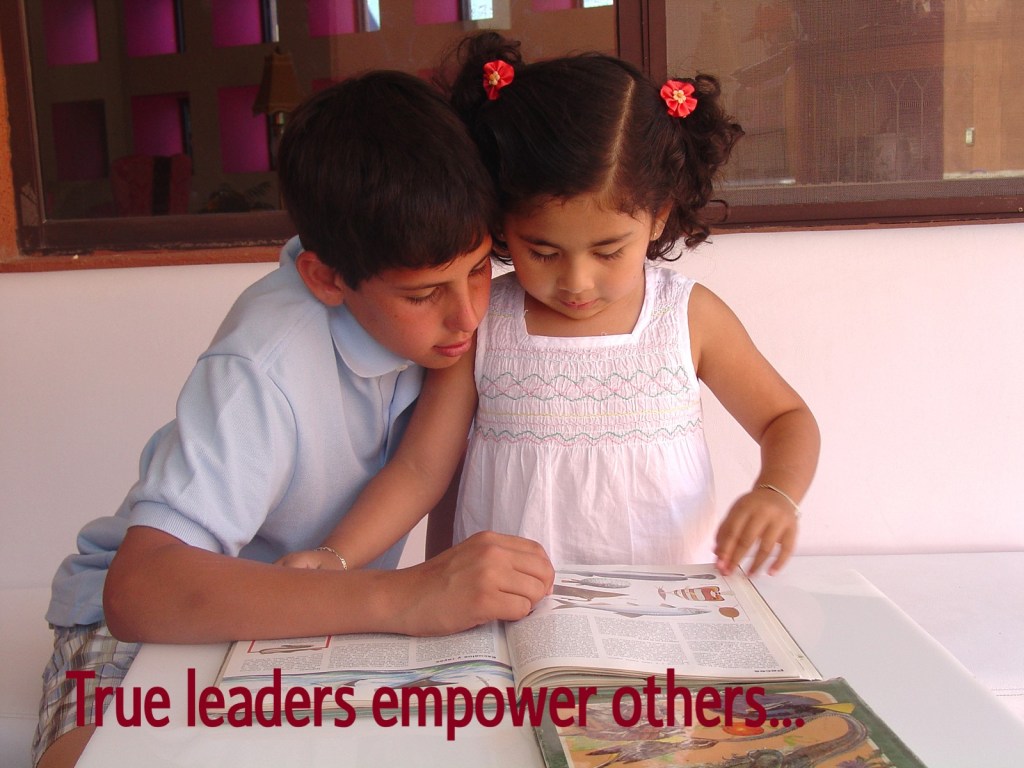
In God’s kingdom the last are first and the first are last. A true leader does not fear other leaders, but encourages them. A true leader does not control subjects, but empowers people. When we are called to leadership – by God, people, or circumstance – let us consider it humbly and prayerfully. When God calls us to lead, he calls us to serve.

Comfort: God equips those whom God calls to lead.

Challenge: Be discerning about who is a self-proclaimed leader, and who is actually qualified to lead.

Prayer: Merciful God, I will seek to follow the example of Christ, servant and Lord of all. Amen.

Discussion: Who are the leaders you trust?

Join the discussion! If you enjoyed this post, feel free to join an extended discussion as part of the C+C Facebook group. You’ll be notified of new posts through FB, and have the opportunity to share your thoughts with some lovely people. Or feel free to comment here on WordPress, or even re-blog – the more the merrier!



Humble Piety

Today’s readings:
Psalms 46 or 47; 147:12-20, Isaiah 65:1-9, Revelation 3:1-6, John 6:1-4


The Gospels may be “The Good News,” but many of the things Jesus taught us – or perhaps more accurately re-taught us – were good and old. Centuries before Jesus reminded the people of his day that true obedience to God meant embodying a spirit of mercy and justice – rather than mercilessly following the letter of the law – Old Testament prophets had tried to deliver the same message. Isaiah told the exiled nation of Israel she had lost God’s favor because of her “holier than thou” attitude (not even paraphrasing – see Isaiah 65:5). Their burnt offerings, once a pleasing fragrance, became a stench in God’s nostrils as they substituted superficial piety for love and mercy.

Flash forward 800 years, and no one seemed to have learned anything. The occupying force may have changed from Babylon to Rome, but the Jewish people still needed to hear they were like whitewashed tomb: dressed up on the outside, but decaying inside. Flash forward another millennium or two and – no surprise – followers of Jesus need to hear we might be a little too focused on displays of piety and not enough on mercy. Who are the prophets of the message this time? Certainly many voices from within the church, but more telling are the voices of outsiders looking in. Surveys consistently reveal that non-Christians perceive Christians as hypocritical and judgmental. When non-believers are filling in for Isaiah and Jesus, it’s time to take note.

Misplaced piety seems to be a chronic condition of the faithful. And lest we begin to feel too superior for reigning in our own pious impulses … that’s a form of it also. The good (old) news is that prophets speak because there is always hope we will listen and change our ways. Sowing mercy and justice is challenging work. It’s much more comfortable to check off lists and to follow familiar rules than to listen to the voices telling us we need to reevaluate what we think God wants from us – especially when that might mean others will look down on us. When we feel challenged, “Let anyone who has an ear listen to what the Spirit is saying to the churches” (Rev 3:6).

Comfort: God’s message to us has remained constant.

Challenge: We have to do the work of properly understanding it.

Prayer: God of Grace, teach me to be merciful.

Discussion: We are all sometimes guilty of hypocrisy. What do you do when you find yourself acting like a hypocrite?

Join the discussion! If you enjoyed this post, feel free to join an extended discussion as part of the C+C Facebook group. You’ll be notified of new posts through FB, and have the opportunity to share your thoughts with some lovely people. Or feel free to comment here on WordPress, or even re-blog – the more the merrier!
Ineffable

in-ef-fa-ble *
adjective
1. incapable of being expressed or described in words
2. not to be spoken because of its sacredness; unutterable

Applying words to God is a tricky business. Since God is infinite, any definition we construct is by definition insufficient. We write and speak about God, and around God, but the words we use are not God. Not surprisingly, some of the most powerful and revealing writing about God is not descriptive but poetic.

The psalmists and prophets were particularly gifted at painting their experience of God in vivid metaphors, some so strange as to be dreamlike. When discussing God as a saving force, Isaiah described a warrior with a breastplate of righteousness, a helmet of salvation, garments of vengeance, and a mantle of fury. God is infinitely more than a warrior, but for Isaiah this was an image that addressed the needs of the time. When we contrast that picture with Matthew’s picture of God as a mother hen gathering her chicks, it is apparent different metaphors for God serve different purposes.

One danger of metaphors is that we allow them to solidify into definitions. For example, God as “Father” is one of the most common metaphors, so common that many people take is as a firm definition. Many find this image strong and comforting, but to others who have not had good paternal experience it can be jarring, even alienating. While we should welcome the potential for growth that exists in grappling with challenging notions of God, when we insist on our own image of God is the sole defining one, we do a disservice to the God who is present for all people in all times and all places. Furthermore, we hamper our opportunity to experience God in ever richer ways by considering how God manifests to others.

The good news is that if no words are sufficient – all words are on the table. We may not be able to define God, but we can express our understanding of God in words and images that reflect our own experiences. We are not limited to existing, traditional terms that we find alienating or meaningless. To some people – people who feel the need to control the uncontrollable experience that is God – this notion is dangerous and heretical. But if our goal is truly to better understand God and not just to create a God in an image that is convenient for us, the work of doing so is holy.

Comfort: God can be present to us in many ways…

Challenge: … so we should stay alter to how God is present for other people.

Prayer: Ever-present God, though I may never succeed I strive to experience you as you are, not just as I would have you be.

Discussion: Are they any ideas of God you have abandoned or embraced?


* ineffable. (n.d.). Dictionary.com Unabridged. Retrieved January 08, 2013, from Dictionary.com website: http://dictionary.reference.com/browse/ineffable