Casseroles and Compassion

OLYMPUS DIGITAL CAMERA

Today’s readings (click below to open in new tab/window):
Psalms 143; 147:12-20, Ecclesiastes 3:16-4:3, Galatians 3:1-14, Matthew 14:13-21


When we study the story of the multiplication of the loaves and fishes, we usually focus on the most obvious part – namely, fives loaves and two fishes feeding five thousand men plus women and children. It’s an important and miraculous story on its own, but since the Gospels have been broken into chapters, verses, and headings (absent from their original format) we often read a section without considering the context of what comes before or after.

The first sentence in Matthew’s version of this story – “now when Jesus heard this, he withdrew from there in a boat to a deserted place by himself” – is more meaningful when we remember “this” was the beheading of John the Baptist. More than a prophet announcing the Messiah, John was (depending on which scriptures you read) Jesus’s cousin, teacher, and friend. He prepared the way of the Lord. John’s death was a signpost on the road to Calvary.

How eager would we be to learn thousands of people had followed us to the place where we sought to mourn in private? Many of us would have turned them away. Jesus though “had compassion for them and cured their sick.” Even after he was done – probably many hours later, as it was evening by then – he didn’t choose to turn them away.

John’s parents were probably dead already. Jesus was possibly his only family, and many people who sought Jesus on that day were undoubtedly John’s disciples. According to legend, John did not get a traditional burial, so this gathering may have been as close to a funeral as things got.  What happens after most funerals? Friends of the grieving family bring food and offer support. Note that Jesus did not distribute the food himself: he instructed the disciples to do it, as they would have traditionally done if visiting Jesus in his home after a loss. John may not have had a funeral, but the meal afterward was thousands strong and presided over by Christ … in the only home he had … among his followers.

In the face of death, Jesus responded with healing, nourishment, and generosity – and persuaded the crowd to do likewise.  Whether we grieve or support someone who does, Christ offers hope and new life in ways we can’t imagine until we live them.

Comfort: We never grieve alone.

Challenge: At times we may be called to be compassionate when we really want to be left alone. At those times, can we remember that service is sometimes a path to healing?

Prayer: God of compassion, be with me when I grieve, and help me support those who suffer loss. Amen.

Discussion: What (if any) parts of– funeral rituals do you find most comforting?

Join the discussion! If you enjoyed this post, feel free to join an extended discussion as part of the C+C Facebook group. You’ll be notified of new posts through FB, and have the opportunity to share your thoughts with some lovely people.

Compromised

Compromised

Today’s readings (click below to open in new tab/window):
Psalms 65; 147:1-11, Ecclesiastes 3:1-15,Galatians 2:11-21, Matthew 14:1-12


Is there anyone among us who hasn’t at least once held their tongue or behaved, if not contrary, not quite in alignment with their beliefs to keep the peace? Maybe we didn’t want to ruin Thanksgiving dinner by responding to inappropriate comments from our racist cousin. Maybe we didn’t want to alienate a boss and agreed to a decision we knew was unethical. Maybe we grabbed a cigarette behind the elementary school with friends. Young or old, in large ways and small, peer pressure impacts all of us throughout our lives.

Though they had little else in common, Peter and Herod both found occasion to sacrifice their principles on the altar of appeasement.

In the years after Christ’s death, church leadership was up for grabs. Peter may have been Jesus’s rock, but many disciples considered James, the brother of Jesus, a more natural successor.  In his letter to the Galatians, Paul describes a confrontation with Peter, who “lived like a Gentile” and was not overly concerned with observing Jewish laws until the arrival of some representatives from James (Paul calls them the “circumcision faction”). Suddenly Peter put up a good Jewish front in an attempt to please James and preserve unity in the fragile young church. Paul did not feel the same need for deference – since it bowed to the exclusion of Gentiles from the faith – and accused Peter of betraying the spirit of Christ’s teaching.

King Herod didn’t make good decisions. Contrary to Jewish custom, he divorced his first wife to marry his sister-in-law. John the Baptist publicly spoke against this arrangement. At a drunken party, Herod foolishly promised his step-daughter anything she wanted. At her mother’s urging she asked for the head of John the Baptist. Herod didn’t want to kill John and feared the consequences, but he was more afraid of losing face with his guests.

Giving in or going with the flow may feel easier in the moment, but it doesn’t sit well with our consciences later. In some cases it backfires and delivers trouble on a silver platter. Even with the best intentions, we must be careful how we compromise. Turning the other cheek is not an excuse for being two faced.

Comfort: You don’t have to make everyone happy.

Challenge: When you are torn between speaking your mind and keeping the peace, ask yourself what will be sacrificed if you say or do nothing.

Prayer: Loving God, guide me at all times in the balance of being faithful to you and loving toward your children. Amen.

Discussion: Is there a situation where you regret not sticking to your principles because you didn’t want to cause trouble?

Join the discussion! If you enjoyed this post, feel free to join an extended discussion as part of the C+C Facebook group. You’ll be notified of new posts through FB, and have the opportunity to share your thoughts with some lovely people.

Moving Target

faithcriticism

Today’s readings (click below to open in new tab/window):
Psalms 54; 146, Ecclesiastes 2:16-26, Galatians 1:18-2:10, Matthew 13:53-58


The church is an easy target. As a human institution making the bold claim to represent Christ on earth, we paint that target on our own backs. Internal squabbling, failure to live up to our own standards, and outright corruption opens us to criticism from, well, everyone.

Because we are human we are often hypocrites, and because we are Christian we are charged with combating religious hypocrisy. Unfortunately our historical response to criticism of that paradox has been to double down on our own righteousness, thereby making the target ever broader. Calls to return to vague “traditional values” may feel satisfying to internal hardliners, but for those who are outside the church looking in, it only reinforces their perception of hypocrisy.

That’s not to say we shouldn’t strive for Godly lives. Of course we should! But when we fail and are called out for it, our response should be to look inward as mature people of faith, not to lash outward like children shifting blame.

If we are introspective (rather than defensive) about the health of the body of Christ, we just might conclude the honest and humble response to criticism is admitting we have always fallen short of our ideals. In his letter to the Galatians, Paul addresses a church that is only twenty years old. Already there is infighting between Paul and Peter over Gentile inclusion. Rival (he calls them false) interpreters of scripture and doctrine have infiltrated Galatia. He has to refute claims that he lacks the endorsement of Peter, James and other Apostles. A mere two decades in, the church was providing much of the same fodder for criticism it does today.

Maybe the church should be a target. Our promise is not that we are righteous, but that we are forgiven. Honest criticism can be the swift kick in the back door we need to remind ourselves. We need to own the infighting, particularly around matters of justice. A homogenized church at peace with itself is stagnant; a church in conversation with itself – even heated conversation – is making room for the Spirit to be heard. Intentionally or not, the message we send is: “We are better.” Nobody believes that, nor should they. The story we need to tell is: “We don’t claim to be better, but God’s loving mercy redeems us.” When that is the story we also tell ourselves, it becomes true.

Comfort: Being honest about our failings is a testament to God’s love.

Challenge: When you hear criticism, of the church or otherwise, take time for introspection before defending yourself.

Prayer: God of forgiveness, teach me to tell the story of your love. Amen.

Discussion: What hypocrisies of the church bother you the most? Where do you find productive places to discuss your concerns?

Join the discussion! If you enjoyed this post, feel free to join an extended discussion as part of the C+C Facebook group. You’ll be notified of new posts through FB, and have the opportunity to share your thoughts with some lovely people.

All Is Vanity

toil

Today’s readings (click below to open in new tab/window):
Psalms 57; 145, Ecclesiastes 2:1-15, Galatians 1:1-17, Matthew 13:44-52


Ecclesiastes is the story of a man seeking meaning in life.  The first chapter is titled “Everything is Meaningless” and the rest is about what you’d expect. The seeker does not find meaning in wisdom, pleasure, folly, toil, advancement, or riches. He concedes that wisdom is better than folly because your life will probably be more pleasant and longer. He advises readers to obey the king, keep their vows to God, make some friends, enjoy pleasure in moderation, remember God in youth, and (no kidding) diversify your portfolio.

The third chapter has a passage about everything in life happening in its proper time (which many of us remember best as the lyrics of the lovely Pete Seeger song “Turn! Turn! Turn!”), but the bottom line is no matter what we do we’re all going to die, so all our efforts are no more than vanity.

Fun stuff, right?

But there is wisdom here. The author of Ecclesiastes could also have written Don’t Sweat the Small Stuff … and it’s all small stuff (actually by Richard Carlson). We worry a lot about things that don’t matter in the long run. We convince ourselves we’re in control of far more than we are, then berate ourselves for not doing a better job. We waste emotional energy comparing ourselves to others when the competition and its rewards are completely imaginary. We want life to make sense, so we tell ourselves stories to make it seem so, and when reality collides with our stories we lose faith.

Good things happen. Bad things happen. In the final analysis … maybe there is no final analysis. At least not by human standards.

Faith means trusting that no matter what is going on, God is present and constant throughout. Let’s try to remember that when it feels like things are falling apart personally, nationally, or globally. Jesus tells us worry never added a single hour to anyone’s life … but it steals plenty. Do what you can today; there will be more to do tomorrow, and other people to do it. Do it with faith and love. Everything else is vanity.

Comfort: True meaning is found by recognizing that we live in the presence of God.

Challenge: For a week (if you can), keep a log of how you spend your time, and how what you’re doing makes you feel. Review it for a stark evaluation of where your vanities lie.

Prayer: God, I am with you. Teach me I need nothing else. Amen.

Discussion: What parts of life don’t make sense to you? How satisfied are you with the idea from Ecclesiastes that they don’t need to?

Join the discussion! If you enjoyed this post, feel free to join an extended discussion as part of the C+C Facebook group. You’ll be notified of new posts through FB, and have the opportunity to share your thoughts with some lovely people.

Run, Don’t Walk!

run fast

Today’s readings (click below to open in new tab/window):
Psalm 63:1-8 (9-11), 98; Ecclesiastes 1:1-11; Acts 8:26-40; Luke 11:1-13


The Acts of The Apostles, chronicling the formation and earliest days of the church, tells a story of an ever-widening circle of inclusion.

Philip the Evangelist was one of seven people selected by the Apostles to care for poor Christians in Jerusalem. One day, Acts tells us, an angel instructed Philip to go to a certain place. In that place was a eunuch who served as a court official to Kandake, queen of Ethiopia. The Spirit urged Philip to run to the chariot where the eunuch was reading aloud a passage from Isaiah. Philip offered to explain the passage, and the eunuch gratefully accepted. After Philip used this scripture to share the good news of Jesus, the eunuch was eager to be baptized. When they saw some water, the eunuch stopped the chariot, then Philip baptized him and went on his way leaving a joyous convert behind.

Because of their modified genitals, eunuchs were considered impure under the Levitical code and therefore not allowed full participation in the life of the temple. They could wait in the outer courtyard with women and non-Jews, could but not go in with the other men. Baptism, by contrast, signified full participation in the body of Christ. This man was a Gentile, an African, and a member of an “impure” sexual minority, yet because of Christ, Philip eagerly welcomed him. Before you say, “well of course,” remember we still draw lines in the sand over Biblical interpretation. This type of inclusion was – and still is – radical.

Who are today’s eunuchs? Certainly there are parallels with the exclusion of the LGBT community, and churches continue to be some of the most racially segregated institutions in America. In most places, bilingual church services – including sign language – are a rarity. The list of human-made division goes on. Our exclusion may be less explicit, but our implicit lack of inclusion speaks volumes. Where are the Philips running to greet them? When we do encounter them, do we brand these present-day Philips as evangelists or heretics?

Did Jesus ever condemn anyone for being too inclusive? Rather than ignore our modern eunuchs, let’s run to them with the good news. The worst that can happen? Someone hears it.

Comfort: We’re all outsiders to someone. We’re all insiders to Christ.

Challenge: Start a discussion within your faith community about who you are intentionally or unintentionally excluding, and brainstorm ways to be more inclusive.

Prayer: God of love and abundance, teach me to see Christ in all your children.

Discussion: Who do you have trouble accepting into the body of Christ?

Join the discussion! If you enjoyed this post, feel free to join an extended discussion as part of the C+C Facebook group. You’ll be notified of new posts through FB, and have the opportunity to share your thoughts with some lovely people.

Schadenfreund *

hotcoals

Today’s readings (click below to open in new tab/window):
Psalms 56; 149, Proverbs 25:15-28, 1 Timothy 6:6-21, Matthew 13:36-43


Schadenfreude is a German word which roughly means “finding joy in the misfortune of others.” It’s not properly used to describe being happy about random misery like starving children or disaster victims – there are other words for that, some of them in English – but reserved for the misfortunes of our enemies, rivals, or people who just plain irritate us. It’s not very Christ-like, but it’s human nature. When we want to think of ourselves as too enlightened for that sort of pettiness, we may call it “poetic justice.”

Proverbs 25:21-22 advises us: “If your enemies are hungry, give them bread to eat; and if they are thirsty, give them water to drink; for you will heap coals of fire on their heads, and the LORD will reward you.”

“What?!” you may be asking yourself. “I can please God and honk off my enemies at the same time?” Technically, yes. Once we’ve nursed a good grudge against someone – be it a person, nation, or rival bowling team – we don’t want them to reveal any redeeming traits, because that really sucks the joy out of hating them. It may even force us to examine our own motives. So loving your enemy (which is how you act toward them, not how you feel about them), while the right thing to do, may be exactly what they don’t want.

But how long is it possible to think of someone as an enemy if they continually show you kindness?  And how long is it possible to think of someone as an enemy if you see them hungry, thirsty, tired, and in need of all the same things you are? Unless one or both of you intentionally stokes those coals of fire, they will cool and vengeful kindness becomes simply … kindness.

By the time Paul quotes this verse from Proverbs in his letter to the Romans, Jesus has taught and shown us what it means to love and pray for our enemies. Revenge masquerades as human justice; God’s justice is about reconciliation and forgiveness, and he’s not above subverting our baser instincts to help us get there.

Comfort: You don’t have to feel good about your enemies to love them as Christ instructs.

Challenge: Examine how you treat your enemies or rivals in the workplace or social situations.

Prayer: Merciful God, teach me to love my enemies and take joy in their well-being. Amen.

Discussion: Where have you seen the healing power of reconciliation? Did one or more parties have to demonstrate worldly “weakness” but faithful strength?

Join the discussion! If you enjoyed this post, feel free to join an extended discussion as part of the C+C Facebook group. You’ll be notified of new posts through FB, and have the opportunity to share your thoughts with some lovely people.

*not a misspelling; an attempt at a German pun

Mustard Seeds

weedlove

Today’s readings (click below to open in new tab/window):
Psalms 130; 148, Proverbs 23:19-21, 29—24:2, 1 Timothy 5:17-22 (23-25), Matthew 13:31-35


Have you ever heard someone say they love gardening because it brings them closer to nature? This is somewhat ironic, because manicured lawns and gardens are anything but natural. Nature is not tidy rows bent to human will; it is rambling and untamed. Gardeners fight nature with fertilizer, pesticides, and herbicides to make sure desirable plants  thrive in an orderly fashion, and the plants they don’t value are removed or destroyed. Left to her own devices, nature would overrun most gardens and lawns with a beautiful and diverse ecosystem we call “weeds.”

When Jesus told the parable of the mustard seed – the tiny seed which grows into a great shrub to shelter birds – he wasn’t talking about mustard as a cultivated crop. In his culture, mustard was often a highly invasive plant species which was difficult to remove once it infested a field. Essentially, he was comparing his followers to a persistent nuisance – to weeds.

The Kingdom is all about the humble persistence of small acts of faith. As much as the world tries to insist its structures are the right way to do things, followers of Christ appear and reappear like weeds to defy its exclusionary boundaries. And try as we Christians might to impose order and uniformity through religion, visionaries and prophets spring up among us to remind us God’s vision can’t be contained within ours. In the parable of the mustard seed, it is the nuisance shrub which becomes a great sheltering tree for those needing a safe place to roost. Does that sound like the church today? Or are we busy balancing the soil pH for roses because dandelions are too common and don’t look as pretty?

Gardens aren’t bad. Genesis tells us humankind began in a garden. They can be beautiful, functional, and therapeutic. They can also be expensive, time-consuming, and exhausting. A worship service is like a garden – carefully selected blooms of song, prayer, and scripture to inspire and nourish us. But we can’t spend our entire lives inside church. The Kingdom grows in the wilderness, a sprawling tree for all who seek God’s shelter.

Comfort: Your life doesn’t have to be pretty to grow in the Kingdom.

Challenge: Regularly examine your expectations about church and faith, and ask yourself how God has defied them.

Prayer: God of the garden and the wilderness, I will worship you and spread your love in all places. Amen.

Discussion: What scares you about wandering in the (actual or metaphorical) wilderness?

Join the discussion! If you enjoyed this post, feel free to join an extended discussion as part of the C+C Facebook group. You’ll be notified of new posts through FB, and have the opportunity to share your thoughts with some lovely people.

Spiritual Mentors

neglectgift

Today’s readings (click below to open in new tab/window):
Psalms 36; 147:12-20, Proverbs 21:30—22:6, 1 Timothy 4:1-16, Matthew 13:24-30


Have you ever had a mentor – a person who is purposeful about guiding your development? Mentors come in different flavors. Many businesses offer mentoring programs because it helps them promote and retain good talent, as well as foster a sense of the importance of passing along knowledge and experience. Social programs for youth, such as Big Sisters or Big Brothers, offer mentor programs to young people who lack positive adult role models. Some mentors, particularly those in artistic communities, may act in a less official capacity but still impart wisdom and raise the bar for young performers and artists through collaborative efforts.

Good mentors don’t try to create younger versions of themselves, or have preconceived notions of who you should be. They coach and guide you to explore the best path for you, provide honest feedback, and get you to hold yourself accountable for your progress. They do more listening than speaking.

Have you ever had a spiritual mentor? Paul filled this role for his young protege Timothy. He offered Timothy advice and encouragement. Perhaps more importantly he trusted him to act independently, and treated mistakes as opportunities for learning rather than reasons for punishment. Our record of their relationship is through Paul’s surviving letters, which of course reveal only one side of the conversation. If he was like other successful mentors, Paul wasn’t pontificating because he liked the sound of his own voice (or of his scratching pen); he was responding to Timothy’s questions and concerns. An effective mentoring relationship depends very much on what contributions the student brings to the relationship; it is not a monologue by the mentor but a conversation fueled by the student’s questions, enthusiasm, and curiosity.

Mentors themselves benefit from being mentored. There’s always someone we can learn from. It’s worth taking the time to invest in these relationships. Wherever we are on our spiritual journey, someone has already been through it. Their guiding hand can help us to navigate familiar territory, thereby freeing us to progress further and faster. The ultimate responsibility of mentors is to coach their students enough not to need them.

You could use a mentor. You could be a mentor. You could do both. A simple conversation gets the ball rolling.

Comfort: Seeking guidance is not a sign of weakness, but of maturity.

Challenge: When you are challenged in your faith or spiritual growth, don’t depend on only yourself to get through it.

Prayer: Thank you, Lord, for the wisdom of the collected Body of Christ. Teach me to listen to it, teach me to add to it. Amen.

Discussion: A mentor is generally not a direct superior or a parent. What are the advantages of picking someone who isn’t “in charge” of you?

Join the discussion! If you enjoyed this post, feel free to join an extended discussion as part of the C+C Facebook group. You’ll be notified of new posts through FB, and have the opportunity to share your thoughts with some lovely people.

Poverty of Ideas

mockinsult.jpg

Today’s readings (click below to open in new tab/window):
Psalms 15; 147:1-11, Proverbs 17:1-20, 1 Timothy 3:1-16, Matthew 12:43-50


Americans have a schizophrenic attitude toward people living in poverty. On one hand we canonize Mother Theresa for her work with the poor, and missionaries who feed starving Ethiopian children. On the other, we tend to think less charitably of the poor at home, and frequently require them to justify their poverty because we can’t stand the idea that someone somewhere is taking advantage of the “system.” Among Christians and nonbelievers alike, the poor are too often vilified rather than loved, torn apart rather than restored.

Do we honestly believe poor people “over there” are somehow different from or more deserving than people sleeping under bridges in Chicago? Poverty is a product of injustice and bad luck. America may have more resources and opportunity than many nations, but we can’t ignore the social, political, and economic structures that intentionally or unintentionally conspire against the poor. Jesus may have pointed that out once or twice.

We all know examples of people who’ve risen above – maybe we’ve done it ourselves – but lifting oneself out of poverty, especially generational poverty, usually requires exceptional talent. Hard work alone does not guarantee success. Your able body, sound mind, ethnicity, gender, and looks are all matters of chance helping or hindering  you. People who possess socially favorable variations of these traits have the opportunity to earn more, but do they inherently deserve more?

We treat intelligence and strength – and the success they engender – as virtues, but they are not something we choose; they are unearned gifts God has entrusted to us. Aren’t they meant to serve more than our bank accounts? Whether comfortable or afflicted, we should all do our fair share, but Christ taught if we have two coats and our neighbor has none, we should give them one. How often do we instead grill them about why they are too irresponsible to have a coat?

Who among us dares volunteer to tell Jesus we know who is deserving and undeserving, and the poor but unexceptional just don’t make the cut? Yet we do that with our votes and checkbooks every day.

The problem of poverty is complex, but the solution is never to dismiss poor people as weak or lazy. Both Old and New Testament scriptures have very clear positions on loving the poor. Why look for so many reasons not to?

Comfort: Whatever your financial or social status, in God’s eyes and heart you are equal to all His children.

Challenge: Examine what biases, hidden or overt, you might have against the poor. How do you think Christ would respond?

Prayer: God of love, open my heart to those in need. Amen.

Discussion: In what ways do you think America effectively works to alleviate poverty? In what ways is it ineffective?

Join the discussion! If you enjoyed this post, feel free to join an extended discussion as part of the C+C Facebook group. You’ll be notified of new posts through FB, and have the opportunity to share your thoughts with some lovely people.
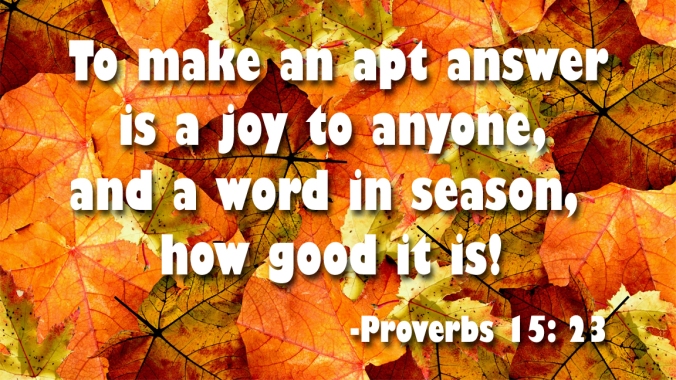
No Noise is Good Noise

aptanswer

Today’s readings (click below to open in new tab/window):
Psalms 123; 146, Proverbs 15:16-33, 1 Timothy 1:18—2:15, Matthew 12:33-42


The mind of the righteous ponders how to answer, but the mouth of the wicked pours out evil.

The ear that heeds wholesome admonition will lodge among the wise.

Those who ignore instruction despise themselves, but those who heed admonition gain understanding.

– Proverbs 15:28, 31, 32

The Book of Proverbs is a collection of pithy sayings, instructions, and poems from several sources. Chapters 10 through 22 are attributed to Solomon, but he probably did not author them directly. Proverbs contains many themes, and one of the most prominent is wisdom.

A lot of this wisdom centers on the idea that, frankly speaking, we should know when to keep our mouths shut.

In our culture, most conversations pretend to be exchanges of ideas, but we generally lack tolerance for the silence necessary to thoughtfully reflect on what someone is saying to us. Instead we fill “awkward” silences by speaking whatever comes to mind first. Often we are mentally formulating our response before the other person finishes talking. And too often our default response mode is rebuttal rather than reflection. This is especially true when the discussion is about a disagreement, and we are more concerned with making our case – with winning the argument – than considering what the other person might have to add to our understanding. Spirited debate can be invigorating, even fun, but how often are we listening to respond, rather than listening to learn?

When we receive constructive criticism, we don’t have to immediately reply with a defense; we can take time to mull it over. When someone is experiencing grief or pain, we don’t have to offer cliched sentiments because we feel we have to say something comforting; we can simply be with that person. When someone is telling us about their problems we don’t have to offer unsolicited solutions; we can support them better with open ears and open arms. In these situations and many more, taking time to think will improve what we have to say, or show us we needn’t say anything.

Listening without feeling a need to respond every time will make us better friends, better parents, better co-workers, and better followers of Christ. Don’t be afraid of silence; that’s when we can hear God speak.

Comfort: Being slow to respond is often a sign of depth, not ignorance.

Challenge: For the remainder of the week, whenever possible, count to five before responding – or thinking about responding – to questions, news, etc. Note how these pauses affect the conversations.

Prayer: Loving God, teach me to listen for you in the silence. Amen.

Discussion: In what situations do you find it difficult to hold your tongue, even when you know better than to speak?

Join the discussion! If you enjoyed this post, feel free to join an extended discussion as part of the C+C Facebook group. You’ll be notified of new posts through FB, and have the opportunity to share your thoughts with some lovely people.