Sweet Temptation

cupcake-1318337-1919x1278

Today’s readings:
Psalms 5; 147:1-11, Jeremiah 18:1-11, Romans 8:1-11, John 6:27-40


Have you ever tried to give up excess sugar? At first it’s an unpleasant mixture of headaches, cravings, and fatigue. After a while those symptoms fade, and you start to feel pretty normal – maybe better than normal, without all the highs and lows of unsteady blood sugar. Eventually candy and soda may become so unbearably sweet on the tongue that you wonder how you ever enjoyed them in the first place. Your appetite changes, and you are better off for it.

The Apostle Paul tried to teach members of the Christian church in Rome about changing their appetites. He knew many of them still had more of an appetite for the flesh then the Spirit. When he tells them “those who live according to the flesh set their minds on the things of the flesh, but those who live according to the Spirit set their minds on the things of the Spirit,” he knows they aren’t excited to give up their earthly habits cold turkey. He also knows that by practicing a life in Christ (and enduring a few resulting headaches and cravings) they will wean themselves off a taste for sin. Maybe they’ll begin to wonder why it was ever so appealing.

Years before Paul wrote to the Roman church, Jesus spoke to the Jews about an appetite change. The Pharisees wanted a sign from him, like the manna they ate while wandering the desert after fleeing Egypt. For a time manna was necessary for survival, but it was limited. Manna, gathered in the mornings, would not keep overnight and rotted away before morning.

Instead he offered them himself as the Bread of Life: “Whoever comes to me will never be hungry, and whoever believes in me will never be thirsty.” To develop a taste for that bread, they would have to stop feasting on the law which they craved but could no longer sustain them.

To savor a better life, we must sometimes figure out which lesser appetites we have been feeding instead. Whatever sweet temptations we think we can’t live without, Jesus promises us something far better.

Comfort: God always has something better in store.

Challenge: Make a list of what appetites – social, physical, mental – you give too much priority. Then write down some goals and strategies for changing that.

Prayer: Abundant Lord, I wish to be filled with the Bread of Life. Amen.

Discussion: What’s your favorite food? Is it good for you?

Join the discussion! If you enjoyed this post, feel free to join an extended discussion as part of the C+C Facebook group. You’ll  have the opportunity to share your thoughts with some lovely people. Or feel free to comment here on WordPress, or even re-blog – the more the merrier!

The Good We Want

Image result for quotes about willpower

Today’s readings:
Psalms 34; 146, Jeremiah 17:19-27, Romans 7:13-25, John 6:16-27


Willpower.

We’re prone to judging people, including ourselves, as morally weak or strong depending on whether we believe they have a little or a lot of it. We blame poor willpower for addictions, eating disorders, bad habits, cowardice, and any number of human failings. Recent studies, however, indicate that reliance on willpower alone to change behavior may actually set us up for further failure. To understand a behavior is more than understanding what we do, but why we do it.

The Apostle Paul was ahead of the research on this one. He freely admitted: “I do not understand my own actions. For I do not do what I want, but I do the very thing I hate […] I can will what is right, but I cannot do it. I do not do the good I want, but the evil I do not want is what I do.” He described his mind as a slave to God, but his flesh as a slave to sin.

Repenting of a behavior is more complicated than declaring, “I am done.” It’s unfair to expect that of ourselves. We owe it to ourselves and to God to take the time to understand why we gossip (or cheat or lie or whatever it is we wish to change). Repentance starts with a decision, but we may need to find ways to reinforce that decision every day – perhaps every hour – for a long time. Prayer is the best start, but we shouldn’t be ashamed to employ all the tools necessary to be successful. Those tools may include everything from daily affirmations to professional counseling.

We may need to physically alter our environment; if so, let’s think of that as a sign not of our weakness, but of our dedication. We may need to leave behind friends who undermine or mock our efforts. Backsliding may be part of the process. Willpower tells us backsliding is failure; repentance tells us backsliding signals time for another change of direction away from the darkness and toward the light.

Viewed through eyes of grace, our imperfections are not barriers between us and the divine, but invitations to more fully understand ourselves and our God.

Comfort: God’s love is unconditional. Yes, that was yesterday’s comfort as well. Repeat as necessary.

Challenge: Read this short article on changing bad habits, and maybe seek out others.

Prayer: Holy and forgiving God, thank you for being by my side both when I fail and when I succeed. Amen.

Discussion: What’s the most difficult habit or behavior you’ve broken?

Join the discussion! If you enjoyed this post, feel free to join an extended discussion as part of the C+C Facebook group. You’ll  have the opportunity to share your thoughts with some lovely people. Or feel free to comment here on WordPress, or even re-blog – the more the merrier!

Made to be Broken

broken-glass-1569217-1918x1278

Today’s readings:
Psalms 119:73-80; 145, Jeremiah 16:(1-9) 10-21, Romans 7:1-12, John 6:1-15


You’ve probably heard the saying “Rules were made to be broken.” The Apostle Paul, in his letter to the Romans, phrased it a little differently: “if it had not been for the law, I would not have known sin.” It seems like wonderful news that the law, fulfilled in Christ, no longer condemns us. Isn’t that the kind of freedom we desire?

One might think so, yet we seem eager to impose new laws. Over the years Christians have forbidden everything from dancing to haircuts. We’ve twisted religion to enforce cultural traditions as though they were divine rules. Why do this? Maybe because it’s so much easier to understand and navigate a system of laws rather than a commandment to love.

But this isn’t the only reason it’s harder to accept living under grace than living under the law. Accepting grace means accepting a God of unconditional love. That means God is willing to forgive people we’d rather He didn’t: ex-spouses, people who’ve wronged us, terrorists, etc. In the story of Jonah, the reluctant prophet wanted God to withhold forgiveness so badly that God had to deliver him to his enemies in Nineveh via the belly of a giant fish. There’s a little Jonah in all of us. Knowing God will forgive people we can’t (or won’t) rubs us the wrong way, so we return to the law even if God hasn’t.

It’s not like we’re any easier on ourselves. If we were eager to believe we could be unconditionally loved and forgiven, therapists would go out of business. The world teaches us we must prove ourselves in order to be valued. Jesus tells us we are already valued, and asks us to live lives that prove it. Sometimes we have to untie a lifetime of spiritual and psychological knots before are free to believe that. But once we are able to embrace it, we want it for others as well.

Maybe rules were made to be broken, but we were not. God desires wholeness for each of us. Christ teaches us how to mend our souls – to sand down the jagged edges and mend the cracks – by tending to each other’s brokenness. When the law is love, the penalty is more love.

Comfort: God’s love is unconditional.

Challenge: If you can’t bring yourself to forgive someone, at least pray for them.

Prayer: Gracious and Merciful God, I am humbled by and grateful for your love. Amen.

Discussion: Do you really believe God loves you unconditionally? Why or why not?

Join the discussion! If you enjoyed this post, feel free to join an extended discussion as part of the C+C Facebook group. You’ll  have the opportunity to share your thoughts with some lovely people. Or feel free to comment here on WordPress, or even re-blog – the more the merrier!

Tearing down or building up?

IM000822.JPG

Today’s readings:
Psalms 43; 149, Jeremiah 13:1-11, Romans 6:12-23, John 8:47-59


Upon passing a site undergoing renovation, a quick glance may not reveal whether it is in the stages of demolition or construction. They can look similar for a long time. The church has been undergoing renovation for centuries, and to bystanders (and members) the status may not be quite clear.

What do we think when we hear someone described as “religious?” Even if we consider ourselves religious, we may not automatically assume that person is similar to us. Increasing numbers of Americans—including those who regularly attend Christian churches—identify as “spiritual but not religious” to avoid the stigma of religion. For their book unChristian, David Kinnamon and Gabe Lyons surveyed a group of young Americans—Christians included—and 85% or more described Christians as hypocritical and judgmental. 70% described them as insensitive to others. We can be reasonably skeptical about statistics, and some of the authors’ conclusions about how the church should respond are debatable, but are the results surprising? Not really.

As the church, let’s follow Paul’s advice to the Romans and spend less time denouncing the world and each other, and more time building each other up. When people hear “Christian” they should think of people who share with anyone in need, who visit the sick and imprisoned, and who love God with “gladness and sincerity of heart” (Acts 2:46).

If Christianity is known mostly for the things Christians won’t do and the people they won’t embrace, whose fault is that? If our main concern is moralizing when we are as prone to sin as anyone, why wouldn’t the world see us as hypocrites? Some people will always be intractably bigoted against the religious, but our reputation is our own responsibility. We can change the perception of the world by choosing to build rather than demolish. This broken world needs people who participate in mending it, not in grinding it into irrecoverable pieces.

Early Christians stumbled and lost track of the Good News when they began judging each other. Maybe we can avoid the same mistakes by asking not who is sinning, but who is hungry, ill, poor, or unloved.

Comfort: If you’re doing what’s right, the world’s judgment doesn’t matter.

Challenge: Be a builder, not a destroyer.

Prayer: God of creation, help me represent my faith well. Amen.

Discussion: Have you ever caught yourself being a bad representative of Christianity?

Join the discussion! If you enjoyed this post, feel free to join an extended discussion as part of the C+C Facebook group. You’ll  have the opportunity to share your thoughts with some lovely people. Or feel free to comment here on WordPress, or even re-blog – the more the merrier!

Convection is good for the soul

20170324_160358-01.jpeg

Today’s readings:
Psalms 22; 148, Jeremiah 11:1-8, 14-17, Romans 6:1-11, John 8:33-47


It’s good to keep your freezer full, but not overly so. Solid items are easier than empty space (or mostly empty space) to keep cool, so it shouldn’t be empty. However, too many (or improperly placed) items can restrict the air flow necessary for proper operation. This can result in frost build-up, uneven cooling, and wasted energy. Ovens, especially convection ovens, also work best when there’s enough space for airflow.

We human beings also operate better when we leave room for the Spirit (or as it’s called in Greek, pneuma which also means breath or air). Take the Pharisees for example: Jesus told them, “you cannot accept my word.” Why not? Because their hearts were so crammed full of religion there wasn’t room for revelation. Ever seen a freezer whose contents have frosted into one giant immobile block? That’s what happens to a heart so overloaded with dogma, doctrine, and doing that nothing else – even the divine breath – can enter it. We can’t be so concerned with preserving the past that we ignore the present and oppose the future.

While the freezer preserves, the oven prepares. But we have to be sure we’re not putting too much in there at once either. Faith is not a body of knowledge to be contained and mastered, but an experience to be lived. We can cram countless theological concepts into that oven, but without time and space to expose them to the breath of the Spirit they may turn out to be half-baked. Sure your theology of suffering may have browned up nicely, but if it’s just one of many recipes you’ve rushed to complete, instead of testing thoroughly, it may still be a gooey, useless mess inside. Our ideas about God shouldn’t crowd out our experience of God, or those ideas won’t sustain us in times of need.

As with physical possessions, we may be surprised by how few mental possessions we really need to get by. At some point they become idols clogging our spiritual airways. Let’s preserve the essentials, prepare what’s been entrusted to us, and periodically check for an expiration date on the rest.

Comfort: You don’t have to fill up every space and second.

Challenge: Every day, take time to breathe deeply.

Prayer: God of mercy and love, I seek to sink deeply into your Spirit. Amen.

Discussion: When’s the last time you really cleaned out things you didn’t need?

Join the discussion! If you enjoyed this post, feel free to join an extended discussion as part of the C+C Facebook group. You’ll  have the opportunity to share your thoughts with some lovely people. Or feel free to comment here on WordPress, or even re-blog – the more the merrier!

Truth will set you free

the-truth-shall-make-you-free-1201069

Today’s readings:
Psalms 27; 147:12-20, Jeremiah 10:11-24, Romans 5:12-21, John 8:21-32


Where do we find truth? Do we know it when we hear it?

We’d like to believe most people are truthful, but from earliest recorded history through up-to-the-minute reporting, deception runs rampant. Journalism has become propaganda. History has been revised and textbooks politicized. Facts are reduced to opinions then dismissed. Opinions and conjecture are elevated to facts and published as news. No ideology seems immune to these distortions. Information is more widely available than ever, yet it is notoriously faulty. If, as Jesus says in the Gospel of John, “the truth will make you free”… what is the state of our freedom?

In this age of moral relativism and political correctness, it is important to know what we believe and why. Our own memory and understanding are possibly the sources we rely on most for truth, and while for most of us they are thoroughly convincing, they can be surprisingly deceptive. We need reliable sources of truth, but they can seem few and far between.

Luckily – or perhaps providentially – some truths are eternal and immutable. Chief among them is God’s love for his creation. As we sift through the information overload that threatens to bury us, that love can be our barometer for evaluating many kinds of truth, such as matters of justice or compassion. Truth will move people toward freedom, love, and inclusion, not away from it.

Sometimes truth is not something that can be expressed directly. We may need poets and composers and other artists to point us toward it. Rationalism and materialism, while vital for revealing truths about the physical world, are not the only paths to truth. What is right and good may not make empirical sense. Sacrificing ourselves for others is quite counter-intuitive, yet the person who spoke the most important truths to us believed in it with all his being. The truth of the cross and resurrection exist somewhere beyond facts and historical accuracy, somewhere within our hearts. Truth is never manufactured, but unearthed by those with ears to hear and eyes to see. It makes us free when it is free.

Comfort: The truth is on your side.

Challenge: Be on the side of truth.

Prayer: God of truth and love, I seek you and your ways. Guide me to freedom. Amen.

Discussion: Has accepting a difficult truth ever set you free in some way?

Join the discussion! If you enjoyed this post, feel free to join an extended discussion as part of the C+C Facebook group. You’ll  have the opportunity to share your thoughts with some lovely people. Or feel free to comment here on WordPress, or even re-blog – the more the merrier!
Endurance Training

Runners

Today’s readings:
Psalms 5; 147:1-11, Jeremiah 8:4-7, 18-9:6, Romans 5:1-11, John 8:12-20


And not only that, but we also boast in our sufferings, knowing that suffering produces endurance, and endurance produces character, and character produces hope, and hope does not disappoint us…
– Romans 5:3-4

I did not put you here to suffer. I did not put you here to whine.
I put you here to love another and to get out and have a good time.
– The Rainmakers, “Let My People Go-Go”

Suffering, while an inevitable part of the Christian journey, is never meant to be the destination. We are assured that, through the glory of God, all suffering can be transformed for good. We don’t need to seek pointless suffering just for the sake of enduring it, but when we need to exercise self-discipline or find suffering inescapable, we can turn that suffering over to God. But let’s not for a minute assume this is a passive process which requires nothing of us but curling up into a cocoon of self-pity and waiting for divine metamorphosis. It takes intention.

The steps in this process all require conscious choices on our part. Endurance training is something we take for granted in athletics, but not as often in other parts of life. Can we teach ourselves to view suffering as a form of spiritual training which develops our spiritual muscles? What about character? We romanticize the idea of sports building character, but not every top athlete is an upstanding citizen. Our spiritual training needs to be tempered with humility and mercy, a desire to serve rather than conquer.

The best coaches – and their best players – embrace being part of a greater story. It’s that type of character – the type that recognizes our greatest glory does not begin and end with our personal achievements and failures – which opens us up to hope. Hope is only present when we can see the big picture, the picture that tells the story of God’s kingdom becoming reality.

Athletes build endurance through difficulty. Butterflies nearly die before leaving the cocoon. Neither of them are victims of suffering; they use it to transform themselves into something miraculous.

Comfort: Suffering is not inflicted on us by God…

Challenge: … but God can help us through it.

Prayer: God of holy mystery, I trust you above anything. Amen.

Discussion: How have you dealt with suffering?

Join the discussion! If you enjoyed this post, feel free to join an extended discussion as part of the C+C Facebook group. You’ll  have the opportunity to share your thoughts with some lovely people. Or feel free to comment here on WordPress, or even re-blog – the more the merrier!
Here’s your sign.

signs-1444874-1920x1440

Today’s readings:
Psalms 84; 150, Jeremiah 14:1-9 (10-16) 17-22, Galatians 4:21-5:1, Mark 8:11-21


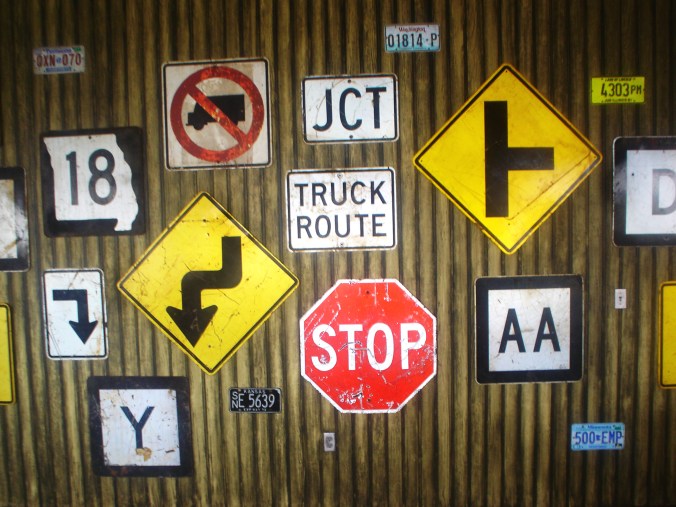
For Jesus, signs were a double-edged sword. They demonstrated his authenticity, his power, and his priorities. However, for some people, the signs themselves became more important than his message. When the Pharisees asked him for a sign to test him, “he sighed deeply in his spirit and said, ‘Why does this generation ask for a sign? Truly I tell you, no sign will be given to this generation.’”

Just a little while later, when he tried to make a point about the influence of the Pharisees and Herod by comparing it to the contaminating properties of yeast, the disciples fixated on literal bread. Jesus asked why they were still talking about bread – had they forgotten all about how he fed not one but two multitudes with few resources but plenty of faith?

Aggravating circumstances often accompany his miracles: before he wants to reveal himself his mother goads him into changing water into wine at a wedding; the disciples are shocked he can feed a multitude with a few loaves and fishes … the second time; his closest friends doubt him even as he raises Lazarus from the dead; Peter begins to sink beneath the waves when he doubts the Christ who helps him walk across the water. Christ hopes for faith that doesn’t depend on miracles, yet sometimes he resigns himself to the “necessary evil” of providing a sign.

Many of us have hoped for signs. Who couldn’t use a little reassurance now and then? For some of us they provide a kick start to spiritual experience. But the real measure of faith is what we do in the absence of signs. How pleasing must it have been for Christ when peopled followed him not because of what he could do for them, but because of who he was and what he taught?

The second time the disciples presented him with loaves and fishes, he commanded them to feed the crowd themselves, and they were successful. Faith is not just believing in what Christ can do for us, but in trusting that he will accomplish miraculous things through us.

Comfort: God is with us regardless of whether we see signs.

Challenge: The next time you want to ask for a sign, try instead to pray for faithful discernment.

Prayer: Lord of all things, I will trust you always. Amen.

Discussion: How do you feel about signs?

Join the discussion! If you enjoyed this post, feel free to join an extended discussion as part of the C+C Facebook group. You’ll  have the opportunity to share your thoughts with some lovely people. Or feel free to comment here on WordPress, or even re-blog – the more the merrier!
Bibliophilia

img_20170321_062149_490.jpg

Today’s readings:
Psalms 34; 146, Jeremiah 7:21-34, Romans 4:13-25, John 7:37-52


Here’s a question loaded with potential paradox: can the Bible, which warns us against idolatry, itself become an object of idolatry?

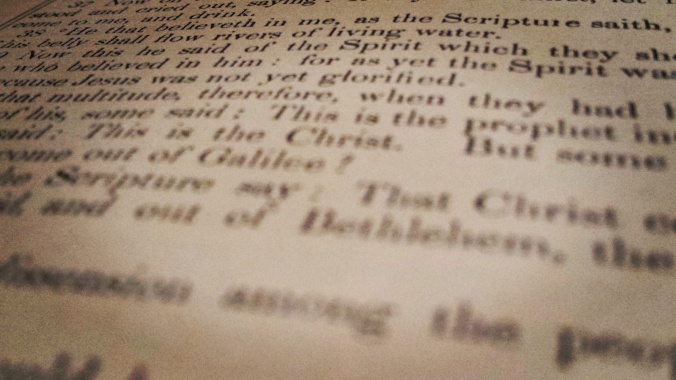
Let’s consider the Pharisees in today’s reading from John. As they tried to determine who this Jesus person was and what he meant to the Jews, they consulted their scriptures. We tend to peg the Pharisees as villains, but in truth they resembled some of today’s Christians, struggling to obey every jot and tittle of their sacred texts. The Pharisees knew Jesus as a Galilean, and therefore dismissed him as a messianic candidate since their sources said the Messiah would come from Bethlehem. No prophet at all was expected from Galilee. Yes, they were ignorant of the facts surrounding Jesus’ birth, but weren’t they also guilty of ignoring the evidence in front of them, evidence the less pious correctly accepted? The Pharisees idolized their scriptures over the Truth before them. Those same scriptures we revere today.

Ever seen the bumper sticker that reads: “The Bible says it. I believe it. That settles it”? We like to believe we would have seen things differently than the Pharisees, but our bumper stickers say otherwise. Perhaps it’s not the Bible itself we idolize, but our confidence in our own understanding of it. This tendency is not limited to either conservative or liberal readers of the Bible. While the former may forego nuance and context, the latter can deconstruct it to the point of meaninglessness. Exaggerated self-confidence wears no particular political stripe. Sometimes we all prefer certainty to mystery.

If we close our minds to new understanding of scripture, we may miss the Truth in front of us. We do not trust God because the Bible says to—we trust the Bible because we trust God. Many life experiences will not fit our understanding of scripture. At these times we do not abandon scripture for ease or convenience, but would be wise to humbly heed the advice of Proverbs 3:5-6: “Trust in the LORD with all your heart and lean not on your own understanding; in all your ways submit to him, and he will make your paths straight.”

Comfort: We are meant to wrestle with scripture.

Challenge: Meditate on how experience defies your expectations.

Prayer: God of holy mystery, I trust you above anything. Amen.

Discussion: How has your relationship with the Bible evolved over time?

Join the discussion! If you enjoyed this post, feel free to join an extended discussion as part of the C+C Facebook group. You’ll  have the opportunity to share your thoughts with some lovely people. Or feel free to comment here on WordPress, or even re-blog – the more the merrier!

Sorry, not sorry.

lovesorry

Today’s readings (click below to open in new tab/window):
Psalms 119:73-80; 145, Jeremiah 7:1-15, Romans 4:1-12, John 7:14-36


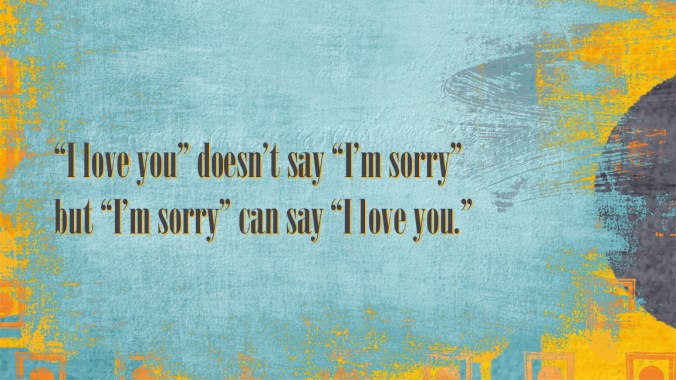
Have you ever tried to apologize by telling someone: “I love you?” Has anyone ever tried that with you? It’s a terrible way to end a dispute, because it resolves nothing. “I love you” is not an apology. It is not an admission of guilt. It is not a promise to change one’s ways. At best it is an attempt to appease someone by exploiting their emotional vulnerability in order to avoid conflict. “I love you” may precede or follow an apology; it does not replace it. Trying to do so is merely lip service.

The prophet Jeremiah addresses the Israelites about how they have been paying spiritual lip service to God. They have been profaning the Lord’s name and committing all kinds of crimes and sin, but on the Sabbath they enter the temple and proclaim “This is the temple of the Lord, the temple of the Lord, the temple of the Lord.” Like a lover who has had enough of hearing all the right words but observing all the wrong deeds, the Lord declares the words deceptive. They are not sincere enough to wipe clean the offenses of a people who utter faithful words to cover their bases, but live otherwise unfaithful lives.

Love, whether of God or of a person, requires sincerity. When we betray that relationship repeatedly, declarations of “I love you” or “This is the temple of the Lord” do nothing but undermine and cheapen the meaning of those words. They are like pretty paper wrapped around a gift of yesterday’s moldering trash. Eventually the contents leak through and the paper itself is fouled by contamination; the pretty words become an ugly stench. Only when we have demonstrably repented – when we no longer try to excuse our wrongdoing with hollow sentiment – can we expect the relationship to mend. Over time we have to rebuild the trust that our words reflect the state of our heart.

Actions really do speak louder than words. If the only proof of our love and devotion is a bouquet of desperate words which have already begun to stink, we must repent until words are unnecessary.

Comfort: God’s love for you does not change.

Challenge: When you apologize, mean it.

Prayer: My God, I am heartily sorry for all my sins. Amen.

Discussion: What is the worst or best apology you’ve received or given?

Join the discussion! If you enjoyed this post, feel free to join an extended discussion as part of the C+C Facebook group. You’ll  have the opportunity to share your thoughts with some lovely people. Or feel free to comment here on WordPress, or even re-blog – the more the merrier!