Our Daily Apocalypse

think-small

Today’s readings (click below to open in new tab/window):
Psalms 93; 148, Isaiah 25:1-9, Revelation 1:19-20, John 7:53-8:11


Isaiah 25 looks toward the day when “God will wipe away the tears from all faces, and the disgrace of his people he will take away from all the earth.” Today’s reading from Revelation introduces John’s vision of Christ’s victory over the evils in the world. Both are standard Christmastide readings, as we celebrate Christ’s arrival in the world. To which victory of the Lord do these readings refer?

Ancient people read scripture with a different sense of time and meaning than we might. For example, we read the Lord’s Prayer as the present-tense: “give us this day our daily bread.” In Greek, this prayer uses the aorist tense, a kind of “once and for all” tense signifying not just the present, but the unfolding future as well. While Isaiah’s vision was about the eventual restoration of a Jewish people exiled in Babylon, early Christians co-opted it to tell of the coming Messiah. This approach might seem odd to modern sensibilities, but for people of the time it was part of understanding that God’s plan of salvation unfolds in the past, present, and future.

Isaiah 25 is an early example of apocalyptic literature. Revelation is also apocalyptic literature. Typical of the genre, both blur the lines between the past and the future. Apocalyptic literature is not so concerned with historical accuracy or specific prophecy as with the idea of the cosmic story of salvation. Time is fluid in these writings because God is always revealed anew to us, and the world is always being remade.

Apocalyptic literature invites us to dwell in the mystery of God’s unfolding plan, better expressed through visions and dreams than facts. The events have already happened, yet are still to happen. This paradox offers confidence that change will come, because it has come. During the Civil War and Civil Rights eras, African-Americans and their allies found inspiration in apocalyptic themes, which assured God’s eventual deliverance. Though mysterious, these themes were comforting.

If we read Isaiah only for the past, or Revelation only for the future, we miss the message of what God is doing today.

For additional thoughts on today’s reading from John, see Thud!

Comfort: God’s plan is unfolding—and we are part of it.

Challenge: Watch the news for modern stories of God’s deliverance.

Prayer: O timeless Creator, thank you for your people’s dreams and visions. Amen.

Discussion: Are you able to see Christ’s work as both complete and continuing?

Join the discussion! If you enjoyed this post, feel free to join an extended discussion as part of the C+C Facebook group or follow @comf_and_chall on Twitter. You’ll  have the opportunity to share your thoughts with some lovely people. Or feel free to comment here on WordPress, or even re-blog – the more the merrier!
Deadline or Lifeline?

20161217_211959-01.jpeg

Today’s readings (click below to open in new tab/window):
Psalms 90; 149, Isaiah 10:20-27, Jude 17-25, Luke 3:1-9


“Teach us to number our days, that we may gain a heart of wisdom.”
– Psalm 90:12

Many people claim “I do my best work under pressure.” More often than not this actually means “I do my work only under pressure.” Sometimes a deadline can help us sort out competing priorities. If a project overwhelms us and we are spinning our wheels, a looming deadline can force us to find the necessary traction to make decisions and lurch forward. Other times we meet a deadline – such as a bill payment, a task at work, or Christmas shopping – because we don’t want to reap unpleasant consequences. Whatever the reasons, deadlines motivate us to action.

The author of Psalm 90 acknowledges our need to be motivated by a sense of limited time. For this psalmist, wisdom is more than the experience of accumulated years: it is also the acute awareness that these years are finitely numbered. Many people avoid “putting their affairs in order” until they experience a health scare or receive a terminal diagnosis. Others wake up one day to realize their children are adults and wonder how they could have missed sharing so much childhood. And what percentage of the world’s diets are scheduled to start “tomorrow?” When we convince ourselves we have forever – possibly because we are uncomfortable with confronting mortality – what we end up with is never.

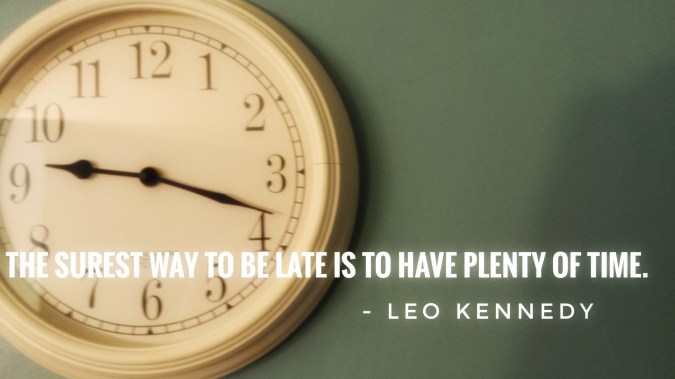
During Advent we are called to gain wisdom in our hearts by focusing on some spiritual deadlines: the arrival of Christ (in the past, present and future); the passing of the world as we know it to make room for the realm of God; our own eventual passing. At first they might seem like disturbing things to contemplate, but they also liberate us to decide what we will, what we won’t, and what we need to accomplish with our lives. They can stir us from complacency to determination, from inertia to action, and from despair to hope for the future. Leo Kennedy said: “The surest way to be late is to have plenty of time.”

Sometimes a deadline is a lifeline.

Comfort: Time limits are not oppressive, but liberating..

Challenge: Before Advent ends – or at the latest before this year ends – select three tasks you have been putting off. Explore why you haven’t completed them, then do them.

Prayer: God of Hope, help me gain a heart of wisdom. Amen.

Discussion: When do you procrastinate, and why?

Join the discussion! If you enjoyed this post, feel free to join an extended discussion as part of the C+C Facebook group or follow @comf_and_chall on Twitter. You’ll  have the opportunity to share your thoughts with some lovely people. Or feel free to comment here on WordPress, or even re-blog – the more the merrier!

No (Fake) News is (The) Good News

20161216_215036-01.jpeg

Today’s readings (click below to open in new tab/window):
Psalms 102; 148, Isaiah 10:5-19, 2 Peter 2:17-22, Matthew 11:2-15


There’s a lot of real news about fake news – but it’s old news.

2 Peter warned the faithful against false teachings circulating among them.  It cautioned them against listening to teachings that appealed to their baser natures –that approved of licentiousness and corruption. Many gentile converts were used to fertility cults and temple prostitution, and the lure remained. When certain teachers coopted Jesus’s name to say pretty all this was permissible, many thought they could return to their old ways.

According to Matthew, Jesus may not have been what John was expecting. Never one to soften a message for popularity’s sake, John held a hard line on God’s coming judgment. When Jesus started a ministry revealing God’s judgment would be expressed through mercy, John questioned what he heard. John asked Jesus to confirm he was the real thing. If that makes his commitment seem wishy-washy, remember self-proclaimed messiahs had been popping up with startling regularity.

How do we know when news about faith or current events is fake? Our first clue is that it perfectly confirms everything we want to believe. When it tells us we are biased against the right people, or that our foes fit every stereotype we would layer upon them … it’s probably fake. When it doesn’t challenge us to change in any ways that make us unhappy or uncomfortable … it’s probably fake. If it makes us feel righteous in our anger, hatred, or cowardice … it’s probably fake.

“But I know the difference,” we might say. Smart people of all political persuasions are duped by fake news. Well-meaning Christians have been bilked by charlatans since the first person realized there was profit in it. Like John the Baptist, we can be both faithful and skeptical. How did Jesus confirm his identity? By sending this message to John: “The blind receive their sight, the lame walk, the lepers are cleansed, the deaf hear, the dead are raised, and the poor have good news brought to them.”

The fruits of truth are reconciliation and healing. Let us devour them hungrily, and reject what poisons our spirits.

Comfort: You can discern the truth…

Challenge: … but you may have to work a little harder at it.

Prayer: God of Truth, lead me in Your ways. Amen.

Discussion: Have you ever fallen for a fake news story? What about?

Join the discussion! If you enjoyed this post, feel free to join an extended discussion as part of the C+C Facebook group or follow @comf_and_chall on Twitter. You’ll  have the opportunity to share your thoughts with some lovely people. Or feel free to comment here on WordPress, or even re-blog – the more the merrier!

Fire of God

20161215_221008-01.jpeg

Today’s readings (click below to open in new tab/window):
Psalms 18:1-20; 147:12-20, Isaiah 9:18-10:4, 2 Peter 2:10b-16, Matthew 3:1-12


Fire is a prominent theme in today’s scriptures. It is equated with the coming of God twice in Psalm 18, twice in the Isaiah reading, and three times by John the Baptist in our passage from Matthew’s gospel. Fire is an apt metaphor: it terrifies us, yet sustains us; it destroys us, yet we exist because of flames ignited billions of years ago. Maybe you’ve heard someone compare fire to a living thing. While not technically true, fire is primal, unpredictable, and uncontrollable. Under some conditions, attempting to contain fire may cause more harm than good. Decades of fire prevention in the Southwest contributed to many of the raging firestorms appearing in our present day.

Isaiah’s people thought they had contained the fire of the Lord, that they had reduced it to meaningless rites and empty sacrifices; they were a people ignoring the smoldering coal in their midst, willfully ignorant of the inevitable destruction such negligence would bring upon them. When people shrugged off the warnings of John the Baptist because they considered being Jewish – children of Abraham – all the righteousness they needed, John told them the Lord could raise His people from stones and burn them like chaff separated from the wheat.

But fire also heals. It cleanses. It is absolutely essential to the reproductive cycle of some plants. Humans couldn’t live in many of the places we do without it.

God, like fire, is a force we simultaneously fear, respect, require, flee, draw near, and can’t safely touch. The gospel though, is a lit torch. We pass it to others when we see them shivering in the cold and dark. We gather around it in community. We share its flame so others may bear it where we do not go. In our darker moments, we forget why it was gifted to us and march with it against our enemies. We must always remember the torch we bear is a pale reflection of its source, and shun the pride that tells us we own or control it.

This Advent we wait for the spark in a dark, dark world.

Comfort: God is always larger than we can imagine, but never so large that we are small to God.

Challenge: Meditate on a candle, a campfire, or some other open flame. What do you see?

Prayer: All powerful Lord, I will seek Jesus as the light in the darkness. Amen.

Discussion: How does thinking of God as a fire make you feel?

Join the discussion! If you enjoyed this post, feel free to join an extended discussion as part of the C+C Facebook group or follow @comf_and_chall on Twitter. You’ll  have the opportunity to share your thoughts with some lovely people. Or feel free to comment here on WordPress, or even re-blog – the more the merrier!

Intersections

1481770706315-01.jpeg

Today’s readings (click below to open in new tab/window):
Psalms 50; 147:1-11, Isaiah 9:8-17, 2 Peter 2:1-10a, Mark 1:1-8


In the opening of Mark’s gospel, the author quotes the prophet Isaiah: “Prepare the way of the Lord, make his paths straight.” The quote continues to say valleys shall be raised and mountains brought low. In this metaphor, the highest and lowest of us all are equal before God and God’s justice. It’s easy to picture a single, clear, straight road leading the Lord right to that place of justice. But note that Isaiah uses the plural “paths.” This may simply indicate turns or changes in direction, but could it be more?

Promoters of social justice often use the term “intersectionality.” In brief, it means that all forms of justice, rather than being separate situations, are connected and intertwined. Issues of poverty are not separate from issues of race, which are not separate from issues of gender, and so on. It is possible to make headway directing our efforts down only one of these paths, but that means we aren’t contributing to progress on the others, which actually holds us back. Even the most privileged person is trapped in systems of injustice, and intersectionality teaches him to see how he is both oppressed by and contributes to them. Intersectionality is not about saying one group’s privilege is bad, but about removing obstacles to that same privilege for everyone else.

And that brings us back to paths, plural. God is beyond time, space, and understanding. His paths to righteousness are infinite, cutting through many wildernesses at once. The Lord’s justice is not completed in a single march, but through a convergence from all directions, all times, all the colors of its spectrum merging into a destination shining with divine understanding. We each have the opportunity to walk with the Lord on many paths, all headed toward that unified light. Let’s make sure we’re not making progress on leveling our own path by throwing our rubble onto someone else’s.

Like love, justice exists in endless supply, but we must let it rush through us like rivers instead of damming it up. Over time, rivers straighten their own paths, and so can we.

Comfort: Your path is as valid as everyone elses.

Challenge: Read about intersectionality.

Prayer: Infinite God, I will seek your justice in all directions. Amen.

Discussion: Have you ever found your well-being tangled with someone who was not like you?

Join the discussion! If you enjoyed this post, feel free to join an extended discussion as part of the C+C Facebook group or follow @comf_and_chall on Twitter. You’ll  have the opportunity to share your thoughts with some lovely people. Or feel free to comment here on WordPress, or even re-blog – the more the merrier!

No-Win Scenario

nothing-right

Today’s readings (click below to open in new tab/window):
Psalms 33; 146, Isaiah 9:2-7, 2 Peter 1:12-21, Luke 22:54-69


They said, “If you are the Messiah, tell us.” He replied, “If I tell you, you will not believe; and if I question you, you will not answer.

When Jesus was arrested and brought before the Jewish authorities, they purposely put him in a no-win scenario. If he claimed to be the Messiah they would charge him with blasphemy and the Romans would charge him with sedition. Denying it would undermine his entire ministry. Keeping silent enabled them to impose whatever meaning best benefited them onto his silence. He responded simply by pointing these things out.

Have you been in a situation where there was no right answer?  Most of us have. Like Christ, we may find ourselves damned by both our words and our silence. Unlike Christ we almost never have to face consequences like crucifixion (and probably shouldn’t compare minor inconveniences to that event), but the very real consequences can result in professional, personal, and/or social damage. When facing a no-win situation, the best option is the one that maintains personal and spiritual integrity.

We are less likely to recognize when we are on the other side – when we have made up our minds that a person can do no right. Many a marriage or friendship struggles when one party or the other uses some grievance or infraction to dismiss all efforts, whether good or bad, from the other. Because we feel aggrieved, we feel justified. In a professional setting, a single mistake can kill an otherwise successful career, while less illustrious co-workers prosper because their mistakes haven’t been revealed. In politics, we can (and are encouraged to) dismiss everything the opposition party proposes simply because it came from “the other side.”

None of us wants to be defined by our mistakes, so we should not define others that way either. Individual and community relationships should, to the best of our abilities, mirror the divine forgiveness and redemption we find in Christ. Christ has not forgiven our sins and mistakes just so we can hold them against each other. We are a reconciling people; let’s act like it.

Comfort: God’s opinion of you is not swayed by the opinions of others.

Challenge: Is there anyone in your life you automatically dismiss, whether consciously or unconsciously? Seek to find common ground with that person.

Prayer: God of forgiveness, teach me to see others not through eyes of judgment but through eyes of love. Amen.

Discussion: Have you ever found yourself in a no-win situation?

Join the discussion! If you enjoyed this post, feel free to join an extended discussion as part of the C+C Facebook group or follow @comf_and_chall on Twitter. You’ll  have the opportunity to share your thoughts with some lovely people. Or feel free to comment here on WordPress, or even re-blog – the more the merrier!

Your Humble Servant

1480221323685-01.jpeg

Today’s readings (click below to open in new tab/window):
Psalms 63; 149, Zechariah 14:12-21, Philippians 2:1-11, Luke 19:41-48


The media often portrays Christians as some sort of monolithic hive-mind, acting and reacting in unison. The truth is, we are all over the map on social and political issues, and understanding or representing anything deeper than a caricature of us takes more work and nuanced thought than the average broadcaster or viewer will invest.

The fault may be partially our own. We each have an assumption of what it means to be Christian, and by default tend to project it onto other Christians until they prove otherwise. Now that doesn’t mean we necessarily buy into the definition we are projecting; some of us assume other Christians will agree with us, and others assume we will be opposed on some issues. It can be tempting to say someone isn’t a “real” Christian if they think differently than we do, or to quickly make it clear we aren’t one of “those” Christians. Either way, too often we limit what it means to be Christian, making it that much easier to stereotype us.

In his letter to the Philippians, Paul advises them to “be of the same mind, having the same love, being in full accord and of one mind.” In our diversity, have we betrayed that advice? Is it any longer possible for the diverse universe of Christians to be in “full accord?” It is if we look at how Paul defined it:

Do nothing from selfish ambition or conceit, but in humility regard others as better than yourselves. Let each of you look not to your own interests, but to the interests of others.

There isn’t one word of dogma in there. No specific religious practice. It says to look out for others first. That means listening more than convincing. Learning more than preaching. Serving more than insisting. Loving more than condemning. If I’m putting you first, and you’re putting me first, we aren’t even agreeing on who is first – but we are acting in accord. Following Christ isn’t about insisting others believe exactly as we do, but on serving them exactly as we believe Christ would have us do.

Comfort: You can love and serve Christians who think differently than you do.

Challenge: You have to love and serve Christians who think differently than you do.

Prayer: Lord, teach me to be your humble servant to all people. Amen.

Discussion: Beyond accepting Jesus, do you think there is a minimum set of beliefs necessary to be a Christian?

Join the discussion! If you enjoyed this post, feel free to join an extended discussion as part of the C+C Facebook group or follow @comf_and_chall on Twitter. You’ll  have the opportunity to share your thoughts with some lovely people. Or feel free to comment here on WordPress, or even re-blog – the more the merrier!

Guess Again

1480134596531-01.jpeg

Today’s readings (click below to open in new tab/window):
Psalms 84; 148, Zechariah 14:1-11 , Romans 15:7-13 , Luke 19:28-40


Jesus used many parables to describe the Kingdom of Heaven: great banquets, lost sheep, bridesmaids, poor but generous widows, scattered seed, and on and on. What he didn’t do was provide a literal description. We can assume this was intentional, and for good reasons. However, while we wrestle with those reasons and interpret parables, we continue to disagree on the details. Perhaps the best, if most trite, advice we have is: “Expect the unexpected.”

When Jesus rode into Jerusalem on a donkey, he confounded both Pharisees and Roman officials by mocking the authority of empire. He also defied the expectations of his own Jewish people, who were anticipating a military-style messiah but got a radical peacenik. Because he was not limited by assumptions, he embodied an unpredictable threat to both the status quo and the hoped-for change.

The Apostle Paul also operated outside acceptable social parameters. As a Jew and Roman taking the gospel to the Gentiles, he expanded the Christian world beyond the imaginations of Christ’s original Jewish disciples. Furthermore, in his letter to the Roman church, he justified it using the words of their own prophet Isaiah: “The root of Jesse shall come, the one who rises to rule the Gentiles; in him the Gentiles shall hope.”

Most of us have some idea of the type of justice we hope to see in Heaven’s fully realized Kingdom. For some, it is the righteous elimination of sin and restoration of goodness. For others, it’s an inclusive realm where the marginalized find their place at the table. There may be as many visions as there are Christians, and somehow the diversity of creation simultaneously supports and disavows each of them. The only thing they all share in common is their incompleteness. Whatever the true Kingdom looks like, it is beyond our imagination – not just in the sense that it is greater than our hopes, but also that it is beyond our ability to conceive.

Insisting on our own vision of the Kingdom is like having a roadmap but never unfolding it; we can only understand the places we’ve already been.

Comfort: The justice you long for is part of the kingdom…

Challenge: … but is it only a part.

Prayer: Gracious God, I will be open to your Kingdom and humble in my expectations. Amen.

Discussion: When did something turn out different – but better – than you expected?

Join the discussion! If you enjoyed this post, feel free to join an extended discussion as part of the C+C Facebook group or follow @comf_and_chall on Twitter. You’ll  have the opportunity to share your thoughts with some lovely people. Or feel free to comment here on WordPress, or even re-blog – the more the merrier!

Invest Wisely

20161124_232048-01.jpeg

Today’s readings (click below to open in new tab/window):
Psalms 116; 147:12-20, Zechariah 13:1-9, Ephesians 1:15-23, Luke 19:11-27


Jesus told a parable about a rich man who traveled out of town to secure a royal title. He gave ten of his servants equal sums of money to manage in his absence. The man was not popular, so the town sent messengers to ask that he not be made king, but he received his title. While he was away, one servant doubled his sum and another increased it by half. The new king was pleased and rewarded both with proportionally greater responsibilities. A third servant had buried his sum. Because the king was displeased, the servant explained he feared punishment had he invested the money and lost it. The king took the sum and gave it to the servant who had invested most wisely. The moral is that those who are trustworthy with a little will be given more, and those who are untrustworthy will have it taken away, so use your time and talents to the best of your ability to further the kingdom of God.

Most discussions of this parable focus on using our talents wisely, but let’s ask what it means that the servant buried what was given him, instead of banking it as his master would have preferred. The man was gambling on the hope that his master would not return a king – and maybe not return at all. Banking it left it in his master’s name; burying it in secret gave him a chance to claim it. If we devote our time and talents only to personal gain, and not to the greater purposes of God, we are in effect stealing what has been entrusted to us; we are betting against the ultimate righteousness of God.

Christ drives this point home in more than one parable. No one’s gifts are too meager to be put to good use. While taking a chance with them can be scary, these parables don’t condemn those who try then experience setbacks – they demonstrate disfavor toward those who do nothing. What you have to offer will be multiplied when you put it to use. Trust God to trust you.

Comfort: Your gifts and talents are meaningful when you give them meaning.

Challenge: One talent most of us have is the ability to encourage others in the use of their talents. Be generous with your encouragement.

Prayer: Thank you, Lord, for the many gifts and talents you have given your people. Guide me to use them to glorify you. Amen.

Discussion: Have you ever been surprised to discover a talent you didn’t know you had?

Join the discussion! If you enjoyed this post, feel free to join an extended discussion as part of the C+C Facebook group or follow @comf_and_chall on Twitter. You’ll  have the opportunity to share your thoughts with some lovely people. Or feel free to comment here on WordPress, or even re-blog – the more the merrier!

Go climb a tree.

Today’s readings (click below to open in new tab/window):
 Psalms 96; 147:1-11, Zechariah 12:1-10, Ephesians 1:3-14, Luke 19:1-10


Zacchaeus was a tax collector and a wealthy man. As a tax collector working for the Roman occupiers, he would have been considered a traitor by many (if not most) of his fellow Jews. As a wealthy person, he would have seemed like the enemy to many of the poor and oppressed followers of Christ. Nevertheless, he was determined to see Christ. Zacchaeus was also short in stature, so in order to see Christ, he climbed a sycamore tree to see over the crowd.

Seeing him in the tree, Jesus called to him, saying: “Zacchaeus, hurry and come down; for I must stay at your house today.” Many people began to grumble: why would Jesus be going to spend time in the home of a sinner? Zacchaeus welcomed Christ into his home, and promised to compensate fourfold anyone he had cheated (a common exploitive practice of tax collectors) and to give generously to the poor. Christ celebrated with him, because a lost sheep had been returned to the fold.

We can all be a Zaccheus. Our desire to know Christ may encounter many obstacles. Perhaps we feel guilt about our sinful past – or present. Maybe others try to stand in judgment between us and Christ. Others, more out of ignorance than ill will, may not realize their language, traditions, and expectations create barriers we can’t see past. And maybe we have shortcomings we can’t change. Whether people are purposefully unwelcoming or just ignorant, we must work with what we’re given.

It may not seem fair, but fairness is not something Christ promised us. If you don’t feel like the church is welcoming you – and that may be equally true for lifelong members as well as those who have never stepped foot in the door – isn’t it better to forge a path than cry about being lost? Christ welcomes any effort to be closer to him – from climbing a tree to facing our critics – by inviting himself into our lives. He doesn’t care whether other people judge or ignore us, so neither should we.

Comfort: Jesus doesn’t need you to be worthy, just willing.

Challenge: If there are obstacles in your way, don’t waste time cursing them when you can be going through them.

Prayer: Loving God, I will make myself available to you. Amen.

Discussion: Describe an obstacle you have overcome.

Join the discussion! If you enjoyed this post, feel free to join an extended discussion as part of the C+C Facebook group or follow @comf_and_chall on Twitter. You’ll  have the opportunity to share your thoughts with some lovely people. Or feel free to comment here on WordPress, or even re-blog – the more the merrier!