
Holy Inappropriate

1479872581264.jpg

Today’s readings (click below to open in new tab/window):
Psalms 12; 146, Zechariah 11:4-17, 1 Corinthians 3:10-23, Luke 18:31-43


The Washington Post, Forbes, The Wall Street Journal, and other publications have written about how the voices of women in the workplace are not heard as strongly as men’s. There are multiple cultural reasons for this, and possibly a few biological ones. When women attempt to compensate, they are often labeled “bossy”, “shrill”, or worse. In environments where men (and sometimes other women) don’t or won’t recognize this phenomenon, women are caught in a no-win scenario of being ignored or being dismissed.

We dismiss a lot of people. As Jesus passed Jericho, a blind beggar on the roadside asked what the commotion was about. When he heard it was Jesus, the beggar called out, “Son of David, have mercy on me!” Those in front scolded him, but he persisted. Eventually Jesus stopped and ordered the crowd to bring the man over. He asked Jesus to restore his sight, and of course Jesus healed him. Then began to follow Jesus and glorify God, and the crowd praised God also.

Jesus wasn’t concerned that the beggar approach him the “right” way. If he hadn’t shouted and annoyed people, he wouldn’t have been heard at all. His blindness and his poverty were greater issues than whether the people around him were comfortable with how he cried for justice. Except for Jesus, not one person in the crowd was noted to express concern with his situation, but they sure spoke up when his attempt to do something about it inconvenienced them. The majority attempting to silence the minority – or the one – has always been an impediment to justice.

How do we silence people today? How often do we insist they need to be polite more than they deserve justice? We comfortably ignore them as long as they remain quiet in the back of the crowd, shush them when they don’t, then dismiss them as inappropriate and undeserving when they do what they must to be heard. Jesus never said “be polite” or “don’t make anyone uncomfortable.” If someone needs to shout to be heard, it’s time to ask why we didn’t notice them before.

Comfort: Everyone’s voice deserves to be heard.

Challenge: Pay attention to any tendencies you may have to dismiss a message or concern because you don’t like how attention is brought to it.

Prayer: Lord of Peace, teach us to listen to one another in love. Amen.

Discussion: When have you felt like you weren’t heard? Or when have you failed to hear someone else?

Join the discussion! If you enjoyed this post, feel free to join an extended discussion as part of the C+C Facebook group or follow @comf_and_chall on Twitter. You’ll  have the opportunity to share your thoughts with some lovely people. Or feel free to comment here on WordPress, or even re-blog – the more the merrier!

Prosperity of the Wicked

1479784158727.jpg

Today’s readings (click below to open in new tab/window):
Psalms 73; 145, Zechariah 10:1-12, Galatians 6:1-10, Luke 18:15-30


For I was envious of the arrogant;
      I saw the prosperity of the wicked.

For they have no pain;
      their bodies are sound and sleek.

They are not in trouble as others are;
      they are not plagued like other people.

Therefore pride is their necklace;
      violence covers them like a garment.

Their eyes swell out with fatness;
      their hearts overflow with follies.

They scoff and speak with malice;
      loftily they threaten oppression.
– Psalm 73:3-8

When the psalmist writes of “the prosperity of the wicked,” who among us can’t relate? The world is full of people who not only get away with but profit from murder, greed, and oppression. Playing by the rules – God’s or man’s – seems to be for suckers. Evil skillfully creates new ways to seize and maintain power at the expense of the most vulnerable. The temptation to fight fire with fire is great. If good were only as conniving, ruthless, loud, and lethal as evil – as willing to do whatever it takes – wouldn’t we all be better off?

Not at all.

Our benchmark is Christ. When he told us to forgive and to turn the other cheek, he didn’t add “until it gets uncomfortable” or “until you are scared” or “until you might lose” or even “until harm threatens you or your loved ones.” Each of us is capable of living out these commands to different degrees, but the standard set by Christ does not waver.

However, let’s never confuse being servants with being subservient to anyone but God. We cry out for justice for the oppressed. We name and stand opposed to evil. We bring light to truths evil would keep in darkness. But we do these things out of love for the least among us, not for retribution or anger. The moment forgiveness is off the table, we have lost more than the battle; we have lost our souls.

Keep the faith, in all ways. While evil will prosper, it does not win unless we accept its ways as our own. You are a child of God, and nothing can take that away.

Comfort: Evil may prosper, but goodness endures.

Challenge: When you are motivated by anger or fear, take time to pray before taking action.

Prayer: Lord, where there is hatred, let me sow love; where there is injury, pardon. Amen.

Discussion: Have you ever taken action, then realized the ends did not justify the means?

Join the discussion! If you enjoyed this post, feel free to join an extended discussion as part of the C+C Facebook group or follow @comf_and_chall on Twitter. You’ll  have the opportunity to share your thoughts with some lovely people. Or feel free to comment here on WordPress, or even re-blog – the more the merrier!
Hammer or Nails?

1479681580266.jpg

Today’s readings (click below to open in new tab/window):
Psalms 108; 150, Zechariah 9:9-16, 1 Peter 3:13-22, Matthew 21:1-13


For Christians, victory is a challenging concept, because so often it looks like defeat. Our savior overcame death, but first he had to humble himself before the powers-that-be and willingly accept the cross. Throughout history beloved saints and martyrs have followed in his footsteps and died for their faith, but collectively we seem to be much more eager to kill for it.

In his first letter, Peter advised disciples to do good even if they suffered for it. Does that sound like what we do today? Or do we, as the dominant faith in our culture, succumb to the temptation to force others into submission to our will and beliefs? The United States is a nation founded on religious freedom, but we certainly didn’t allow the Native Americans to practice their religion in our midst. Every Christmas season, examples of religious inclusion are mocked as politically correct or attacked as un-Christian (and by association, un-American), as though businesses, cashiers, and baristas are somehow obligated to acknowledge Christian traditions to the exclusion of at least a half dozen other religions celebrating holidays in December. When we bury ourselves in wrapping paper and bows, happily co-opt pagan symbols like trees and mistletoe, yet take offense at “Happy Holidays” in a place of commerce (and in today’s reading from Matthew we read about Jesus cleansing the temple of commerce), we aren’t so interested in sharing the Gospel as force-feeding it.

Jesus rode into Jerusalem on a donkey to tell the Empire its power was irrelevant. The marriage of faith identity to national identity produces some unholy offspring. It turns the faith into a hammer, when we are supposed to be willing to take the nails. We only feel the need to hold power when we ourselves are in the grip of fear. Peter wrote: “Do not fear what they fear, and do not be intimidated, but in your hearts sanctify Christ as Lord.” Delivering the Gospel on the point of a sword sanctifies nothing, and ultimately undermines Christ’s message. Living as persistent, humble witnesses, regardless of whether the world accepts us, is true victory.

Comfort: As long as we rely on God, we are never defeated.

Challenge: Examine parts of your life where your decisions are based on fear.

Prayer: Almighty God, in you alone will I seek victory and validation. Amen.

Discussion: Can Christians declare loyalty to a particular nation? Why or why not?

Join the discussion! If you enjoyed this post, feel free to join an extended discussion as part of the C+C Facebook group or follow @comf_and_chall on Twitter. You’ll  have the opportunity to share your thoughts with some lovely people. Or feel free to comment here on WordPress, or even re-blog – the more the merrier!

Pharisee Territory

20161031_152652

Today’s readings (click below to open in new tab/window):
Psalms 122; 149, Malachi 3:13-4:6, James 5:13-20, Luke 18:9-14


A Pharisee and a tax collector were praying in the temple. The Pharisee thanked God that he was not like immoral people such as the tax collector. He even boasted to God about his tithing and fasting. The tax collector prayed, “God, be merciful to me, a sinner!” Jesus told to this parable to some who were patting themselves on the back for their righteousness while condemning others, and he advised them, “all who exalt themselves will be humbled, but all who humble themselves will be exalted.”

We all like to think we are like the tax collector, but it’s tough. We can’t just not be the Pharisee. The tax collector – who would have been judged by his fellow Jews for working for the Roman empire – never compared himself to anyone. He simply admitted his sins before God and asked for mercy. True humility goes beyond not bragging, to embracing the idea that we could be completely wrong but still trusting in God’s mercy to forgive us and possibly set us right.

When we differ with people on matters of religion, politics, or anything else, it’s natural and easy to talk about why they are wrong. Mostly we talk about it with like-minded people who reinforce our opinions, but sometimes we gird ourselves for philosophical battle. If that happens, are we more concerned with convincing others we are right (which by definition insists they are wrong), or in finding common ground for mutual benefit? It feels good to puncture the balloons of the self-righteous, but when it is designed to shame or demonize rather than serve and love, we aren’t doing the work of the kingdom, because we’ve wandered into Pharisee territory.

Loving our enemies isn’t going to feel satisfying. At times it will feel downright humiliating. Yet that is what Christ calls us to do. If we are to be peacemakers, we need to let go of ego, and then to let go of the certainty that we’ve let go of ego. We are not justified by triumph in this world, but by faith in the realm of God.

Comfort: God doesn’t love you for being right, but for being faithful.

Challenge: In discussions or arguments about sensitive topics, try to understand the opposing point of view (rather than your preconceptions about it) before asserting your own.

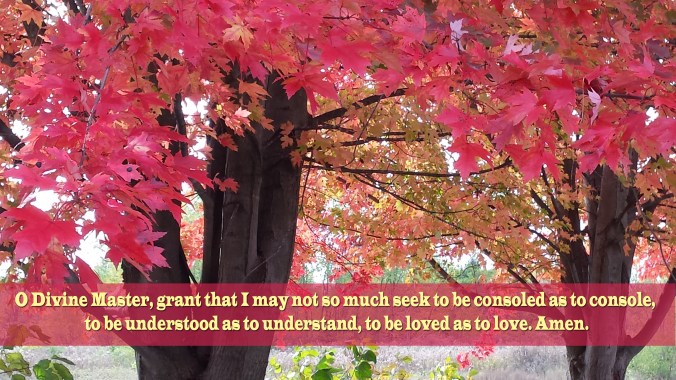
Prayer: O Divine Master, grant that I may not so much seek to be consoled as to console, to be understood as to understand, to be loved as to love. Amen.

Discussion: Are there topics you can’t discuss without insisting on your way?

Join the discussion! If you enjoyed this post, feel free to join an extended discussion as part of the C+C Facebook group or follow @comf_and_chall on Twitter. You’ll  have the opportunity to share your thoughts with some lovely people. Or feel free to comment here on WordPress, or even re-blog – the more the merrier!
Justice or Just Us?

1479529236564.jpg

Today’s readings (click below to open in new tab/window):
Psalms 88; 148, Malachi 3:1-12, James 5:7-12, Luke 18:1-8


Jesus told a parable about a widow who kept asking a judge for justice against her opponent. This judge neither feared God nor respected people. He refused her for a long time, but eventually relented so she would not wear him out with constant bother. Jesus said if such an unjust judge granted justice, God would surely be swift to grant justice to His children when they cried out to him.

Justice doesn’t always seem swift. Like the widow, we keep asking but it eludes us. Why would a God who acts swiftly make us wait? Danish philosopher and Christian theologian Søren Kierkegaard said “Prayer does not change God, but it changes him who prays.” When justice seems slow, perhaps it is because we are slow to change. If our prayer for justice remains unanswered, could it be time to examine what we’re asking for, why we’re asking, and whether we need to change to make it happen? Or maybe we are changing, but don’t feel it. We don’t know how many times the widow approached the judge, or what she said, but in her persistence she one day became the person he didn’t want to be bothered by again. Even if her demand never changed, what she represented did and that could only happen over time.

When Pope Francis said: “You pray for the hungry. Then you feed them. That’s how prayer works,” he was very much in line with Kierkegaard. If our only hope for justice is outside ourselves and our relationship with God, we will be forever disappointed. Despite what you’ve read on bumper stickers, Gandhi never actually said “Be the change you want to see in the world,” but it resonates with us because it is a universal truth. Justice begins on the inside. We can point fingers all day long, often with good reason, but ultimately that fixes nothing and persuades no one.

Prayer is what we say, but also what we do and how we live. If you feel like justice isn’t being served, maybe it’s waiting for you to whip up a batch.

Comfort: Prayer will change you if you let it.

Challenge: Be open to being changed.

Prayer: Lord, make me an instrument of your peace, and your justice. Amen.

Discussion: Have you ever realized you were the solution to a problem?

Join the discussion! If you enjoyed this post, feel free to join an extended discussion as part of the C+C Facebook group or follow @comf_and_chall on Twitter. You’ll  have the opportunity to share your thoughts with some lovely people. Or feel free to comment here on WordPress, or even re-blog – the more the merrier!

Kingdom Come

20150314_075230-01.jpeg

Today’s readings (click below to open in new tab/window):
Psalms 143; 147:12-20, Malachi 2:1-16, James 4:13-5:6, Luke 17:20-37


When it comes to the concept of “end times” Christians are all over the theological board, from people believing the Bible contains clues to the actual date, to believing it’s all a big metaphor, to countless subtle, overwrought positions between them. After two thousand years it’s hard to believe it’s just around the corner (as did many of his contemporaries), but Jesus talked about it too much to simply ignore it.

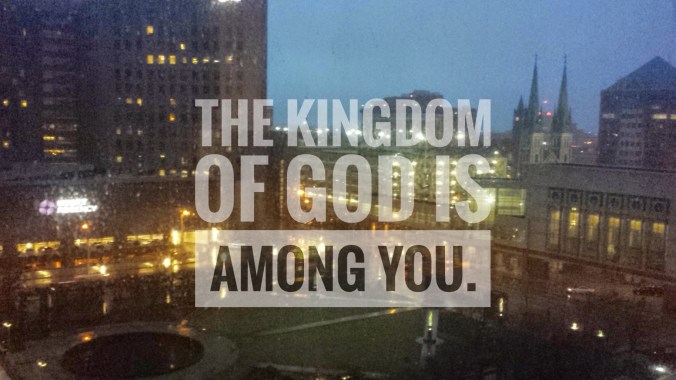
When the Pharisees asked Jesus when the kingdom of God was coming, he told them it was nothing that could be observed but “in fact, the kingdom of God is among you.” So which is it – now or later?

He shared examples of what it would be like. Two in a bed, and one taken. Two grinding meal, one taken, the other left behind. Ordinary things. Things we’re not likely to be doing if we think the world is ending. Things we do every day, right now, even as the world ends for so many people caught in war, famine, and disaster.

When the kingdom arrives for you, maybe you’ll be in bed and startle awake with a gasp that feels like the first complete breath you’ve ever taken, a breath full of sorrow and hope that connects you to all the other breaths of the Kingdom. The person sleeping next to you, and their shallow breaths, will wake next to someone who understands why we do good to our enemies, and how forgiveness saves the world, and wonder why you can no longer share the same hate. The kingdoms you wander could suddenly not be more different.

Perhaps the kingdom will come in the middle of your daily grind, when a remembered verse about lilies in the field blooms large, and your fears are cast out. A new perspective, a focus on what’s eternally important rather than what’s mundanely urgent, now separates you from co-workers who look at you like you’re from another planet. Your sudden inability to share their worries confirms their suspicions.

Thy kingdom come. Thy will be done. That is when earth is like heaven.

Comfort: The kingdom is right here.

Challenge: Pick a random page in the newspaper (or your regular online news source) and ask yourself how residents of the kingdom might see the stories differently.

Prayer: Thank you, merciful God, for inviting me into your realm. Amen.

Discussion: Do you feel like part of the present kingdom?

Join the discussion! If you enjoyed this post, feel free to join an extended discussion as part of the C+C Facebook group or follow @comf_and_chall on Twitter. You’ll  have the opportunity to share your thoughts with some lovely people. Or feel free to comment here on WordPress, or even re-blog – the more the merrier!
Jesus and Abraham

20161116_180641-01.jpeg

Today’s readings (click below to open in new tab/window):
Psalms 65; 147:1-11, Malachi 1:1, 6-14, James 3:13-4:12, Luke 17:11-19


James wrote:

You want something and do not have it; so you commit murder. And you covet something and cannot obtain it; so you engage in disputes and conflicts. You do not have, because you do not ask. You ask and do not receive, because you ask wrongly, in order to spend what you get on your pleasures.

Few of us resort to murder, but unhealthy cravings drive us to acquire more than we need, and part with less than we should. When we lack necessities – food, water, safety – we may resort to emotional, political, or physical violence. If we have the basics, James advises to ask not for objects of personal enrichment, but things we can use toward the betterment of the Kingdom. It’s a win-win when we learn to crave things we can use to serve those in need.

Abraham Maslow’s “hierarchy of needs” –illustrated as a stratified pyramid – describes motivations for behavior and growth. According to Maslow, we must satisfy lower needs before we can aspire to higher ones. The lowest Physiological level includes food, water, etc. The next highest is Safety. The middle one is Love/belonging. Esteem and Self-actualization top the pyramid. The higher the level, the fewer people achieve it.

If we expect a need will never be met, we may be spiritually stunted. In a village between Samaria and Galilee, Jesus encountered ten people with leprosy, a lifelong sentence of rejection. Forbidden from drawing near, they called to Jesus from a distance: “Have mercy on us.” He told them to show themselves to the priests. On the way all were healed. Only one, a Samaritan man, returned to thank Jesus. Not only had Jesus restored this man’s health, he restored the possibility of love, belonging, and all that might follow.

That sense of love and belonging is the bridge between our base needs and our higher selves. Sometimes we need to offer someone ordinary bread from our own table before they can cross over to Christ’s table for the bread of life. If you’re not sure which to share when, ask God for both.

Comfort: Your needs are important to God.

Challenge: You may need to learn to distinguish needs from cravings.

Prayer: God of abundance, I ask only for what will equip me to serve you. Amen.

Discussion: What is something you really wanted but didn’t get? How did you handle it?

Join the discussion! If you enjoyed this post, feel free to join an extended discussion as part of the C+C Facebook group or follow @comf_and_chall on Twitter. You’ll  have the opportunity to share your thoughts with some lovely people. Or feel free to comment here on WordPress, or even re-blog – the more the merrier!

First, do no harm.

1479243135156-01.jpeg

Today’s readings (click below to open in new tab/window):
Psalms 54; 146, Habakkuk 3:1-10 (11-15) 16-18, James 3:1-12, Luke 17:1-10


Primum non nocere – Latin for “first do no harm” – is a widely accepted principle of the medical community. It may seem obvious that the art of healing would be opposed to harm, but medicine is less cut-and-dried than we’d like. Physicians need a healthy ego. Especially in life-threatening situations, hesitation and self-doubt can have serious consequences for the patient. Yet decisive action needs to be tempered by humility, for the wrong treatment may make things worse and our intentions can’t prevent that.

James advised early Christians against becoming teachers, because teachers are held to higher standards of judgment and we all make plenty of mistakes. He explained many mistakes involve the tongue (our words) and the damage caused by its improper use. In matters of faith, it takes a certain amount of ego to claim to be a teacher, and even more humility to be a good one. Without the right balance, teachers can do more harm than good to a faith community. There’s a difference between sharing and discussing our faith, and establishing ourselves as authorities. Much caution is advised for the latter.

Acknowledging there are countless opportunities to make mistakes, Jesus warned his disciples: “It would be better for you if a millstone were hung around your neck and you were thrown into the sea than for you to cause one of these little ones to stumble.” How do we cause people to stumble? Well, the next thing he talked about was forgiving people who sin against us (note he didn’t mention forgiving those who sin against others, because neither the offense nor the forgiveness are ours). If they offend us seven times a day, we are to forgive them each time they repent. Think of it as a physician who tells her patient at every annual checkup to eat less and exercise more; the patient is contrite and promises to do better, and though it never happens, the physician retains the patient.

What is the connection between forgiveness and stumbling? That may be for a teacher to reveal. Until you find one, try to do no harm.

Comfort: Repentance is not a one-time offer.

Challenge: Find some spiritual exercises to build your forgiveness muscles.

Prayer: Loving and merciful God, grant me the strength, humility, and wisdom to share your love with others even when I don’t want to. Amen.

Discussion: Who do you have trouble forgiving? What impact does that have on your spiritual and emotional well-being?

Join the discussion! If you enjoyed this post, feel free to join an extended discussion as part of the C+C Facebook group or follow @comf_and_chall on Twitter. You’ll  have the opportunity to share your thoughts with some lovely people. Or feel free to comment here on WordPress, or even re-blog – the more the merrier!
K.I.S.S. (Keep It Simple, Saints)

1479180862780-01.jpeg

Today’s readings (click below to open in new tab/window):
Psalms 57; 145, Habakkuk 2:1-4, 9-20, James 2:14-26, Luke 16:19-31


“Simplicity is the glory of expression.”
– Walt Whitman

Habakkuk was a prophet who demanded an accounting for the oppression of the Jewish people in Babylonian exile. He asked where God was in the midst of His people’s suffering. God answered in the vivid and poetic language of a vision for justice.

The Lord tells the author of Habakkuk: “Write the vision; make it plain on tablets, so that a runner may read it.” The runner is likely a messenger who would have been carrying stone tablets to share with others, and God wants them to be plain enough to be read while running. The message would have to be relatively short, or the tablets would be too numerous and heavy to carry, let alone run with. The print would probably have to be large; anything too small would be impossible to focus on. Though Habakkuk itself is only three chapters and thirty-nine verses long, the content of the tablets would have been shorter and simpler still.

It’s easy to over-complicate the vision God has for us. Christ summed it up simply and beautifully when he said:

“‘You shall love the Lord your God with all your heart, and with all your soul, and with all your mind.’ This is the greatest and first commandment. And a second is like it: ‘You shall love your neighbor as yourself.’ On these two commandments hang all the law and the prophets.”

That’s a message we can run with.

So why do we often feel the need to burden ourselves with the weight of theology and doctrine, and struggle so hard to balance and carry it that rather than run we plod – or stand still? Even standing still, the message is in language so cramped and difficult for passers-by to interpret that most squint and go on their way with no idea what we’re about.

Faith is not simplistic, but it should be simple. Sharing it should be easy. As our life in the Spirit matures, the less we need to know about it, and the more we are able to live it.

Comfort: Theology is fine, but faith is better.

Challenge: Pick one way to simplify your life, and do it before the end of the month.

Prayer: God of all creation, I humbly offer my simple faith. Amen.

Discussion: In what ways do you or have you unnecessarily complicated your beliefs?

Join the discussion! If you enjoyed this post, feel free to join an extended discussion as part of the C+C Facebook group or follow @comf_and_chall on Twitter. You’ll  have the opportunity to share your thoughts with some lovely people. Or feel free to comment here on WordPress, or even re-blog – the more the merrier!

Citizenship in Heaven

1479093315279-01.jpeg

Today’s readings (click below to open in new tab/window):
Psalms 67; 150, Habakkuk 1:1-4 (5-11) 12-2:1, Philippians 3:13-4:1, Matthew 23:13-24


Have you ever heard someone described as a “citizen of the world?” Such people are usually considered well-traveled, sophisticated, and fluent in diverse cultures. We perceive them as feeling at home in almost any setting. Though we may sense in them a bit of restlessness, we generally admire their ease and poise.

In Paul’s letter to the Philippians, he claims their citizenship is in heaven. What does it mean to be a citizen of a place you can’t physically visit? First, we must recognize that in Paul’s Roman Empire, where slaves outnumbered citizens, the term “citizen” carried significant meaning. When Paul told people – regardless of legal class – they were citizens of heaven, he was telling them they had full rights and protections bestowed by God. Today’s strife over illegal immigration gives us only a small taste of the feelings that must have arisen – in citizens and non-citizens alike – when Paul announced all people were on equal footing under God.

What are the implications of our heavenly citizenship? Certainly it should add an element of critique to any form of nationalism; the borders of heaven are limitless, after all. How will we conduct ourselves in non-native lands, among people of different or no belief? How can we avoid becoming the Christian equivalent of the “ugly American” who treats other cultures with (one hopes) unintentional disrespect? In many physical countries, we might rely on an ambassador or embassy to coach us in diplomacy and respect. Fortunately, we have Christ as our ambassador. His example of moving among all peoples with a strength born of peace and love is our example.

One last component of citizenship is responsibility. While citizens of the world have a responsibility to comply with local laws and customs, citizens of heaven are responsible to act justly, love mercy and walk humbly (Micah 6:8), even when doing so conflicts with expectations. Simultaneously loving and confounding is quite the balancing act. We can expect that not everyone will admire or even like us. We may even be outright rejected. But our true home and Lord will never abandon us.

Comfort: No one can revoke the citizenship God grants us.

Challenge: Try composing a Christian “Bill of Rights.”

Prayer: God of the journey, thank you for my rights and responsibilities.. Amen.

Discussion: What conflicts exist between your national and divine citizenships?

Join the discussion! If you enjoyed this post, feel free to join an extended discussion as part of the C+C Facebook group or follow @comf_and_chall on Twitter. You’ll  have the opportunity to share your thoughts with some lovely people. Or feel free to comment here on WordPress, or even re-blog – the more the merrier!