

My grandparents were generous people. They didn’t have a lot, especially when they were a younger couple, but any family members or friends present at meal-time were fed. Actually it didn’t have to be meal-time: if you showed up, they offered you food. Somehow Grandma could transform half a pound of ground beef and a can of tomatoes into a meal for a dozen people gathered in their tiny four-room house.
The village where they lived had a nearby rail yard, so it was not infrequent for hobos to drop by asking for food. Today “hobo”can have an offensive connotation, but in the first half of the 20th century hobo culture thrived. Grampa would tell me stories about how Grandma cooked up breakfast for them, and shared stories and conversation.
Because hobos were a community, they liked to help each other out. Often they would draw discreet symbols on fenceposts or the like to let each other know what they could expect from the owners of the home. One of the earliest symbols was a plus sign or cross (+). This indicated the people in the home were friendly and would be willing to feed you. Over the years these symbols evolved. The cross eventually came to mean: “these people will feed you, but you’ll have to listen to some bible-thumping first … and they might not get to the feeding.” Another sign like a small table (∏) gradually replaced the cross as a symbol for a generous home.
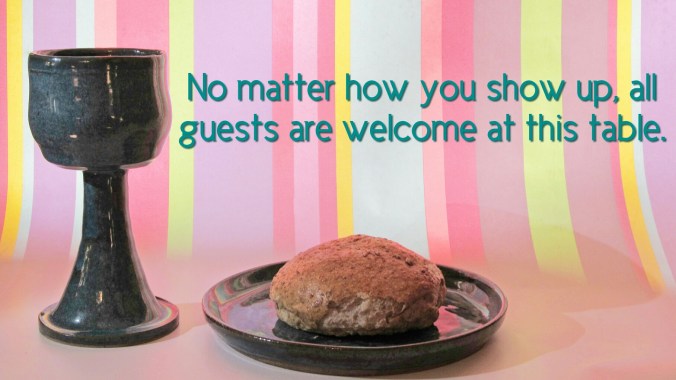
I was almost forty years old when I first heard the term “table theology.” It describes a type of worship that doesn’t focus as much on the crucifixion of Christ as his efforts to bring us together in loving community. Table theology doesn’t exclude the importance of crucifixion – the communion meal at the center of the table symbolizes Christ’s death! – but it promotes his message we are to love one another.
In secular society, the symbol of the cross has similarly evolved. Polls consistently show non-Christians no longer associate the faith and its most famous symbol with radical love and self-sacrifice, but with judgment and exclusion. Sadly that’s often true. Some churches are more concerned with who can’t come to the table (or enter the door, or lead the choir, or preach the sermon) than they are with sharing Christ’s unconditional love. James 2:16 tell us: “If one of you says to them, ‘Go in peace; keep warm and well fed,’ but does nothing about their physical needs, what good is it?” Being welcome to the table is not a reward, because none of us perfectly deserves it; welcome is a default position because we are all wandering children of God who are hungry, even when we don’t know what for. Sharing this sacred meal opens an ongoing, sacred conversation among a person, a community, and our God. Come in from the cold. Have your fill of the Bread of Life. Tell your friends.
May the peace of our Lord Jesus Christ be with you.
After a post about suffering and celebration, I really wanted to re-visit one of my all-time favorite interpretations of a classic piece. If you want to see some 90’s fashions, or really young versions of Lauryn Hill and Jennifer Love Hewitt, or just a truly joyful celebration of the Lord, this is for you!
After that picture, I just needed to hear the song. Peace!

A couple years ago, this little gray striped cat started hanging out on our back porch. If you sat on the steps, she would lie next to you and scoot closer until you petted her. She was pretty and friendly and maybe most importantly she didn’t trigger any of the allergies that prevented us from keeping a cat in the house.
One afternoon she was purring with a little more urgency than usual and looking into the kitchen. Both of us had Italian grandmothers, so naturally we fed her. We emptied a can of tuna into a bowl and set it out. She wolfed it down. After that, Miss Susan Moochie (yep that’s what we call her) was a daily visitor. We started buying tuna and cat food to be ready for her visits. We even rotated brands and flavors when she seemed to lose interest.
After a while, a couple other cats started showing up. These two were a little more wild and had no interest in meeting us. One was white with gray markings. We called it The Nemesis. The other was almost all black and we just called it The Other One. Together they were… The Interlopers. Miss Susan Moochie didn’t like to eat when The Interlopers were around. We didn’t want them around harassing our Miss Susan, so we’d shoo them away. As soon as she was done eating we brought her leftovers into the house.
Little by little, Miss Susan started skipping a day here or there, or leaving more than half the food untouched. The Interlopers were persistent, and seemed hungry. When the weather started to turn cold, we felt a little bad for them, and stopped taking in the leftovers. The Nemesis and The Other One consistently finished off whatever was in the bowl. Gradually, Miss Susan weaned herself off our company and generosity. We can only assume it was because she didn’t care for the continuing presence of The Interlopers.
Now we feed the Interlopers when they show up. The Nemesis will let me pet it once in a while, but never for long. The Other One has never even been close enough to bite the hand that feeds it. They aren’t the cats we wanted, but they are faithful and in need. Probably they are faithful because they are in need.
I don’t particularly like The Interlopers, but that felt like a pretty darn hypocritical reason not to feed them. After all, in Matthew and Luke Jesus says: “If you love those who love you, what credit is that to you? Even sinners love those who love them.” That got me thinking about people and church and communities. We are sad when the “right” people move on because the “wrong” people — usually people who have less than we do or are unfamiliar to us — have invaded our church, or neighborhood, or country.
We are called to love the people who do not love us. Christ invites everyone to the table, and we’re not going to love them all. Some people may harass us and others may not speak to us. Some may seem like they’re only showing up to take and not to give. We don’t get to pick and choose who Christ feeds. Jesus is the host and whether we showed up to the party first or last, dressed to the nines or looking like we don’t care, we are his guests and arrive on equal terms. We are all interlopers to someone. How fortunate for us Jesus is the one with the can opener.
The Peace of Christ be with you.
Today’s readings: Psalms 46 or 47; 149, Isaiah 45:14-19, Colossians 1:24-2:7, John 8:12-19

Judgment: to some degree, we’re all guilty of of it. At our best we can take a mental step back and move beyond it. At our less-than-best, we’re capable of doling out some pretty shabby treatment. Why do we judge? Sometimes it’s out of fear. Other times it’s because we see traits reflected in others that we don’t like in ourselves. Once in a while it’s because we need to believe someone did something wrong — usually defining “wrong” as something we haven’t done or been caught doing — that caused their illness, death, poverty, unemployment, public shame, prison sentence, or other problem. After all, the unacceptable alternative would be to admit that under the same circumstances we might have the same outcome, rather than convince ourselves we are saved by our virtue. Continue reading
Today’s readings: Psalms 46 or 97; 147:12-20, Deuteronomy 8:1-3, Colossians 1:1-14, John 6:30-33, 48-51

When we talk about peer pressure, we are usually talking about school age children. We worry their friends will pressure them into drugs, alcohol, sex, or smoking. We offer them overly-simplistic methods of dealing with peer pressure, such as “Just say no.” We repeat advice we heard from our parents (“If your friend jumped off a bridge …”) even though it had little if any effect on us in our own young lives. Peer pressure concerns us not only because so much of it happens beyond our sphere of influence, but also because in our hearts we know it is something we never escape. Continue reading
Today’s readings: Psalms 46 or 97; 147:12-20, Deuteronomy 8:1-3, Colossians 1:1-14, John 6:30-33, 48-51

Bread gets a bad rap. The carbs, preservatives, bleached flours, and chemicals it contains fill our media and magazines with articles about how they are slowly killing us. We see it on a restaurant table and know it’s there to fill us up before the real food arrives. Baking it ourselves is better, but in most homes that is a rare and indulgent occasion. If Jesus called himself the “bread of life” in the United States today, some disciple would try to substitute a lettuce wrap Continue reading
 Comfort & Challenge