Body(building) of Christ

off the couch

Today’s readings (click below to open in new tab/window):
Psalms 99; 147:1-11, Isaiah 4:2-6, Ephesians 4:1-16, Matthew 8:28-34


One of Paul’s favorite descriptions of the Church is a body with Christ at its head. In his letter to the Ephesians, he explains how all the gifts of the community work together, just as all the parts of the body work together. He also says the Body of Christ needs to grow into maturity and unity. This growth requires exercise.

Why do we exercise our bodies? Is it just to look good, or is it to keep ourselves fit to accomplish more important tasks? Smart bodybuilders never sacrifice fitness for appearance. Lazy bodybuilders – and churches – do. It’s nice to show off our muscles – be they big biceps or beautiful buildings – but we should never prize them above the overall health of the body. Like healthy bodybuilders, healthy churches achieve results through hard work and good choices; shortcuts result in unsustainable outcomes and dangerous consequences. A body that serves no purpose but to promote itself is not a healthy one.

Bodybuilders are acutely aware of proper proportion. It is easy to focus efforts on areas that respond quickly, don’t tire us, or attract attention. Doing so exclusively, however, leaves key areas neglected. The boring parts are just as important. A church can have a dynamic and popular worship experience, but if it sucks away the energy that could go into mission, the body is out of balance. For bodybuilders such imbalance doesn’t just lose them tournaments, it increases their risk of injury. If the efforts of our Christian body are imbalanced, in the long run we hurt ourselves.

Prevention is the best way to manage injury and illness, but even the most diligent of us may get sick. When that happens, the worst thing to do is ignore it. Far too many people avoid the doctor because of embarrassment or fear. The body of Christ has the same tendencies. We often choose to protect our reputation rather than admit to real problems. Such behavior can be fatal. But it doesn’t have to be. Let’s be sure to take care of the Body in all the right ways!

Comfort: Flex the spiritual muscle you’ve been given – it’s important to the health of the body!

Challenge: Sometimes we think the things that are important to us need to be important to everyone. Try to understand what other people bring to the table that you can’t.What gifts might you undervalue or belittle?

Prayer: God of all good gifts, teach me to make choices to promote the health of the Body. Amen.

Discussion: What gifts – whether yours or someone else’s – might you undervalue or belittle?

Join the discussion! If you enjoyed this post, feel free to join an extended discussion as part of the C+C Facebook group. You’ll be notified of new posts through FB, and have the opportunity to share your thoughts with some lovely people.
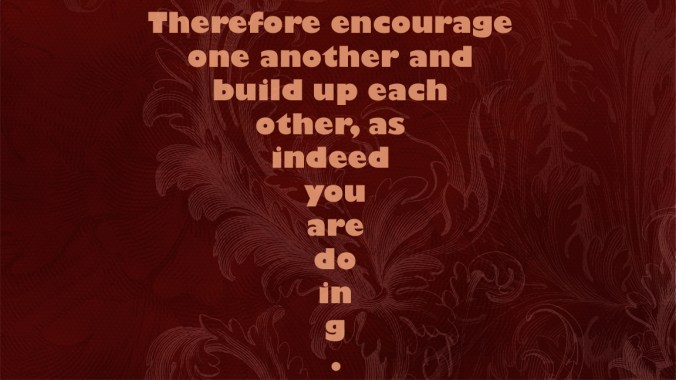
Balancing Act

buildeachotherup.jpg

Today’s readings (click below to open in new tab/window):
Psalms 98; 146, Leviticus 16:20-34, 1 Thessalonians 5:1-11, Matthew 6:7-15


Paul told the Thessalonians the Day of the Lord would arrive like a thief in the night or the pains of labor. Those living in darkness – that is, without the light of Christ – would be caught unawares in a false sense of security and suffer the consequences. Those living in the light would be prepared and rejoice. But how exactly is one to prepare? First century Christians expected Jesus to return any moment, and abandoned many earthly pursuits. As a couple thousand years passed, it became more apparent Christ’s return would be less … immediate.

Every century – maybe every decade – had its share of “prophets” declaring the end was nigh. So far they are batting triple zero. Even today some Christians believe Jesus is returning so soon it may be foolish to buy groceries a week in advance. Most of us are a little more skeptical. Should we be?

Living in anticipation of the Day of the Lord is a balancing act. On the one hand, experience says we probably have a way to go, and should steward our resources wisely. On the other hand, any one of us could meet Jesus tomorrow, if only individually. Does anyone want to have to explain why that never-touched rainy day fund was a better use of our money than charity would have been?

Perhaps that tension is useful. When we lose that sense of immediacy, it’s easy to slip into a comfortable routine which resembles resignation more than anticipation. If we’re so zealous that we focus only on “the end times,” we lose sight of doing the things Christ asked us to do – feed the hungry, visit the sick, etc. A while back there was a popular humorous but pointed bumper sticker: “Jesus is coming. Try to look busy.” Are we merely busy, or are we about the business of discipleship? If Jesus shows up today, would you be happy with where he finds you? If we live today as through Christ could show up tomorrow, and he doesn’t … let’s try not to be too disappointed we’ve made the world a little better.

Comfort: Whether Jesus returns tomorrow or in a thousand years, the Kingdom of God is at hand.

Challenge: Set aside some time to contemplate or discuss the balance between faith and works in world waiting for Christ’s return.

Prayer: Eternal God, thank you for the promise of the future, and the opportunity of the present. Amen.

Discussion: Where can you strike a better balance between what is practical and what is faithful?

Join the discussion! If you enjoyed this post, feel free to join an extended discussion as part of the C+C Facebook group. You’ll be notified of new posts through FB, and have the opportunity to share your thoughts with some lovely people.

A Level Place

20160930_155340-01.jpeg

Today’s readings (click below to open in new tab/window):
Psalms 84; 148, Hosea 4:11-19, Acts 21:37-22:16, Luke 6:12-26


Do you consider yourself comfortable or afflicted? Luke 6:17 begins a passage sometimes called the Sermon on the Plain. It parallels many of the themes of the better known and more comprehensive Sermon on the Mount found in Matthew. This sermon contains a list of blessings and woes that sound very much like the Beatitudes. They describe a reversal of fortune in which the afflicted will be comforted, and the comfortable will be afflicted. These ideas are equally unsettling to us as to Jesus’s original audience.

When we hear “Woe to you who are full now, for you will be hungry,” does it mean we should go hungry? Is the Realm of God a world in which all people hunger? What if we are the hungry, and through the grace of God we become full? Into which camp – the blessed hungry or the cursed full – do we then belong?

A simple answer might be: if we are full (or rich, or laughing, or popular) at the expense of others, woe to us. Perhaps we should never be completely certain which camp we are in. We would be foolish and ungrateful to reject gifts like a good meal or a sheltering roof. After all, Jesus encourages us to provide these things to the poor. However, we would be equally (if not more) foolish to believe such gifts mark us as specially favored by God. The type of blessing Jesus speaks of in this passage is a state of right relationship with God. When we become complacent or take this relationship for granted, the relationship will suffer. Too much certainty our poverty is a sign of God’s favor is no better than a belief that material comfort is evidence of the same thing. This tension in the relationship helps us actively evaluate and fine-tune it throughout our lives.

Unwavering certainty in our own state of righteousness – or sinfulness – closes us off from the transformational grace of Christ in our lives, and in the lives of others. The gift of uncertainty keeps us humble seekers, always ready to discover Christ in new ways.

Comfort: The less we think we know, the better we can know God.

Challenge: Create side-by-side lists of the ways you think are rich and the ways you think you are poor. Do these line up with the Sermon on the Plain?

Prayer: Glorious Creator, thank you for a relationship that always grows. Amen.

Discussion: What is the difference between feeling guilty about the state of the world, and feeling responsible for it?

Join the discussion! If you enjoyed this post, feel free to join an extended discussion as part of the C+C Facebook group or follow @comf_and_chall on Twitter. You’ll  have the opportunity to share your thoughts with some lovely people. Or feel free to comment here on WordPress, or even re-blog – the more the merrier!