The One and the Ninety-Nine

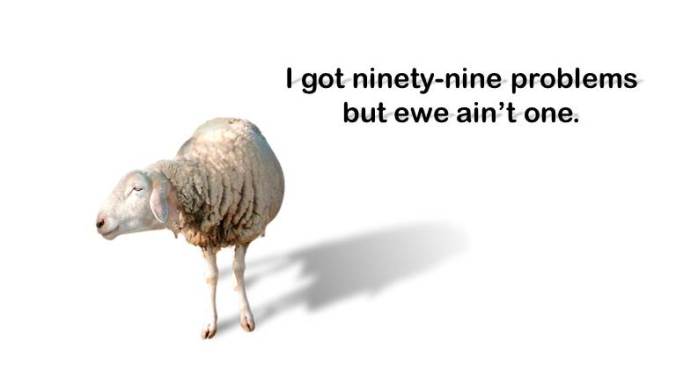
ewe aint one

Today’s readings (click below to open in new tab/window):
Psalms 97; 147:12-20, Numbers 12:1-16, Romans 2:12-24, Matthew 18:10-20Psalms 97; 147:12-20, Numbers 12:1-16, Romans 2:12-24, Matthew 18:10-20


“The needs of the many outweigh the needs of the few. Or the one.”
– Mr. Spock, Star Trek II: The Wrath of Khan

“The needs of the one … outweighed the needs of the many.”
– Captain Kirk, Star Trek III: The Search for Spock

Humankind has always struggled to balance individual need against the need of the greater community. The modern tool of choice is economic system: capitalism, socialism, communism, etc. Lying along a continuum from individualism to collectivism, these models have achieved various levels of success – if measured economically. Measured spiritually, all fall short because they are not ends, but means. How do we approach this struggle of knowing what and when to sacrifice?

Sacrificial living does not necessarily lead to a literal cross. In the parable of the lost sheep, the shepherd leaves behind ninety-nine sheep to find one. Fine if you’re the one, but most of us are among the ninety-nine left on the mountain. Do we grumble about being temporarily inconvenienced and blame the one’s misfortune on its own failure to keep up? Are we willing to sacrifice a little convenience so the one may survive? Often our answer depends on whether we’ve chosen freely or been coerced … but the shepherd doesn’t bother to survey the sheep.

Sacrifice is valued mostly via lip service. We “sacrifice” trips to the movies or our usual pricy selection at Starbucks to keep our debt down or to save for our children’s college. Rarely outside the military are we asked to make true sacrifices in the sacred sense of giving without expecting anything in return. Or maybe the opportunities are abundant but we value merit over mercy. Does the shepherd seem concerned with whether he is giving the lost sheep “a hand up or a handout?” Are we prepared to make the real sacrifices necessary to save the lost in our society? Because in the end, the hands up demand more personal cost in time, money and comfort than do the handouts.

When it’s our turn to be the one sheep, how will we want the ninety-nine to respond? That’s what we should be prepared to sacrifice.

Comfort: No matter how lost you feel, Christ is searching for you.

Challenge: Remember that lost sheep started out part of the flock. They are family, so their burdens are our burdens.

Prayer: Merciful God, I trust you to find me when I am lost. Amen.

Discussion: When you’ve felt lost, how did you know God had found you again?

Join the discussion! If you enjoyed this post, feel free to join an extended discussion as part of the C+C Facebook group. You’ll be notified of new posts through FB, and have the opportunity to share your thoughts with some lovely people.

Why Thee?

countdays

Today’s readings (click below to open in new tab/window):
Psalms 63; 149, Numbers 3:1-13, Galatians 6:11-18, Matthew 17:1-13
Evening Psalms 125; 90


Psalm 90 – the only psalm attributed to Moses – is written from the perspective of someone trying to make sense of it all at the end of a long life. The psalmist doesn’t sugar coat life’s difficulties. He prays the good days might at least outnumber the bad, and acknowledges that the lucky get 80 years of toil and trouble. Yet he prays for God’s work and its meaning to be manifest in the community.

The wise do not wait until the end of their lives to contemplate the meaning of work and suffering, nor do they wait until suffering is upon them. It’s tempting to keep the suffering of others at a certain emotional distance because identifying with it too closely forces us to admit it could happen to us. Distance feels safe, but leaves us ill prepared when God does not exempt us from disease, infidelity, loss, or other tragedy. Suddenly what we saw as part of God’s plan for another person becomes a crisis of faith in our own lives.

If we spend time now asking “Why them?” and “How would you have me respond?” we are less likely to be spiritually devastated when it’s inevitably time to ask “Why me?”

The psalmist doesn’t offer concrete answers to his questions, but the context gives us some clues about where those answers may lie. The questions are universal, and he asks them not about anyone in particular, but about the community. The work is not the work of any one person, but of the community. The meaning of the work transcends any single life or generation. Despite all Moses did to lead the Israelites, he never set foot in the promised land. Any satisfaction Moses gained from his efforts came from the knowledge he had played his role in the greater plan.

When it’s our turn to suffer – and we’ll all have our turn – the question “Why me?” overwhelms us if we can’t see ourselves as but one part of the whole of creation. If we’ve lived a self-centered life divorced from the story of the community, meaning will be difficult to find. Like words chosen by a skillful poet, each of us is complete, important, and beloved by God, but part of a greater work.

Comfort: You are an important piece of your community, supported by and supporting all the other pieces.

Challenge: See above.

Prayer: Loving God, grant me the patience and wisdom to encounter suffering with a heart of mercy and solidarity. Amen.

Discussion: What types of suffering do you identify with? What types do you find difficult to deal with?

Join the discussion! If you enjoyed this post, feel free to join an extended discussion as part of the C+C Facebook group. You’ll be notified of new posts through FB, and have the opportunity to share your thoughts with some lovely people.

Feedback Loop

bear burdens

Today’s readings (click below to open in new tab/window):
Psalms 84; 148, Ecclesiastes 11:9-12:14, Galatians 5:25-6:10, Matthew 16:21-28


A few days ago we considered how we might be receptive to criticism. Today let’s flip that script and think about how we can most constructively give feedback.

In his letter to the Galatians, Paul wrote: “[I]f anyone is detected in a transgression, you who have received the Spirit should restore such a one in a spirit of gentleness.” He also said we are called to bear each other’s burdens. As a culture we seem to have grown increasingly comfortable with providing immediate feedback via social media, comment boards, and even in person to strangers. Unfortunately, we are less adept at the “gentleness” part. Name calling, snap judgments, and attention-grabbing vitriol fill our internet, television screens, newspaper pages, and radio waves.

These types of reactions aren’t really about the other person; they are about satisfying our own sense of righteousness.

There are times when firm reactions are called for. When Peter tried to discourage Christ from his journey to the cross, Jesus responded with: “Get behind me, Satan! You are a stumbling block to me; for you are setting your mind not on divine things but on human things.” This may sound harsh, but he spoke with unmistakable intent because what Peter was tempting him to do was unmistakably in error.  He explained what needed to happen in order to reconcile his disciples to the necessary future.

A single incident or flaw almost never defines a person. Peter was still Jesus’s rock. We need to remember that so we don’t seek mercy for ourselves but punishment for others. Bearing each other’s burden includes making an effort at reconciliation. Character assassination is not part of that process. Can we imagine Jesus launching a Facebook dogpile designed to publicly humiliate Peter? Naming hurtful behaviors is necessary, creating more of them is not part of the reconciliation formula. That may not seem “fair” by worldly standards, but Jesus teaches forgiveness and self-sacrifice, not retaliation.

If we aren’t in a position to offer restoration, we aren’t in a position to offer rebuke. Perhaps we can better use that time pulling the logs from our own eyes.

Comfort: Compassion and rebuke can coexist.

Challenge: If you have social media accounts, try not expressing negative opinions for a week.

Prayer: God of restoration, help me bear the burdens of my community with the help of your Spirit. Amen.

Discussion: When have your received or offered constructive criticism?

Join the discussion! If you enjoyed this post, feel free to join an extended discussion as part of the C+C Facebook group. You’ll be notified of new posts through FB, and have the opportunity to share your thoughts with some lovely people.

Run, Don’t Walk!

run fast

Today’s readings (click below to open in new tab/window):
Psalm 63:1-8 (9-11), 98; Ecclesiastes 1:1-11; Acts 8:26-40; Luke 11:1-13


The Acts of The Apostles, chronicling the formation and earliest days of the church, tells a story of an ever-widening circle of inclusion.

Philip the Evangelist was one of seven people selected by the Apostles to care for poor Christians in Jerusalem. One day, Acts tells us, an angel instructed Philip to go to a certain place. In that place was a eunuch who served as a court official to Kandake, queen of Ethiopia. The Spirit urged Philip to run to the chariot where the eunuch was reading aloud a passage from Isaiah. Philip offered to explain the passage, and the eunuch gratefully accepted. After Philip used this scripture to share the good news of Jesus, the eunuch was eager to be baptized. When they saw some water, the eunuch stopped the chariot, then Philip baptized him and went on his way leaving a joyous convert behind.

Because of their modified genitals, eunuchs were considered impure under the Levitical code and therefore not allowed full participation in the life of the temple. They could wait in the outer courtyard with women and non-Jews, could but not go in with the other men. Baptism, by contrast, signified full participation in the body of Christ. This man was a Gentile, an African, and a member of an “impure” sexual minority, yet because of Christ, Philip eagerly welcomed him. Before you say, “well of course,” remember we still draw lines in the sand over Biblical interpretation. This type of inclusion was – and still is – radical.

Who are today’s eunuchs? Certainly there are parallels with the exclusion of the LGBT community, and churches continue to be some of the most racially segregated institutions in America. In most places, bilingual church services – including sign language – are a rarity. The list of human-made division goes on. Our exclusion may be less explicit, but our implicit lack of inclusion speaks volumes. Where are the Philips running to greet them? When we do encounter them, do we brand these present-day Philips as evangelists or heretics?

Did Jesus ever condemn anyone for being too inclusive? Rather than ignore our modern eunuchs, let’s run to them with the good news. The worst that can happen? Someone hears it.

Comfort: We’re all outsiders to someone. We’re all insiders to Christ.

Challenge: Start a discussion within your faith community about who you are intentionally or unintentionally excluding, and brainstorm ways to be more inclusive.

Prayer: God of love and abundance, teach me to see Christ in all your children.

Discussion: Who do you have trouble accepting into the body of Christ?

Join the discussion! If you enjoyed this post, feel free to join an extended discussion as part of the C+C Facebook group. You’ll be notified of new posts through FB, and have the opportunity to share your thoughts with some lovely people.

Mustard Seeds

weedlove

Today’s readings (click below to open in new tab/window):
Psalms 130; 148, Proverbs 23:19-21, 29—24:2, 1 Timothy 5:17-22 (23-25), Matthew 13:31-35


Have you ever heard someone say they love gardening because it brings them closer to nature? This is somewhat ironic, because manicured lawns and gardens are anything but natural. Nature is not tidy rows bent to human will; it is rambling and untamed. Gardeners fight nature with fertilizer, pesticides, and herbicides to make sure desirable plants  thrive in an orderly fashion, and the plants they don’t value are removed or destroyed. Left to her own devices, nature would overrun most gardens and lawns with a beautiful and diverse ecosystem we call “weeds.”

When Jesus told the parable of the mustard seed – the tiny seed which grows into a great shrub to shelter birds – he wasn’t talking about mustard as a cultivated crop. In his culture, mustard was often a highly invasive plant species which was difficult to remove once it infested a field. Essentially, he was comparing his followers to a persistent nuisance – to weeds.

The Kingdom is all about the humble persistence of small acts of faith. As much as the world tries to insist its structures are the right way to do things, followers of Christ appear and reappear like weeds to defy its exclusionary boundaries. And try as we Christians might to impose order and uniformity through religion, visionaries and prophets spring up among us to remind us God’s vision can’t be contained within ours. In the parable of the mustard seed, it is the nuisance shrub which becomes a great sheltering tree for those needing a safe place to roost. Does that sound like the church today? Or are we busy balancing the soil pH for roses because dandelions are too common and don’t look as pretty?

Gardens aren’t bad. Genesis tells us humankind began in a garden. They can be beautiful, functional, and therapeutic. They can also be expensive, time-consuming, and exhausting. A worship service is like a garden – carefully selected blooms of song, prayer, and scripture to inspire and nourish us. But we can’t spend our entire lives inside church. The Kingdom grows in the wilderness, a sprawling tree for all who seek God’s shelter.

Comfort: Your life doesn’t have to be pretty to grow in the Kingdom.

Challenge: Regularly examine your expectations about church and faith, and ask yourself how God has defied them.

Prayer: God of the garden and the wilderness, I will worship you and spread your love in all places. Amen.

Discussion: What scares you about wandering in the (actual or metaphorical) wilderness?

Join the discussion! If you enjoyed this post, feel free to join an extended discussion as part of the C+C Facebook group. You’ll be notified of new posts through FB, and have the opportunity to share your thoughts with some lovely people.

Spiritual Mentors

neglectgift

Today’s readings (click below to open in new tab/window):
Psalms 36; 147:12-20, Proverbs 21:30—22:6, 1 Timothy 4:1-16, Matthew 13:24-30


Have you ever had a mentor – a person who is purposeful about guiding your development? Mentors come in different flavors. Many businesses offer mentoring programs because it helps them promote and retain good talent, as well as foster a sense of the importance of passing along knowledge and experience. Social programs for youth, such as Big Sisters or Big Brothers, offer mentor programs to young people who lack positive adult role models. Some mentors, particularly those in artistic communities, may act in a less official capacity but still impart wisdom and raise the bar for young performers and artists through collaborative efforts.

Good mentors don’t try to create younger versions of themselves, or have preconceived notions of who you should be. They coach and guide you to explore the best path for you, provide honest feedback, and get you to hold yourself accountable for your progress. They do more listening than speaking.

Have you ever had a spiritual mentor? Paul filled this role for his young protege Timothy. He offered Timothy advice and encouragement. Perhaps more importantly he trusted him to act independently, and treated mistakes as opportunities for learning rather than reasons for punishment. Our record of their relationship is through Paul’s surviving letters, which of course reveal only one side of the conversation. If he was like other successful mentors, Paul wasn’t pontificating because he liked the sound of his own voice (or of his scratching pen); he was responding to Timothy’s questions and concerns. An effective mentoring relationship depends very much on what contributions the student brings to the relationship; it is not a monologue by the mentor but a conversation fueled by the student’s questions, enthusiasm, and curiosity.

Mentors themselves benefit from being mentored. There’s always someone we can learn from. It’s worth taking the time to invest in these relationships. Wherever we are on our spiritual journey, someone has already been through it. Their guiding hand can help us to navigate familiar territory, thereby freeing us to progress further and faster. The ultimate responsibility of mentors is to coach their students enough not to need them.

You could use a mentor. You could be a mentor. You could do both. A simple conversation gets the ball rolling.

Comfort: Seeking guidance is not a sign of weakness, but of maturity.

Challenge: When you are challenged in your faith or spiritual growth, don’t depend on only yourself to get through it.

Prayer: Thank you, Lord, for the wisdom of the collected Body of Christ. Teach me to listen to it, teach me to add to it. Amen.

Discussion: A mentor is generally not a direct superior or a parent. What are the advantages of picking someone who isn’t “in charge” of you?

Join the discussion! If you enjoyed this post, feel free to join an extended discussion as part of the C+C Facebook group. You’ll be notified of new posts through FB, and have the opportunity to share your thoughts with some lovely people.

Invitation: Cross Words

newspaper-412452_1280

For me, one of the greatest delights in life is wordplay. I’ve heard puns described as the lowest form of humor, but a good pun – whether it’s good because it’s clever or because it’s painfully corny – always brings a smile to my face. My older nephew and I will spend and entire weekend of camping trying to out-pun one another. On my Facebook timeline I created a recurring hashtag for #typosthatshouldbewords. (Regreat? Something you’re sorry you did, but you did really well!) Every day I attempt the New York Times crossword puzzle then read the blog about its construction.

My love of crossword puzzles is handed down. On Sundays I would sit at my grandparents’ big kitchen table and do crossword puzzles with my Grandfather. Joint puzzle solving is a character-building experience. When I was young he was patient with me, letting me figure out (or leading me to) some of the answers he of course already knew. I learned relationships are built on give-and-take, and that you may have to wait a little for someone to understand what seems obvious to you.

Last Sunday was Pentecost, and the weekly scriptures included the story of the Holy Spirit, in the form of tongues of flame, descending on the disciples. Afterward, though they spoke many languages, they heard one another in their native tongues. That got me thinking about how we can use so many different words to mean the same thing.

And in turn, that got me thinking about how the same word can mean many different things.

“Love” is a good example. But I’m not talking about that that romantic versus Christian or agape sense of different kinds of love we hear about in sermons.

Several years ago some relationships at church led us to briefly becoming guardians to a teenager who was working some things out with his family. He and I grew close over several mission trips and years of tutoring, movies, cheap pizza, and long talks. We remained in weekly contact for many years. He’s now a father himself and though I see him less frequently, my affection has not waned.

One of things I learned was that “love” meant something different to him than to me. In my family the words “I love you” come easily (but not cheaply or thoughtlessly). Therefore, it felt natural for me to say “love you, buddy” when we parted or ended a phone conversation. He didn’t reciprocate, and I didn’t force the issue. Some people feel left hanging when they say “I love you” and the person doesn’t return it, but over time I’ve come to believe you shouldn’t say “I love you” if what you really mean is “I want to hear that you love me.”

Now he would say it when he was asking me for something inconvenient: “Can you take me to Game Stop [some 15 miles away]? I love you!” It was half jest, half unsuccessful emotional bribe. He’d also say it to girls he dated – in my opinion far too soon and far too often. I think those were more like hopeful little prayers though: “I want to hear that you love me.”

One day as I was dropping him off at his mother’s place, I gave him a hug and said “Love you, buddy.” I was surprised to hear “Love you, too” but I decided not to make it weird. In the moment, at least. The next time we saw each other I mentioned I had appreciated it. He told me he didn’t say it much because his father would make him say it back when he didn’t feel like it or mean it.

We had learned to solve life’s puzzles very differently. What an invaluable lesson in the power of how the intention and reception of our words can be so distant from one another.

Love-the-word had very different meanings for us, but we both understood love-the-feeling. When he trusted me to pull splinters out of his hand, or rode to summer school in my passenger seat in silent protest but never once defied me about actually going, or burped across the table at me in anticipation of how I would rate in on a ten-point scale, we both understood.

When we tell people Christ loves them, our intention may be distant from how they are able to receive it. Sometimes that distance may feel irreconcilable. Maybe they’ve been mistreated by the church and we represent pain. Maybe they’ve had struggles we can’t imagine and a loving God seems like an impossibility. The list of maybes is endless. Regardless of the reason, if they don’t respond in a manner we find acceptable, our reaction to that response tells us whether we are truly seeking to share the gospel … or seeking validation.

The Gospel is not delivered via scare tactic or data dump: it is delivered via relationship, sometimes in many installments over a long period of time. People need to – and should – get to know us before they trust or believe us. We shouldn’t be offended by that. Sure, you and I know we are coming from a place of love and honesty and feel defensive when someone questions that … but do you believe everything told to you by a stranger or acquaintance? “Actions speak louder than words” has become a tried old cliché for a reason.

Crossword clues can be intentionally misleading. That can be fun for the experienced puzzler, but frustrating for those who aren’t used to the conventions. If we want someone to understand love from the clues we’re dropping, it is more important that they be clear than clever.

If you invite someone’s into Christ’s love and they decline … invite them again a different way. Don’t guilt them. Don’t strong-arm them. Don’t dismiss them. Love them.

Take out their splinters.
Endure their moods.
Laugh with them about the things they think are funny.
Play with the words until they make sense.

As my grandfather grew even older and his thoughts slower, the puzzles became much easier for me than for him. It was my turn to sit at the table and  demonstrate patience, and it was easy because I’d had such a good example, who had shown me solving a puzzle together – whether it be about life, love, or the Hawaiian state bird – is about far more than the solution.

Wait for them, and let them wait for you.
Sit patiently at the table.

In the end, it’s not our words that persuade people of Christ’s love. It’s the limitless grace of God, the enduring nature of Christ’s table.

Not our words, but The Word.

You and I simply choose whether or not to love them enough to speak it in a language they can understand. “I want you to hear that Christ loves you. Let’s gather at this table and start that conversation.”

May the peace of our Lord Jesus Christ be with you all.

Overcoming the Limits of Empathy

15272637149407322126593720803166.jpg

Bumper Sticker Wisdom

A few days ago while sitting in traffic I saw a bumper sticker that gave me pause. It read: “There’s only one race: the human race.” On most days I probably would have read it and nodded in agreement with its message of solidarity, but my audiobook had just ended and I was alone with my thoughts.

The basic sentiment was true enough, but does its oversimplification contribute anything substantial to our social discourse? More than once when I’ve engaged in conversations about racism, sexism, homophobia, ableism or other systemic ills, some well-meaning soul or other has offered up a comment like: “We’ve all been picked on or bullied for our looks, or intelligence, or weight, or something. We need to acknowledge everyone’s pain and love each other for who we are.” And again, on the surface that is true enough, but it’s a conversation-stopper. Specific forms of discrimination have specific causes, specific effects, and specific solutions. Not every unkind word or instance of bullying has its roots in systematic oppression; sometimes people, individually and in groups, are just mean. An inability or unwillingness to see the difference is not enlightenment, it’s self-indulgence.

Woke or dreaming?

Have you ever heard someone say, “I don’t see race?” It’s almost always intended to be supportive of racial equality (though most of the time I cynically suspect it’s begging the rest of us to notice how woke the speaker is), but in practice it erases the experiences of people of other races. You or I may claim not to see someone’s race, but that person doesn’t have the convenience of forgetting about it; they have to live with the 24/7 reality of all the people who do see their race and treat them differently because of it. Truly seeing someone means acknowledging hardships they experience but we don’t, not pretending we’ve all had the same hardships and opportunities simply dressed up in different clothes.

Another example of erasing someone’s experience is woven throughout some men’s reaction to the #metoo movement. Right away we saw responses like “not all men” or “men are sexually assaulted too.” Both true, and neither is helpful to the situation being addressed. The first dismisses women’s experiences in favor of comforting men who can’t separate their defensiveness from the actual problem, and the second derails the conversation away from behavior that has become largely normalized and tolerated by equating it with behavior that for the most part is already unacceptable.

The Worst Offense is a Bad Defense

In a culture where we are encouraged to empathize with others, we need to recognize the boundary between empathizing with someone’s story … and trying to make it our own story. When someone tells us their story, we don’t need to figure out how to relate to it, we need to listen. By all means develop a strong practice of empathy – but also recognize its limits.

As uncomfortable as we might be with discrimination, when someone tells us it has happened to them, let’s suppress any initial instinct to discredit that claim (“oh that happens to white people too” or “maybe you’re being overly sensitive”). Of course we can and should think critically about the situation and information, but here’s an example where empathy applies: how do you feel when someone tries to tell you your interpretation of your lived experience is wrong? So how should people feel when you do it to them? Other people understand their own experiences as well as you and I understand ours, so let’s stop trying to tell them (and ourselves) otherwise.

We don’t necessarily launch these reactions from a negative place. Perhaps our intention is to be impartial. Or maybe our intention is to learn. Or to be an ally. Or something else that seems positive to us. The hard truth is, in interpersonal relationships, especially those entangled in the realities of discrimination, intentions might not matter. We feel like they should, but if the practical result of our reaction is that someone feels further alienated and tells us so, does it cause us any harm to consider how we might be wrong? If a conversation that starts with someone’s experience of discrimination ends in a discussion of our hurt feelings about their reaction – that is, if we need comfort because someone else has spoken about being oppressed – the empathy train has gone off the rails. And we have to own that.

The Bigger Story

Not every story has to be about or even relatable to our own story to merit compassion.

I’ve learned this the hard way, because I’ve been guilty of some flavor of pretty much everything I’ve mentioned. The one thing I’m wise enough to know is that no matter how “woke” I think I am now, there’s always more to learn, and that’s done by listening, not by explaining and defending.

As Christians, we are obligated to listen and to be compassionate because every human being is part of Christ’s story. Isn’t that what it means to see the face of Christ in everyone we meet? And isn’t that idea so much bigger and better than our own tiny story?

Let’s find commonality where we can. And where we can’t find commonality, let’s find Christ.

Why I Stopped Posting Political Memes

batmeme

Meme by William Loring. Used with permission and encouragement.

Of course I have opinions on politics. They are many and they are strong. And like the opinions of most people, they are not in point-by-point synchronization with some monolithic party platform. They do not neatly fall to one side or the other of what is fast becoming a high and impenetrable wall on the border between Liberalstan and Conservatica. Partly because a) not every idea is at its core a partisan one no matter how hard we try to make it so, and b) thinking people realize the framework of any “-ism” gets increasingly bent and banged and in need of modification the more it is applied to actual living persons and events.

As a matter of fact, I am seriously considering backing away from any use of “liberal” or “conservative” to describe human beings as individuals or groups. Maybe ideas can be classified so, but the person who observes no exception to an ideology is hopefully as rare as I would like to believe. Tempted as I am to paint an entire population of voters with a broad red or blue brush, people I actually know don’t fit into those categories. Yet sadly, many of the same people who complain about being painted with that broad brush don’t see the hypocrisy in using it to paint “the opposition” with the enthusiasm of a majority shareholder in Sherwin Williams.

And that’s where the political memes come in. Once upon a time, in the heat of the last presidential election and slightly afterward, I found a certain satisfaction in sharing ones that seemed clever. Things changed. Maybe it was me; maybe it was the political conversation. I’m not naïve enough to think politics hasn’t always been ugly (and historically speaking even uglier than it is now). Until recently, however, bad ideas took a lot longer to travel. We couldn’t correspond instantly with everyone whose ideas we found offensive. Serious disagreement required effort and forethought. For that matter, so did agreement. I imagine Lincoln and Douglas could find a lot of common ground in being mutually horrified that days-long debate had been reduced to a couple hours of sound bites further reduced by commercial breaks. Twitter would have seemed like the apocalypse.

PREACHING TO THE PARTISAN CHOIR

Political memes as we understand them aren’t actually meant to communicate. We may think they are because the original concept of a meme was an idea that spread like a virus, but that kind of meme wasn’t intentionally created. Just as viruses spontaneously occurring in nature have been engineered and weaponized, so has the meme. Political memes are meant to whip up the base, not to inform the uninformed. Sure they often pretend to address the snowflakes or the fascists, but that’s so the sharer of the meme can get a little thrill out of feeling like he or she is sticking it to the (largely stereotyped if not outright imagined) opposition. If you were actually out to persuade someone, would you start by insulting their intelligence?

And for those who aren’t bright enough to understand why, the correct answer is “no.”

See how that made you feel?

DESIGNED TO DIVIDE

The virus comparison doesn’t stop with the rapid spread of memes. When we use our powers for good, viruses can be the source of life-saving vaccines. The political meme also inoculates us … but unfortunately the “disease” it protects us from is reason. See, to achieve reasonableness, we can’t just double-down on the ideas we already like. We have to weigh them against the ones that challenge us. Enough doses of the bad logic of political memes (we’ll get into that shortly) eventually trains us to think badly and call it smart. The (often poorly executed) “cleverness” of the political meme also reinforces the idea that sarcasm and irony are tools to be used by everyone. They’re not. Very few people can use them effectively as rhetorical devices.

Instead what we get most of the time is someone listening to a point of view not to fairly consider it, but to refute it in a way that gets in a zing. Doesn’t matter if said refutation actually makes sense, because it makes us feel briefly superior. And that’s what the memes are for: replacing reconciliation with the satisfaction of a cheap shot. Common ground is merely an obstacle.

LAPSE OF LOGIC

To me, one of the most troubling aspects of political memes is how easily they encourage people to forego critical thinking. We don’t want to fact-check anything that reinforces our existing opinions. And even if the facts are correct, how often are they used logically?

One popular style of meme is posting photos or quotes side-by-side to illustrate an implied contrast. For example, showing one politician reacting charitably to a disaster while another is one the golf course at allegedly the same time. Or maybe one person’s best words against another person’s worst. Photos and quotes have context, and in the digital age they are in infinite supply. Anyone can look bad or good for the split-second it takes to be exposed to a camera. Unrelated images and quotes tell us exactly nothing, but we’re willing to project a lot onto them.

Closely related is the meme that forgets we can do two things at the same time. Support good police officers and check bad ones?  Both things can – and should! – happen. Yet any critique of unnecessary police violence must mean you hate law enforcement, and any expression of support for law enforcement must make you a racist. At least according to the poor logic of political memes. Neither stance should be a partisan issue, but too often we express one as reaction and negation to the other because we equate challenging viewpoints with censorship and react disproportionately. Kids, we improve when we think critically about our own positions, not when we start shouting about who’s rubber and who’s glue.

Then there’s good old Double Standard, and its second cousin Whatabout. Notice how people’s definition of “too much time on the golf course” tends to change with the party of the president? Or for what the first lady wears? Or moral lapses? And when people criticize us for letting Double Standard sidle up to the table, we invite Whatabout for reinforcement. He’s really distracting, constantly yelling about how your guy (or gal) did the same or something worse. We don’t let our kids get away with two wrongs making a right, but we let our politicians slide if they’re on our team. How about this idea: both of them can be wrong, or maybe the offense wasn’t really an offense at all. Hypocrisy is the oxygen feeding the flames of illogic.

Finally we have the presumed offense. In politics, for every action there seems to be an equal and opposite preaction. What’s that mean? Think about school shootings. Anymore after one happens, the memes start flying about what we presume the other side is saying. We don’t even wait for them to actually say it. Fortunately for us, this puts them into the position of either confirming our preconceptions (if one is right mustn’t they all be right?) or defending their position. We win either way without ever having to actually engage people of different viewpoints. Almost anything that looks like policy debate on television is merely the preaction reaction. And what happens on Facebook should stay in Vegas.

Only when we return to logical thinking, instead of defensive memery and one-upsmanship, can we hope to actually communicate instead of shouting over each other. The danger of memes isn’t just the momentary reaction as we scroll by them on our timeline, it’s how they retrain us to see each other as opponents instead of companions.

IT’S NOT YOU, IT’S MEME

At this point some readers will undoubtedly think I’m telling them to stop posting political memes. Nope. I’m telling you why I did. If you assume expressing my opinion means I’m telling you what to do, please re-read the previous section. That’s part of the big problem: the breakdown of logic has taught us to hear an argument or an opinion as a threat to our own freedom. “Snowflakes” come in red, white and blue. I am darkly amused when someone who posts about how people are too easily offended by mere words … then get offended by different words. Everyone is offended by something. The trick is not to justify your offense while minimizing someone else’s. Do that enough, and you’ll handle offense like an adult.

SO WHY SHOULD YOU CARE?

So why write about all this on a Christian blog anyway?

Nobody keeps their politics and their faith (or at least their moral beliefs) separate. If we think we do … Surprise! We’ve put faith second.

But if we put faith first, specifically faith in Christ, we are committed to being humble voices of reconciliation and justice. Humble voices often don’t feel like they’re accomplishing much. One at a time, maybe they aren’t.  So we need to stick together and see Christ in each other and be Christ to each other. That means offering dignity and peace even when – especially when – it costs us. Peacemaking is a slow, relentless business. It requires listening more than speaking. Giving more than defending.

Humility isn’t fun. Tribalism and smugness are fun. Terrible, but fun.

Love your enemy. Don’t mock them. Don’t belittle them. Don’t make sport of their feelings and well-being. Love them.

If you can do that in a meme, let’s hope it goes viral.

Peace to you.

Word Power

1463002415138.jpg

Today’s readings (click below to open in new tab/window):
Psalms 47; 147:12-20, Zechariah 4:1-14, Ephesians 4:17-32, Matthew 9:1-8


Speech has the power to build up or to tear down. We might claim words are only words, but they impact the world around us and inside us in real ways. The words our parents speak to us in childhood can enhance or undermine confidence throughout our lives. Gossip can destroy reputations. Journalists can topple empires and poets can terrify dictators. As people following Christ, we are called to use our words constructively.

As Paul wrote to the Ephesians: “Let no evil talk come out of your mouths, but only what is useful for building up, as there is need, so that your words may give grace to those who hear.”

Gossip may be the low-hanging fruit of evil talk, but it is a bumper crop. Not every truth needs to be spoken to every person, especially uninvolved parties. On the occasions we find it necessary to share a harsh truth, our words can be direct without being vindictive. A message that shames or belittles for our momentary satisfaction is not necessary to offer correction or guidance. As rhetoric grows more divisive in this age of anonymous internet comments and confrontational “reality” television, we are encouraged to have an opinion about everything. In matters where we lack knowledge or have no stake, it’s perfectly acceptable to have no opinion at all and stick with it. When we “tell it like it is,” consequences be damned, we reveal more ignorance than wisdom. Bernard Meltzer advises us to ask ourselves if what we are about to say is true, necessary, or kind; if it’s none of these, perhaps we should practice silence.

Yes we must speak up to confront injustice. To share the gospel. To teach each other. But always – always – we are speaking to other children of God.

Words matter because they are manifestation of thoughts, and therefore ignite action. Let silence be a dam between your thoughts and your lips. Release their power in a controlled fashion so as not to leave chaos in your wake. What you hold back represents potential; what you spill can not be reclaimed.

Comfort: Your words have the ability to give grace to those who hear.

Challenge: This week, be especially mindful of when you are silent and when you speak.

Prayer: Loving God, be present in my thoughts, on my lips, and in my heart. Amen.

Discussion: How many of your unnecessary, unhelpful, or unkind words could be replaced with better words or silence?

Join the discussion! If you enjoyed this post, feel free to join an extended discussion as part of the C+C Facebook group. You’ll be notified of new posts through FB, and have the opportunity to share your thoughts with some lovely people.