Body(building) of Christ

off the couch

Today’s readings (click below to open in new tab/window):
Psalms 99; 147:1-11, Isaiah 4:2-6, Ephesians 4:1-16, Matthew 8:28-34


One of Paul’s favorite descriptions of the Church is a body with Christ at its head. In his letter to the Ephesians, he explains how all the gifts of the community work together, just as all the parts of the body work together. He also says the Body of Christ needs to grow into maturity and unity. This growth requires exercise.

Why do we exercise our bodies? Is it just to look good, or is it to keep ourselves fit to accomplish more important tasks? Smart bodybuilders never sacrifice fitness for appearance. Lazy bodybuilders – and churches – do. It’s nice to show off our muscles – be they big biceps or beautiful buildings – but we should never prize them above the overall health of the body. Like healthy bodybuilders, healthy churches achieve results through hard work and good choices; shortcuts result in unsustainable outcomes and dangerous consequences. A body that serves no purpose but to promote itself is not a healthy one.

Bodybuilders are acutely aware of proper proportion. It is easy to focus efforts on areas that respond quickly, don’t tire us, or attract attention. Doing so exclusively, however, leaves key areas neglected. The boring parts are just as important. A church can have a dynamic and popular worship experience, but if it sucks away the energy that could go into mission, the body is out of balance. For bodybuilders such imbalance doesn’t just lose them tournaments, it increases their risk of injury. If the efforts of our Christian body are imbalanced, in the long run we hurt ourselves.

Prevention is the best way to manage injury and illness, but even the most diligent of us may get sick. When that happens, the worst thing to do is ignore it. Far too many people avoid the doctor because of embarrassment or fear. The body of Christ has the same tendencies. We often choose to protect our reputation rather than admit to real problems. Such behavior can be fatal. But it doesn’t have to be. Let’s be sure to take care of the Body in all the right ways!

Comfort: Flex the spiritual muscle you’ve been given – it’s important to the health of the body!

Challenge: Sometimes we think the things that are important to us need to be important to everyone. Try to understand what other people bring to the table that you can’t.What gifts might you undervalue or belittle?

Prayer: God of all good gifts, teach me to make choices to promote the health of the Body. Amen.

Discussion: What gifts – whether yours or someone else’s – might you undervalue or belittle?

Join the discussion! If you enjoyed this post, feel free to join an extended discussion as part of the C+C Facebook group. You’ll be notified of new posts through FB, and have the opportunity to share your thoughts with some lovely people.

Sunday Schooled

img_20180508_160742-015392572678319612467.jpeg

Contemplating how much I still have to learn…

This past Sunday I went to a weekly church service for the first time in a long time. Several years ago I left a church in which I had been very active – board chair, elder, various other roles – for years. My departure was painful for me. There’s no need to rehash my reasons for leaving. When people ask me about why I don’t attend any more, I simply tell them it is no longer a good fit for me. My ego is not so big that I need my personal grievances to become theirs. Just because it’s not my community doesn’t mean I need to run it down to people who may need it to be theirs.

STAGE 5: ACCEPTANCE

It was a tumultuous time for the congregation, and several other congregants also left during roughly the same period. For a few years afterward, I led a house church composed of other people who’d left, a few people who’d stayed, and some people who’d never been there. We interacted with other churches in the denomination and community, including the church most of us had left. Eventually the time for the house church ran its course, and it wound down and we dissolved it amicably. For me and others who attended, it was a time of grieving and healing – which, I believe, go hand in hand when we grieve well.

A friend who had attended both my former congregation and the house church invited me a few times to a church she had found. It was only a few years old. She liked the theology and the music. I checked out their web-site, and my first impression is that they are also involved in spreading the Gospel through service. That last bit is important to me; were I ever to consider “joining” a congregation again (I still think of myself as joined to the larger church as part of the Body of Christ), Gospel-centered service is in my top criteria.

I’ll check out a few more Sundays and other events to get a feel for the possible “fit” of this congregation. There’s another one that’s been piquing my interest lately, and I’ll want to visit it for a while also.  I’m in no hurry to make a decision, but a decision is inevitable.

The same friend has on numerous occasions reminded me of something I once said in a board meeting lo those many years ago: “I don’t know how to be a Christian without a community.”

LOST IN THE CROWD

Leadership positions are rewarding, but they can also be exhausting. This Sunday’s visit was the first time in almost ten years I had been in a worship service (this particular community called it a “gathering” in the apostolic tradition) where I wasn’t leading, facilitating in some way, or otherwise known to the congregation. Nobody was interrupting my worship experience by blurring the boundaries between “time to let you worship” and “time to complain about where Mrs. Smith set up the bake sale table.”

Except for my friend, I was completely anonymous. And I’m not sure how I felt about it.

I expected to feel relieved to experience the service in peace, but I also felt more than a little … let’s call it humbled, though it wasn’t quite so benign. These people were able to more than competently pull off an entire Sunday without needing anything from me. That was exactly what I thought I wanted to experience, but I was conflicted. What was going on?

IT’S NOT YOU, IT’S ME

Despite fantastic music and a terrific message, attending the Sunday gathering left me feeling … unsettled. All afternoon I reflected on why this might be so.

I’m not sure I figured it out, but a lot of old thoughts and emotions about my last church resurfaced. Whatever feelings of unease I brought into this new setting were undoubtedly related to my past experiences, but my problems with the old place couldn’t fairly be projected onto this new one.

So what to do? I needed to squarely face my own contributions to the prior experience, so as not to repeat them anywhere new.

Now I hadn’t acted with malice or carelessness. I really believe there’s nothing I need or needed to “confess” about my failings, yet there were some failings. And I think they’re pinned to leadership. More specifically, my suitability for the type of leadership I accepted.

I say “accepted” because it wasn’t anything I sought. In a small enough congregation, being reliable and competent and experiencing a few small successes is all that’s needed to get nominated to any number of positions.  And it’s flattering when people ask you to lead. If they ask enough times, you may even start to think you’re qualified.

But “accepted” is not passive. My initial hesitations were well-grounded, so I should have known enough to decline. Leadership comes in many flavors. Strategic leadership is not the same as project leadership. And if I’m honest with myself, I have some strong project leadership skills, but strategic leadership is not where I shine. There’s plenty of blame to go around when a congregation fractures, and I believe that’s the piece I need to own, the humble pie I need to swallow.

For a while I told myself I wouldn’t be sucked into leadership in any congregation I joined; that doing so was a sure road to dissatisfaction and stress.

It hadn’t occurred to me until now that maybe no one would ask. If that bruises my ego, Jesus and I need to walk it off.

LITTLE JESUS FISH IN A BIG POND

Turns out experiencing a whole Sunday service that didn’t need me was humbling in a good way. It’s not necessarily comfortable, but it’s not the chafe of the ill-fitting strategic suit I’d mistakenly tried on.

Maybe, wherever I end up, they won’t need – or even ask! – me to lead anything. Undoubtedly there will be plenty of opportunities to serve. There will be times I’ll feel called to step up. And I’ll try to live out one of the best lessons I’ve picked up from mission trips: need is about the served, not the servant.

Ego is a tricky thing – especially when it disguises itself as service. The next leg of my faith journey seems to be a detour down Humble Highway.

Think I’ll take my time.

Peace!

Accounting 101

goodfruit

Today’s readings (click below to open in new tab/window):
Psalms 92; 149, Leviticus 23:23-44, 2 Thessalonians 3:1-18, Matthew 7:13-21


Near the end of his second letter to the church in Thessalonica, Paul addressed the complaint that some believers were not doing their fair share, but were idle busybodies: “Now such persons we command and exhort in the Lord Jesus Christ to do their work quietly and to earn their own living.” He reminded the church of his earlier lesson: “Anyone unwilling to work should not eat.” Remember that the early church lived in close community, pooling their resources and distributing them according to need. Any resources that went to support the idle among them could not be put to better use by helping the poor.

When we commit ourselves to Christ, we can’t just say we believe the right things and think our responsibility ends there.

We are responsible to the greater body, which is in turn responsible to Christ’s mission. If we grow lax, are we willing to be subject to Paul’s additional advice that other believers avoid us until we step it up? It sounds harsh, and is not a very politically correct sentiment, but sometimes consequences are necessary to drive change. Note that Paul does not say to force idlers from the community or to regard them as enemies, but to “warn them as believers.” A community depends on everyone doing their part.

It is important to remember that not all of us will be able to contribute equally in all ways, but all of our contributions should be equally valued for what they are. Just as it is in the workplace,  a call to accountability is not a punishment but a statement of trust. The flip side of this social contract is our willingness to be sensitive to what people can and can not do, and what resources they do or do not have. Would it make sense to ask the accountant to fix the furnace, or the facilities manager to keep the books? No, and we’d be setting them up to fail.  That sensitivity also applies to considering someone’s “fair share;” demanding what others can’t supply, or resenting them for not supplying it, does not serve Christ, only our own egos.

Do what you should. Lovingly hold accountable those who do not. Accept corrections as appropriate. These practices help build a health body that will bear healthy fruit.

Comfort: It’s OK – even desirable – to hold others accountable.

Challenge: It’s OK for others to hold you accountable.

Prayer: God of justice, teach me to do my fair share, to help others do theirs, to appreciate the gifts of others, and to honor their limitations. Amen.

Discussion: How do you determine whether someone is doing their fair share? Does that mean they must be doing an equal share?

Join the discussion! If you enjoyed this post, feel free to join an extended discussion as part of the C+C Facebook group. You’ll be notified of new posts through FB, and have the opportunity to share your thoughts with some lovely people.

The Seat of Mercy

Today’s readings (click below to open in new tab/window):
Psalms 92; 149, Exodus 25:1-22, Colossians 3:1-17, Matthew 4:18-25


The LORD said to Moses: Tell the Israelites to take for me an offering; from all whose hearts prompt them to give you shall receive the offering for me.
– Exodus 25:1-2

The Ark of the Covenant was a container built to hold the tablets of the Ten Commandments, God’s first laws for Israel. Its golden cover, with grand cherubim sculpted into either end, was called the Mercy Seat. The Mercy Seat was where God was present in the center of his people, and where sacrifices were offered for atonement of the sins of the people. All the gold for the Ark, as well as materials for the tabernacle (portable temple) which housed it – other precious metals, fine fabrics, gems, leather, spices, etc. – were collected voluntarily from people whose hearts were moved to give. This was a special kind of generosity since the people of the nation of Israel had only the possessions they had taken with them when they fled Egypt, and were a wandering, exiled people without other resources or trading partners. Each contribution was a meaningful sacrifice. What a wonderful metaphor: God’s dwelling place is created by the generosity of the community.

The Ark was secured in the innermost part of the tabernacle, and later in the temple at Jersualem, called the Holy of Holies. Only high priests were permitted to be in the presence of the Ark, and each year on the Day of Atonement they would sprinkle sacrificial blood on the Mercy Seat. Flash Forward a few centuries and in the outermost part of the temple we would find the money-changers whose presence offended Jesus so much that he drove them out with a whip. What started with the generosity of the people had become a place for the powerful to exploit the poor.

Offering himself as the ultimate sacrifice, Christ fulfilled the law and made the Mercy Seat obsolete. His was the blood of the new covenant, shed for all. We are no longer separated from God by law, but redeemed to him by love. As Paul taught the Colossians, in Christ there is no male or female, Greek or Jew, slave or free … inside the Holy of Holies or outside; all are equal members of the Body of Christ. Together, through our generosity and love, we are tasked with building a holy place, more precious than gold, with this new covenant at its center.

Comfort: God dwells among us.

Challenge:  When you can, work toward reconciliation.

Prayer: Loving God, I thank you for the sacrifice of Jesus the Christ. Make me a worthy bearer of his covenant. Amen.

Discussion: What divisions do you observe among the body of Christ? Conservative or liberal? Catholic or Protestant? Others?

Join the discussion! If you enjoyed this post, feel free to join an extended discussion as part of the C+C Facebook group. You’ll be notified of new posts through FB, and have the opportunity to share your thoughts with some lovely people.

Lament

1458575182584.jpg

Today’s readings (click below to open in new tab/window):
Psalms 119:73-80; 145, Lamentation 1:1-2, 6-12, 2 Corinthians 1:1-7, Mark 11:12-25


The Book of Lamentations was written in response to the destruction of Jerusalem hundreds of years before Christ’s birth. We revisit it during Holy Week because its theme of spiritual self-destruction is timeless. The author(s) of Lamentations believed God allowed the ruin of his people and their land because they had abandoned God and sinned shamelessly. Exiled and oppressed, the Jewish people sought vainly for consolation and mourned their foolishness.

Our modern understanding of salvation and sin as personal episodes distances us from the experience of communal lamentation.

Every so often some televangelist blames a natural disaster on  the sin of a community, but they always seem to be disasters “over there” – in New Orleans, Haiti, or some other place the preacher doesn’t live, and they always seem to be sins the preacher doesn’t commit – or admit. But the biblical prophets tell us the sins which most angered God weren’t attributable to individuals, and the just weren’t spared the repercussions. Hypocrisy, mistreatment of widows, orphans, and the poor, and other injustices – these angered God. We can’t point to one person and blame them for the plight of widows and orphans, so it’s easy to blame “the system.” But what is the system if not the cumulative response or neglect of individuals?

Our choice is simple: Repent now or lament later. Do we really believe no spiritual implosion looms on the communal horizon when we let industrial toxins disproportionately poison the poor? Or when our justice system prioritizes revenge over rehabilitation? Or when the most popular religious voices are teaching us faith is a means to tap into God’s limitless ATM? When no one is accountable, everyone is responsible.

By the time Jesus starts flipping the tables in our temple, it will be too late. The system will implode. But beyond that horizon is the promise of resurrection. As God eventually returned a contrite nation to Jerusalem, Christ restores our contrite hearts to the kingdom. Jesus taught that when we pray, we should forgive so we can be forgiven. Let’s recognize what we as a community need to be forgiven for.

Comfort: Resurrection is always on the horizon.

Challenge: It’s tempting dismiss injustice as “that’s the way things are.” You can’t fight every injustice, but can you pledge some of your time, talent, or money to combating at least one that doesn’t impact you directly?

Prayer: God of Mercy, accept my sacrifice of a contrite heart. Open my eyes to the ways I carelessly or ignorantly neglect the least among us, for in your kingdom they are the greatest. Amen.

Discussion: How do you feel about salvation as a community experience?

Join the discussion! If you enjoyed this post, feel free to join an extended discussion as part of the C+C Facebook group. You’ll be notified of new posts through FB, and have the opportunity to share your thoughts with some lovely people. Or feel free to comment here on WordPress, or even re-blog – the more the merrier!

Not Against Us

1457972178830.jpg

Today’s readings (click below to open in new tab / window):
Psalms 119:73-80; 145, Exodus 4:10-20 (21-26) 27-31, 1 Corinthians 14:1-19, Mark 9:30-41


The Rev. Martin Luther King Jr. claimed the most segregated hour in America was 11:00 a.m. on Sunday morning. Our chosen church communities tend to resemble us racially, politically, and economically. It’s comfortable and easy to be with people “like us” and erect tall walls on a foundation of small differences. However, comfortable and easy are not Christian virtues. Today’s readings contain lessons about being in community with people different from ourselves.

In Exodus 4, Moses meets his brother Aaron. Together they deliver the Lord’s message to the Hebrews. Moses was raised Egyptian, spent forty years living as a Midianite, and was slow of speech (possibly due to a speech impediment). Aaron was of the priestly Levite class of Hebrews and quite eloquent. Together they represented an effective marriage of substance and style.

In 1 Corinthians 14 Paul addresses the importance of the spiritual gifts of prophecy, speaking in tongues, and interpretation. While emphasizing the need for prophecy (defined not so much as making predictions but as speaking words of encouragement, rebuke, and consolation from God), he also asks the question: what good is speaking in tongues if no one understands? Without interpretation, a person gifted with tongues does not build up the community, and without something to interpret, a person so gifted doesn’t bring much to the table.

When the disciples complained about people who were casting out demons in Jesus’s name, yet were not following them, Jesus told them: “Whoever is not against us is for us.” He knew the common goal of spreading the good news overrode petty differences.

Insisting on our specific way merely protects our egos when other gifts and perspectives make us feel insecure about our own. When we build or join a community, do we seek those whose strengths and weaknesses complement our own? If a church wants to tackle poverty, but is mostly a lot of rich people deciding what’s best for “the poor” without knowing or even asking them, how effective can it be? A team of co-workers who all share the same perspective rarely create innovative solutions. Our diversity was not created to be a source of jealousy or conflict, but to help us help each other.

Comfort: Your weaknesses are an opportunity to appreciate someone else’s strengths.

Challenge: Make a point of attending a church service or social event with people you normally don’t interact with.

Prayer: Thank you, Creator God, for the great diversity of life. Teach me to appreciate the beauty in the abundant shapes and thoughts of your world. I praise your holy vision and creativity. Amen.

Discussion: In what areas of your life do you seek like company? Are these areas where it might make sense to diversify your community?

Join the discussion! If you enjoyed this post, feel free to join an extended discussion as part of the C+C Facebook group. You’ll be notified of new posts through FB, and have the opportunity to share your thoughts with some lovely people. Or feel free to comment here on WordPress, or even re-blog – the more the merrier!

Technical Difficulties

MINOLTA DIGITAL CAMERA

Today’s readings (click below to open in new tab/window): 
Psalms 27; 147:12-20, Genesis 42:29-38, 1 Corinthians 6:12-20, Mark 4:21-34


“All things are lawful for me,” but not all things are beneficial.

Paul wrote these words to the Corinthian church because its members were twisting his message. They believed they were permitted to sin with abandon because Christ had paid the price to free them from the law, and Corinth was the place to sin big – think New Orleans during Mardi Gras, minus the restraint. Paul had painted himself into a bit of a theological corner; he couldn’t reprimand the people for breaking the law, but would be remiss to let them off on that technicality. So when the Corinthians claimed “all things are lawful” Paul countered with “not all things are beneficial.” If the driving force in our choices is not Christ, we are lost.

We face the same moral perils if we think of salvation in purely personal terms. Right belief does not excuse wrong behavior, even when that behavior is within the law. Throughout history, many legal but immoral things have been practiced by Christians: spousal abuse, genocide, child exploitation, Jim Crow, reparative therapy, etc. We may try to excuse terrible legalities by claiming they were a product of ignorance and era, but Christ’s teachings are timeless. For example, while neither Paul nor Jesus condemned slavery, both spoke against mistreating slaves, who were equally beloved children of God.

And there’s the key: salvation is not just about me, but about Christ’s love for everyone. I may be within my legal rights to exploit a vulnerable person or community. I may call it good business and pat myself on the back for my savvy. I may even sleep soundly in the blanket of my salvation … but have I served Christ as he has commanded me to? Have I willingly sacrificed my own wealth and comfort to serve those who have less than I do – even those I despise? Have I let civil law excuse vice and suppress virtue?

Christ did not have kind words for people who built their faith around legal technicalities. Let’s concentrate on what we can give, and not what we can get away with.

Comfort: Christ has freed us from the law so we can better love.

Challenge: The golden rule is “Do unto others as you’d have them do unto you.” The platinum rule is “Do unto others as they’d have you do unto them.” Let’s follow the priceless rule: “Do unto others as Christ would have you do unto them.”

Prayers: God of grace, thank you for the priceless gift of salvation through Jesus Christ. Make me strong enough to live beyond the law, and to love as you have asked me. Amen.

Discussion: Have you ever gotten away with something on a technicality? How did it feel?

Join the discussion! If you enjoyed this post, feel free to join an extended discussion as part of the C+C Facebook group. You’ll be notified of new posts through FB, and have the opportunity to share your thoughts with some lovely people. Or feel free to comment here on WordPress, or even re-blog – the more the merrier!

Just. Plain. Crazy.

The Lord Loves

Today’s readings (click below to open in new tab/window):
Psalms 34; 146, Genesis 42:1-17, 1 Corinthians 5:1-8, Mark 3:19b-35


If we are faithful to Jesus’ teachings, eventually someone will think we are at least a little crazy. It may happen at work when we say “I’m sorry, but this isn’t an ethical practice.” Or when we get arrested protesting injustice. It may happen when we tell church friends we feel called to something that makes no sense to them. Or when we tell secular friends we are joining a church and following Christ. It may happen when we invite a homeless person to the table in our home or church—and then we are not just crazy but reckless.

Despite those who would claim the United States is a Christian nation, our culture clings to many values conflicting with Christ’s teachings. Greed, corruption, abuses of power, and contempt for the poor and unfamiliar are as prevalent today as they have ever been – among the faithful as well as unbelievers. Christians are called to challenge these things when we encounter them. When our walk with Christ is faithful, we will find ourselves out of step with the world (and yes, much of the church) and labeled crazy when we fail to conform.

Jesus’ own family tried to restrain him when his preaching began to unnerve them. The scribes tried to claim he was possessed by demons. If we are to speak plainly and justly, we will inevitably make some people uncomfortable, and possibly angry. These may be people we love, or people in power. The nature of Christianity is revolutionary and counter-cultural, but even fellow Christians grow anxious when someone starts to take discipleship “too seriously.”

When our beliefs push us to the fringe of the larger culture, belonging to a supportive Christian community can give us strength. Jesus sent disciples out to spread the Gospel two by two. Travelling in pairs promoted their safety, but it also allowed for encouragement and accountability. Standing up for what is right can be dangerous and exhausting. The support of our family in Christ can help sustain us.

As Christians, we act justly. We speak plainly and truly to power. We are willing to appear crazy to the eyes of the world. We and God will both know better.

Comfort: The world may look at you askance, but God looks at you with love.

Challenge: Do something which you think it the right – but scary – thing to do.

Prayer: God of justice, you are my source and my life. May my words and actions always serve you. When my friends and enemies don’t understand me, teach me to show them Christ rather than shame. Amen.

Discussion: Are there times you let your need to be accepted overrule your call to act in faith? How has that made you feel?

Join the discussion! If you enjoyed this post, feel free to join an extended discussion as part of the C+C Facebook group. You’ll be notified of new posts through FB, and have the opportunity to share your thoughts with some lovely people. Or feel free to comment here on WordPress, or even re-blog – the more the merrier!

Barnacle-Free Faith

barnacles and crustations

Today’s readings (click below to open in new tab/window):
Psalms 104; 149, Genesis 29:1-20, Romans 14:1-23, John 8:47-59


One characteristic of an effective movement, whether religious or secular, is an ability to stay focused. Unfortunately, the older and larger a movement grows, the more likely it is to lose focus. We need look only as far as the church to see a primary example. Early Christians were focused around the idea that Jesus was the savior, and through him all sin was forgiven. They had de facto leaders but no real bureaucracy, and were more focused on freedom than restriction.

Is that what the church looks like today? Can we imagine Peter poring over investment policy revisions, or Paul reading the latest theories on why you should have one third more seats than you do members? These activities aren’t wrong in and of themselves, but if we’re not careful we may start thinking and behaving as if the point of church is to perpetuate church, rather than to serve God.

One of Paul’s purposes in writing to the Roman (and other) churches was to encourage them to stick to the basics of the faith. Like present-day churches, the simple ideas and practices that bound them as a community began to accumulate individual and cultural restrictions. Like barnacles on a ship – sometimes known as fouling organisms – these additions adversely impacted the performance and structure of the church. Paul told the Romans they needed to scrape off “fouling” ideas.

Today’s church can be just as prone to fouling ideas. Most of the time we can recognize them because they separate us from each other or the world around us. Any time we decide someone who professes dedication to Christ is not a “real” Christian because their denomination, practices, or identity don’t fit our mold, we are probably victims of fouled faith. Rifts have developed over everything from whether coffee is allowed in the sanctuary to politically correct language in hymns to the proper order of a liturgy. As Christians, we are called to find ways to rise above such trivialities and unite rather than divide.

Paul adds a wrinkle though: we can’t just write off people with sincerely held belief in more rules than we believe as silly or misguided. In Paul’s example, the “strong” who believed no food was unclean didn’t need to make a show of eating certain foods to the “weak” who clung to prior practices. Relationship with Christ and God is central to faith and community, so causing someone to feel they were undermining that relationship was not “walking in love;” if someone believed something was unclean, it was indeed unclean to them. Your stumbling blocks and someone else’s may differ.

Of course, if it’s our belief-barnacle we will struggle to recognize it as such, and the older and bigger it is, the more difficult it will be to scrape off. Then there’s the danger that in our zeal to tear off the non-essentials we carelessly go too far and scrape away part of the hull; we don’t want to damage or discard what is necessary and true. And there’s the balance of community: learning to respect each other’s sincerely held beliefs and practices without imposing them on each other – and over time stripping away all that is not part of Christ.

Faith is not always simple, but let’s resist the temptation to complicate it unnecessarily. If we focus on winning souls instead of winning arguments, the barnacles on our faith fall away much more easily.

Comfort: Christ is the lens that focuses our faith.

Challenge: What barnacles have you accumulated? Scrape them off.

Prayer: God of Abundance, I will keep my eye on Christ. Amen

Discussion: If you’re not a sailor, barnacles may not mean much to you. What are some other metaphors for religious or spiritual “clutter?”

Join the discussion! If you enjoyed this post, feel free to join an extended discussion as part of the C+C Facebook group. You’ll be notified of new posts through FB, and have the opportunity to share your thoughts with some lovely people. Or feel free to comment here on WordPress, or even re-blog – the more the merrier!

The Cloud

image

Today’s readings (click below to open in new tab/window):
Psalms 116; 147:12-20, Genesis 23:1-20, Hebrews 11:32-12:2, John 6:60-71


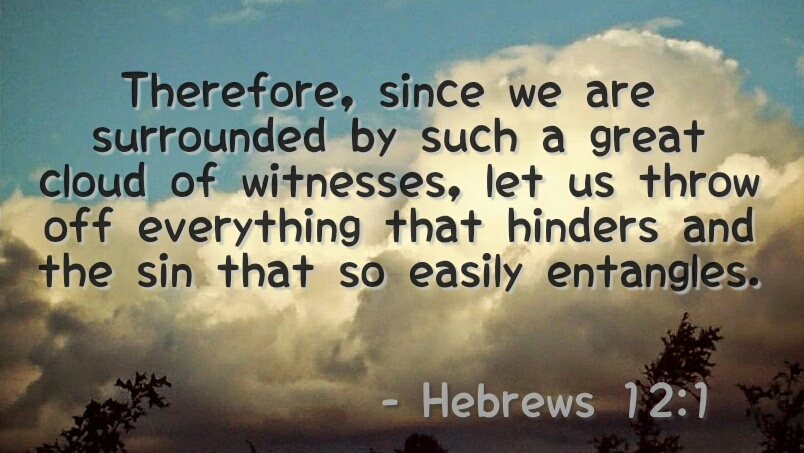
Pauls’s letter to the Hebrews describes the faith of many heroes of the Old Testament, including Abel, Noah, Abraham, Moses and others. None of them were perfect, but by faith they did amazing things. They are examples and inspirations that endure. Paul describes them – and all the faithful departed – as a “great cloud of witnesses” that surrounds us always.

Over the years the cloud has only grown larger.

From the 20th century alone we might add names of heroes like Martin Luther King, Jr., Edith Stein, and Dietrich Bonhoeffer. Or minds like C.S. Lewis, Thomas Merton, and Dorothy Day. Still more are less well known, but influential in our lives. When we struggle we can look to their lives, works, and words for strength.

Yet during difficult times, many of us insist on toughing it out alone. We convince ourselves no one has experienced the pain, grief, loss, or doubt that we endure. We isolate ourselves because no one could possibly understand us, relate to our situation, or stand to be around us. The beauty of leaning on the cloud of witnesses is that they are beyond feeling burdened by us. And they have so much to teach us.

Feeling despair? Crack open The Dark Night of the Soul by Saint John of the Cross, and you’ll probably start to feel like an amateur. Not much of a reader? Listen to recordings of the Psalms – number 137 reveals anguish at its purest. We don’t seek out these works to wallow in misery like a jilted lover listening to break-up songs, but because they offer wisdom from others who have overcome similar trials. Otto von Bismarck wrote: “A fool learns from his mistakes, but a truly wise man learns from the mistakes of others.” We can also learn from their triumphs.

Despite our occasional insistence to the contrary, we are never alone. Those witnesses who have gone before us, and those who stand beside us today, are a mortal manifestation of the strength and hope that come from faith. No matter where we are in life, we can plug into The Cloud.

Comfort: The entire history of God’s people is available to support you.

Challenge: Next time you feel compelled to isolate yourself because you think others wouldn’t understand, get in touch with someone to share your story.

Prayer: Thank you, Lord, for the legacy of all who have come before me. Help me to be a worthy heir and addition to the great cloud of witnesses. Amen.

Discussion: In times of difficult, are you more likely to go it alone, or ask for assistance? What do you think that reveals about your attitude toward those who need help?

Join the discussion! If you enjoyed this post, feel free to join an extended discussion as part of the C+C Facebook group. You’ll be notified of new posts through FB, and have the opportunity to share your thoughts with some lovely people. Or feel free to comment here on WordPress, or even re-blog – the more the merrier!