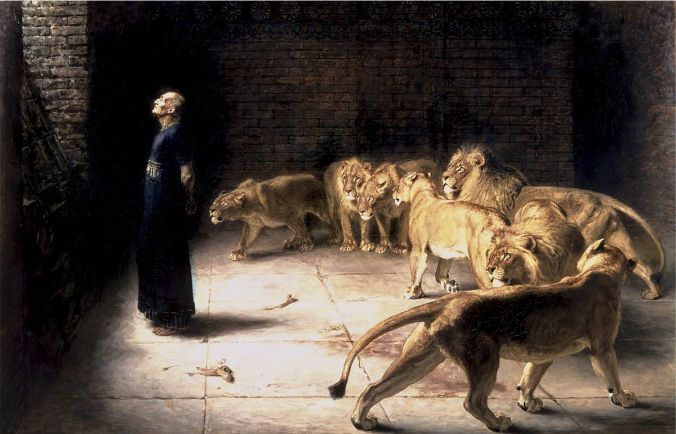
Lion’s Den

Briton_Riviere_-_Daniel's_Answer_to_the_King_(Manchester_Art_Gallery)

Daniel’s Answer to the King, Briton Rivière, 1890

Today’s readings (click below to open in new tab/window):
Psalms 92; 149, Daniel 6:16-28, 3 John 1-15, Luke 5:27-39


What is power?

Emperors and kings, queens and prime ministers, presidents and dictators – we associate these people with power. Some – like emperors – seem to have nearly unlimited power, while others – such as presidents – have clearly defined powers. Yet even the power of an emperor is insignificant before the power of faith.

King Darius was heartbroken after his advisers exploited his ego and Daniel’s faith to tricked Darius into condemning Daniel to the lion’s den. Darius tried desperately to find another course of action, but was trapped by his own decree. It seems even an emperor is not more powerful than his own word. He prayed that Daniel’s God might save him, then retreated to his castle for a sleepless night of fasting. In the morning, Daniel emerged unharmed. Darius decreed that all should tremble before the Living God of Daniel. He had the advisers and their families thrown into the den, where they had the same chance as Daniel, but their faith in deception and idols did not serve them as well.

Every ruler (or ruling body) is limited to actions that they believe will allow them to retain power. Sometimes that means observing the law, and sometimes that means creating fear. But in some circumstances they still have to watch the consequences of their actions unfold well beyond the reach of their control. While Darius could do nothing, Daniel’s faith in God saved both of them.

No matter who is technically in control, the moral health of a nation, religious body, corporation, or other entity depends on the faith and basic decency of ordinary people. Regardless of whether the powers-that-be are rooting for us or against us, how we enter the lion’s den matters. The resistance of persistent faith in the face of what seems like certain defeat or destruction changes us, the world, and the powerful.

Margaret Mead famously said: “Never doubt that a small group of thoughtful, committed, citizens can change the world. Indeed, it is the only thing that ever has.” For citizens of the Kingdom of Heaven that commitment is to Christ.

Power is faith.

Comfort: Your faith matters, even when you don’t feel like it does.

Challenge: When you feel like your actions and faith don’t matter, pray for understanding of why they do.

Prayer: Mighty God, teach me to find the strength in faith. Amen.

Discussion: What do you feel powerless against? Now what would you tell someone who felt the same way?

Join the discussion! If you enjoyed this post, feel free to join an extended discussion as part of the C+C Facebook group  or visit comfortandchallenge.tumblr.com. You’ll  have the opportunity to share your thoughts with some lovely people. Or feel free to comment here on WordPress, or even re-blog – the more the merrier!

Eat Your Vegetables

DCF 1.0

Today’s readings (click below to open in new tab/window):
Psalms 97; 145, Daniel 1:1-21, 1 John 1:1-10, John 17:1-11


The Babylonians routinely took captives from the lands they conquered and trained them for civil service in the empire. Daniel of Judah and his friends were captives of this sort. While they could serve the king without betraying their faith, they couldn’t eat food from his table because it had been sacrificed to foreign Gods. One of their jailors took pity on them and agreed to bring them nothing but vegetables and water – as long as they did not become obviously thinner and weaker than the other captives. Daniel and his friends flourished and outperformed their fellows.

It’s tempting to sacrifice our principles under duress. Unlike Daniel and friends, when layoffs start happening at work, or we are the victim of a crime, or we feel like the culture around us is pressuring us to change, we may not feel the same assurance that God will help us endure and thrive. Though faith is on our minds and lips, it may falter in our hearts. At those moments, it’s easy to say, “I know this is wrong, but I have to do it to survive.”

The Book of Daniel tells us Judah fell into captivity because it did not faithfully follow God. While God eventually restored Judah, it seems that, to God, surviving may be secondary to thriving. 1 John declares: “If we say that we have fellowship with him while we are walking in darkness, we lie and do not do what is true; but if we walk in the light as he himself is in the light, we have fellowship with one another, and the blood of Jesus his Son cleanses us from all sin.” Whether we are true to God, ourselves, and each other during hard times is an indicator of whether we will thrive spiritually when those hard times pass, or if they endure.

Accepting Christ is the moment we step into the light. Each step we take is a decision whether to stay in the light or stray from it. God’s love never falters, but whether we  thrive or merely survive is up to us.

Comfort: Staying true to God and yourself gives you inner peace.

Challenge: When times get tough, double down on your commitment to doing the right thing.

Prayer: Heavenly Creator, I will walk in your light and love. Amen.

Discussion: How do you feel when you have not lived up to your own principles?

Join the discussion! If you enjoyed this post, feel free to join an extended discussion as part of the C+C Facebook group , visit comfortandchallenge.tumblr.com, or follow @comf_and_chall on Twitter. You’ll  have the opportunity to share your thoughts with some lovely people. Or feel free to comment here on WordPress, or even re-blog – the more the merrier!

Invest Wisely

20161124_232048-01.jpeg

Today’s readings (click below to open in new tab/window):
Psalms 116; 147:12-20, Zechariah 13:1-9, Ephesians 1:15-23, Luke 19:11-27


Jesus told a parable about a rich man who traveled out of town to secure a royal title. He gave ten of his servants equal sums of money to manage in his absence. The man was not popular, so the town sent messengers to ask that he not be made king, but he received his title. While he was away, one servant doubled his sum and another increased it by half. The new king was pleased and rewarded both with proportionally greater responsibilities. A third servant had buried his sum. Because the king was displeased, the servant explained he feared punishment had he invested the money and lost it. The king took the sum and gave it to the servant who had invested most wisely. The moral is that those who are trustworthy with a little will be given more, and those who are untrustworthy will have it taken away, so use your time and talents to the best of your ability to further the kingdom of God.

Most discussions of this parable focus on using our talents wisely, but let’s ask what it means that the servant buried what was given him, instead of banking it as his master would have preferred. The man was gambling on the hope that his master would not return a king – and maybe not return at all. Banking it left it in his master’s name; burying it in secret gave him a chance to claim it. If we devote our time and talents only to personal gain, and not to the greater purposes of God, we are in effect stealing what has been entrusted to us; we are betting against the ultimate righteousness of God.

Christ drives this point home in more than one parable. No one’s gifts are too meager to be put to good use. While taking a chance with them can be scary, these parables don’t condemn those who try then experience setbacks – they demonstrate disfavor toward those who do nothing. What you have to offer will be multiplied when you put it to use. Trust God to trust you.

Comfort: Your gifts and talents are meaningful when you give them meaning.

Challenge: One talent most of us have is the ability to encourage others in the use of their talents. Be generous with your encouragement.

Prayer: Thank you, Lord, for the many gifts and talents you have given your people. Guide me to use them to glorify you. Amen.

Discussion: Have you ever been surprised to discover a talent you didn’t know you had?

Join the discussion! If you enjoyed this post, feel free to join an extended discussion as part of the C+C Facebook group or follow @comf_and_chall on Twitter. You’ll  have the opportunity to share your thoughts with some lovely people. Or feel free to comment here on WordPress, or even re-blog – the more the merrier!

Go climb a tree.

Today’s readings (click below to open in new tab/window):
 Psalms 96; 147:1-11, Zechariah 12:1-10, Ephesians 1:3-14, Luke 19:1-10


Zacchaeus was a tax collector and a wealthy man. As a tax collector working for the Roman occupiers, he would have been considered a traitor by many (if not most) of his fellow Jews. As a wealthy person, he would have seemed like the enemy to many of the poor and oppressed followers of Christ. Nevertheless, he was determined to see Christ. Zacchaeus was also short in stature, so in order to see Christ, he climbed a sycamore tree to see over the crowd.

Seeing him in the tree, Jesus called to him, saying: “Zacchaeus, hurry and come down; for I must stay at your house today.” Many people began to grumble: why would Jesus be going to spend time in the home of a sinner? Zacchaeus welcomed Christ into his home, and promised to compensate fourfold anyone he had cheated (a common exploitive practice of tax collectors) and to give generously to the poor. Christ celebrated with him, because a lost sheep had been returned to the fold.

We can all be a Zaccheus. Our desire to know Christ may encounter many obstacles. Perhaps we feel guilt about our sinful past – or present. Maybe others try to stand in judgment between us and Christ. Others, more out of ignorance than ill will, may not realize their language, traditions, and expectations create barriers we can’t see past. And maybe we have shortcomings we can’t change. Whether people are purposefully unwelcoming or just ignorant, we must work with what we’re given.

It may not seem fair, but fairness is not something Christ promised us. If you don’t feel like the church is welcoming you – and that may be equally true for lifelong members as well as those who have never stepped foot in the door – isn’t it better to forge a path than cry about being lost? Christ welcomes any effort to be closer to him – from climbing a tree to facing our critics – by inviting himself into our lives. He doesn’t care whether other people judge or ignore us, so neither should we.

Comfort: Jesus doesn’t need you to be worthy, just willing.

Challenge: If there are obstacles in your way, don’t waste time cursing them when you can be going through them.

Prayer: Loving God, I will make myself available to you. Amen.

Discussion: Describe an obstacle you have overcome.

Join the discussion! If you enjoyed this post, feel free to join an extended discussion as part of the C+C Facebook group or follow @comf_and_chall on Twitter. You’ll  have the opportunity to share your thoughts with some lovely people. Or feel free to comment here on WordPress, or even re-blog – the more the merrier!

Prosperity of the Wicked

1479784158727.jpg

Today’s readings (click below to open in new tab/window):
Psalms 73; 145, Zechariah 10:1-12, Galatians 6:1-10, Luke 18:15-30


For I was envious of the arrogant;
      I saw the prosperity of the wicked.

For they have no pain;
      their bodies are sound and sleek.

They are not in trouble as others are;
      they are not plagued like other people.

Therefore pride is their necklace;
      violence covers them like a garment.

Their eyes swell out with fatness;
      their hearts overflow with follies.

They scoff and speak with malice;
      loftily they threaten oppression.
– Psalm 73:3-8

When the psalmist writes of “the prosperity of the wicked,” who among us can’t relate? The world is full of people who not only get away with but profit from murder, greed, and oppression. Playing by the rules – God’s or man’s – seems to be for suckers. Evil skillfully creates new ways to seize and maintain power at the expense of the most vulnerable. The temptation to fight fire with fire is great. If good were only as conniving, ruthless, loud, and lethal as evil – as willing to do whatever it takes – wouldn’t we all be better off?

Not at all.

Our benchmark is Christ. When he told us to forgive and to turn the other cheek, he didn’t add “until it gets uncomfortable” or “until you are scared” or “until you might lose” or even “until harm threatens you or your loved ones.” Each of us is capable of living out these commands to different degrees, but the standard set by Christ does not waver.

However, let’s never confuse being servants with being subservient to anyone but God. We cry out for justice for the oppressed. We name and stand opposed to evil. We bring light to truths evil would keep in darkness. But we do these things out of love for the least among us, not for retribution or anger. The moment forgiveness is off the table, we have lost more than the battle; we have lost our souls.

Keep the faith, in all ways. While evil will prosper, it does not win unless we accept its ways as our own. You are a child of God, and nothing can take that away.

Comfort: Evil may prosper, but goodness endures.

Challenge: When you are motivated by anger or fear, take time to pray before taking action.

Prayer: Lord, where there is hatred, let me sow love; where there is injury, pardon. Amen.

Discussion: Have you ever taken action, then realized the ends did not justify the means?

Join the discussion! If you enjoyed this post, feel free to join an extended discussion as part of the C+C Facebook group or follow @comf_and_chall on Twitter. You’ll  have the opportunity to share your thoughts with some lovely people. Or feel free to comment here on WordPress, or even re-blog – the more the merrier!

Hammer or Nails?

1479681580266.jpg

Today’s readings (click below to open in new tab/window):
Psalms 108; 150, Zechariah 9:9-16, 1 Peter 3:13-22, Matthew 21:1-13


For Christians, victory is a challenging concept, because so often it looks like defeat. Our savior overcame death, but first he had to humble himself before the powers-that-be and willingly accept the cross. Throughout history beloved saints and martyrs have followed in his footsteps and died for their faith, but collectively we seem to be much more eager to kill for it.

In his first letter, Peter advised disciples to do good even if they suffered for it. Does that sound like what we do today? Or do we, as the dominant faith in our culture, succumb to the temptation to force others into submission to our will and beliefs? The United States is a nation founded on religious freedom, but we certainly didn’t allow the Native Americans to practice their religion in our midst. Every Christmas season, examples of religious inclusion are mocked as politically correct or attacked as un-Christian (and by association, un-American), as though businesses, cashiers, and baristas are somehow obligated to acknowledge Christian traditions to the exclusion of at least a half dozen other religions celebrating holidays in December. When we bury ourselves in wrapping paper and bows, happily co-opt pagan symbols like trees and mistletoe, yet take offense at “Happy Holidays” in a place of commerce (and in today’s reading from Matthew we read about Jesus cleansing the temple of commerce), we aren’t so interested in sharing the Gospel as force-feeding it.

Jesus rode into Jerusalem on a donkey to tell the Empire its power was irrelevant. The marriage of faith identity to national identity produces some unholy offspring. It turns the faith into a hammer, when we are supposed to be willing to take the nails. We only feel the need to hold power when we ourselves are in the grip of fear. Peter wrote: “Do not fear what they fear, and do not be intimidated, but in your hearts sanctify Christ as Lord.” Delivering the Gospel on the point of a sword sanctifies nothing, and ultimately undermines Christ’s message. Living as persistent, humble witnesses, regardless of whether the world accepts us, is true victory.

Comfort: As long as we rely on God, we are never defeated.

Challenge: Examine parts of your life where your decisions are based on fear.

Prayer: Almighty God, in you alone will I seek victory and validation. Amen.

Discussion: Can Christians declare loyalty to a particular nation? Why or why not?

Join the discussion! If you enjoyed this post, feel free to join an extended discussion as part of the C+C Facebook group or follow @comf_and_chall on Twitter. You’ll  have the opportunity to share your thoughts with some lovely people. Or feel free to comment here on WordPress, or even re-blog – the more the merrier!
K.I.S.S. (Keep It Simple, Saints)

1479180862780-01.jpeg

Today’s readings (click below to open in new tab/window):
Psalms 57; 145, Habakkuk 2:1-4, 9-20, James 2:14-26, Luke 16:19-31


“Simplicity is the glory of expression.”
– Walt Whitman

Habakkuk was a prophet who demanded an accounting for the oppression of the Jewish people in Babylonian exile. He asked where God was in the midst of His people’s suffering. God answered in the vivid and poetic language of a vision for justice.

The Lord tells the author of Habakkuk: “Write the vision; make it plain on tablets, so that a runner may read it.” The runner is likely a messenger who would have been carrying stone tablets to share with others, and God wants them to be plain enough to be read while running. The message would have to be relatively short, or the tablets would be too numerous and heavy to carry, let alone run with. The print would probably have to be large; anything too small would be impossible to focus on. Though Habakkuk itself is only three chapters and thirty-nine verses long, the content of the tablets would have been shorter and simpler still.

It’s easy to over-complicate the vision God has for us. Christ summed it up simply and beautifully when he said:

“‘You shall love the Lord your God with all your heart, and with all your soul, and with all your mind.’ This is the greatest and first commandment. And a second is like it: ‘You shall love your neighbor as yourself.’ On these two commandments hang all the law and the prophets.”

That’s a message we can run with.

So why do we often feel the need to burden ourselves with the weight of theology and doctrine, and struggle so hard to balance and carry it that rather than run we plod – or stand still? Even standing still, the message is in language so cramped and difficult for passers-by to interpret that most squint and go on their way with no idea what we’re about.

Faith is not simplistic, but it should be simple. Sharing it should be easy. As our life in the Spirit matures, the less we need to know about it, and the more we are able to live it.

Comfort: Theology is fine, but faith is better.

Challenge: Pick one way to simplify your life, and do it before the end of the month.

Prayer: God of all creation, I humbly offer my simple faith. Amen.

Discussion: In what ways do you or have you unnecessarily complicated your beliefs?

Join the discussion! If you enjoyed this post, feel free to join an extended discussion as part of the C+C Facebook group or follow @comf_and_chall on Twitter. You’ll  have the opportunity to share your thoughts with some lovely people. Or feel free to comment here on WordPress, or even re-blog – the more the merrier!

Faith and Figs

1478054496561.jpg

Today’s readings (click below to open in new tab/window):
Psalms 42; 146, Zephaniah 1:14-18, Revelation 14:14-15:8, Luke 13:1-9


One of the most troubling clichés in Christianity is blaming someone’s misfortune on a lack of faith. Many an action contains the seed of its own consequences, and we want to avoid those tragedies, but catastrophes like illness and natural disasters happen to the faithful, the doubtful, and the indifferent in equal measure. We don’t know the details of why or how the tower of Siloam fell and killed eighteen people, but Jesus – unlike many of today’s televangelists – used the tragedy not to shame the victims, but to point out the need for everyone to repent:

Do you think that they were worse offenders than all the others living in Jerusalem? No, I tell you; but unless you repent, you will all perish just as they did.

In other words, don’t put off until tomorrow what could be prevented forever by a falling tower today.

Why are we eager to link tragedy with sin, especially when Jesus said otherwise (see also “it rains on the just and the unjust” in Matthew 5)? Maybe because we want the world to make sense. Maybe because the inverse proposition is that a lack of tragedy assures us we are doing faith “right.” Maybe because we trust the (imaginary) justice in front of us more than God’s eternal justice. Whatever the reason, Jesus tries to redirect our thinking away from externally-directed blame and inward toward repentance.

Jesus follows up with a parable about a vineyard owner with a fig tree that hasn’t produced fruit in three years (perhaps not coincidentally the length of Jesus’s active ministry). He wants to cut it down, but the gardener asks for one more year to tend and fertilize it. We never learn the fate of the tree.

Rather, it bends us toward God regardless of fortune. Like the fig tree we need to develop roots that dig deep and branches that stretch for the light so we can bear fruit through all kinds of weather. We repent joyfully because God loves us enough to offer a future regardless of our past.

Comfort: Whatever the question, faith is the answer.

Challenge: Think about something in your life you wish would change. Is there something you could change within instead?

Prayer: God of possibilities, do with my life as you will. Amen.

Discussion: How do you typically react to problems that are beyond your control?

Join the discussion! If you enjoyed this post, feel free to join an extended discussion as part of the C+C Facebook group or follow @comf_and_chall on Twitter. You’ll  have the opportunity to share your thoughts with some lovely people. Or feel free to comment here on WordPress, or even re-blog – the more the merrier!
Worry: about that hour you’ll never get back…

1477680614272-01.jpeg

Today’s readings (click below to open in new tab/window):
Psalms 84; 148, Nahum 2:13-3:7, Revelation 13:1-10, Luke 12:13-31


Worry-mongering is a profitable business strategy – more profitable even than fear. Where fear is a reaction to something real and bad, worry anticipates something that might be bad. If the bad thing goes away, or turns out not to be so bad after all, fear ends. Worry is sustainable, a cash cow that never runs short of milk, and always ready for exploitation by media and marketers. Plant a seed of worry about national security or the inevitability of aging, and reap a harvest in sales of body scanners or anti-wrinkle serums.

Jesus asked his disciples: “Can any of you by worrying add a single hour to your span of life?” Ironically, not only does the stress of worry not add to our life, it decreases the quality, health, and length of that life. Jesus taught not to worry about food or clothing; if God provided for birds and the lilies of the field, how could he not do that and more for His children? Instead, he said, we should “strive for the kingdom” and everything else will fall into place.

We’d like to believe that, but modern life saps our confidence in those ideas.

Or not. Two thousand years ago Jesus was reminding people: “One’s life does not consist in the abundance of possessions” … and back then there was far less for the average person to possess. Could it be that life is not more stressful, but that we’ve always needed to hear the same message? We have access to more products than we could need in ten lifetimes, so as the forces of consumerism grow ever more sophisticated, they market less to our needs and more to a generalized sense of anxiety that demands to be fed but is never satisfied.

In many traditions, including the Christian one, enlightenment involves simplification and detachment. The biggest thing we have to give up, and what the world tries hardest to sell us, is the fear that God alone is not enough. It’s also the only thing, because once we’re rid of it the rest really does fall into place.

Comfort: You are not your stuff.

Challenge: Get rid of unnecessary stuff.

Prayer: Loving and merciful God, I will trust in you alone. Amen.

Discussion: Have you ever been relieved to let go of something you held onto for a long time?

Join the discussion! If you enjoyed this post, feel free to join an extended discussion as part of the C+C Facebook group or follow @comf_and_chall on Twitter. You’ll  have the opportunity to share your thoughts with some lovely people. Or feel free to comment here on WordPress, or even re-blog – the more the merrier!

Running Away From God

1477270337293.jpg

Today’s readings (click below to open in new tab/window):
Psalms 108; 150, Jonah 1:1-17a, 1 Corinthians 10:15-24, Matthew 18:15-20


Most of us remember Jonah from childhood Sunday School classes, and mostly how he was swallowed by a great fish and spit up on shore. In some Christian circles the fish and the attempts to explain how it could have “really happened” are such a focus that the more important points of the story blur in the background. Jonah is a book about God’s love for all people, even the people we don’t love ourselves.

The first chapter opens as God commands Jonah to deliver a message to Nineveh, the capital of the Assyrians, who for a long time were Israel’s captors. Jonah decides to head in the opposite direction toward the port city of Tarshish in the west. This decision doesn’t pan out well. The Lord sends a great storm to trouble the ship Jonah has chosen, and it doesn’t cease until the crew members throw Jonah overboard because they realize he has angered the Lord.

Are we ever like Jonah? Do we ever head the opposite direction from where the Lord would have us go? Intentionally or not, we all make that mistake sometimes. Maybe we don’t like what God is asking us to do, or the people he’s asking us to do it for. Maybe we are too preoccupied with our own concerns to hear the call. Maybe we think we’ll answer later. Maybe we’re too busy justifying a fish story to see the greater truth behind it.

When we turn our face away from God, we can expect some rough weather. Probably not our own personal tsunami or mammoth tuna, but our lives won’t be what they could. Even if everything appears fine to outside eyes, inside we will know things are off kilter. When we ignore God’s call, the repercussions play out in our lives not as punishments but as natural consequences. A nagging lack of peace and contentment ripples through and distorts all our relationships to other people, God, and ourselves. As we will explore throughout our reading of Jonah, we will know we are heading toward God when we are heading toward reconciliation.

Comfort: Even if we move away, God is waiting for us to come back.

Challenge: Throughout your day, stop regularly to assess whether your actions are leading you toward or away from God’s call.

Prayer: God of Mystery, when you call me I will move toward you. Amen.

Discussion: Have you ever moved away from where God was trying to send you?

Join the discussion! If you enjoyed this post, feel free to join an extended discussion as part of the C+C Facebook group or follow @comf_and_chall on Twitter. You’ll  have the opportunity to share your thoughts with some lovely people. Or feel free to comment here on WordPress, or even re-blog – the more the merrier!