Relay Race

OLYMPUS DIGITAL CAMERA

Today’s readings (click below to open in new tab/window):
Psalms 108; 150, Numbers 27:12-23, Acts 19:11-20, Mark 1:14-20


One of the hardest lessons of faith is learning to trust that God will come through, but not always according to our preferred schedule – or in our lifetime. As the nation of Israel drew nearer and nearer to entering the promised land, God reminded Moses that, because of past disobediences, Moses would not be entering it with them. After forty years of wandering, Moses must have found the disappointment almost unbearable. Can we imagine, were we to be in Moses’s sandals, not clinging to some sliver of hope that God might relent and let us in, if only for a day? Yet Moses chose to trust God and contribute to a smooth transition in leadership.

From the decades wandering in the desert, to the church being established in Acts, to our modern day, faith is a community experience. Our current vocabulary around faith emphasizes personal salvation, and that is an element of it, but the peace we pray for and the justice we long for are not personal but communal transformations. Maturing in that faith includes recognizing when it is time to pass the torch. Projects and missions near and dear to our hearts may not be fully realized in our own lifetimes. A narrow, individual perspective interprets this as failure, but a faith founded in community – in the eternal Body of Christ – invests hope in the long game.

Whether we are retiring from ministry or can no longer find time to serve as bake sale coordinator, merely stepping aside is not enough; when possible we should work to ease the transition for both our community and the person assuming our burden. When the Lord named Joshua as Moses’s successor, Moses presented him to the congregation, and personally commissioned him to lead the people. How humbling it must have been for Moses to admit the people could enter the promised land with or without him. Yet for a long time he was God’s chosen instrument of liberation and survival, and there must have been immense satisfaction as well.

Faith is not a sprint, or a marathon, but a relay race.

Comfort: You alone are not responsible for the fate of the world.

Challenge: When it is time to pass along your responsibilities, do so with grace.

Prayer: Eternal God, teach me to appreciate the time and tasks you have given me, as well as the opportunity to rest in your peace. Amen.

Discussion: Do you have trouble letting other people do things their own way?

Join the discussion! If you enjoyed this post, feel free to join an extended discussion as part of the C+C Facebook group. You’ll be notified of new posts through FB, and have the opportunity to share your thoughts with some lovely people. Or feel free to comment here on WordPress, or even re-blog – the more the merrier!

Come to the Banquet

1467321551779.jpg

Today’s readings (click below to open in new tab/window):
Psalms 143; 147:12-20, Numbers 23:11-26, Romans 8:1-11, Matthew 22:1-14

After the Parable of the Husbandmen, Matthew presents us the Parable of the Wedding Banquet. In the first parable, a landowner hired tenants to farm his vineyard. When he sent his servants and son to collect, the tenants killed them. The landowner killed the tenants and replaced them with more suitable staff.

In the second parable, a king prepares a wedding banquet for his son. He sends servants to gather the invited guests, but the guests refuse to come. He sends more servants, who share details about the sumptuous feast, but the guests seize, mistreat, and kill them. After the king’s army destroys those who rejected him, he sends more servants to invite anyone they can find, until the wedding hall is filled. One guest is inexplicably without wedding clothes, and the king throws him out.

We could interpret these parables as lessons about a harsh God, but these stories – especially read back-to-back without the artificial separation of chapters – say something more poignant. In both parables, the God figure generously invites people to participate in his abundance. The people not only repeatedly reject his offers, they kill his true servants. More than simple disobedience, or even indifference, the rejection is a deep betrayal. These lessons say God’s default attitude toward us is one of eager welcome, and that trying his patience to the breaking point takes some serious effort.

When the king invites the second group of guests to the banquet, he makes no distinction between good and bad. The guest who rejects the wedding clothes (which would have been provided by the king) has already been forgiven, and still chooses to dishonor his benefactor. When we accept the invitation to God’s banquet, Christ has already wiped the slate for us prior to our arrival, but we would be foolish to take it for granted.

No matter what harsh teachings you may hear, remember God does not eagerly pounce on your failure, but desires you to enjoy life in his abundance. It is not something we can win or that God capriciously takes from us, but it is ours to lose.

Comfort: God is rooting for you to accept Him.

Challenge: Some people are determined to reject God. We are still to love them.

Prayer: Generous God, thank your for the life of abundance you freely offer. Amen.

Discussion: Have you ever felt like rejecting God? What did you do?

Join the discussion! If you enjoyed this post, feel free to join an extended discussion as part of the C+C Facebook group. You’ll be notified of new posts through FB, and have the opportunity to share your thoughts with some lovely people. Or feel free to comment here on WordPress, or even re-blog – the more the merrier!

Innocence by Association

Today’s readings: Psalms 46 or 97; 147:12-20, Deuteronomy 8:1-3,  Colossians 1:1-14, John 6:30-33, 48-51

1452221934297

When we talk about peer pressure, we are usually talking about school age children. We worry their friends will pressure them into drugs, alcohol, sex, or smoking. We offer them overly-simplistic methods of dealing with peer pressure, such as “Just say no.” We repeat advice we heard from our parents (“If your friend jumped off a bridge …”) even though it had little if any effect on us in our own young lives. Peer pressure concerns us not only because so much of it happens beyond our sphere of influence, but also because in our hearts we know it is something we never escape. Continue reading

Something To Chew On

Today’s readings: Psalms 46 or 97; 147:12-20, Deuteronomy 8:1-3, Colossians 1:1-14, John 6:30-33, 48-51

1452141617072

Bread gets a bad rap. The carbs, preservatives, bleached flours, and chemicals it contains fill our media and magazines with articles about how they are slowly killing us. We see it on a restaurant table and know it’s there to fill us up before the real food arrives. Baking it ourselves is better, but in most homes that is a rare and indulgent occasion. If Jesus called himself the “bread of life” in the United States today, some disciple would try to substitute a lettuce wrap Continue reading

Out of Thin Air

Today’s readings: Psalms 93; 147:1-11, 1 Kings 17:17-24, 3 John 1-15, John 4:46-54

1451459082880

Why do miracles happen? American Christianity often portrays them as rewards for diligent prayer and great faith. The Gospel of John tells a different story. Jesus performed seven miracles – John called them “signs”- before he was crucified. The second was the healing of a royal official’s son. The official met Jesus in Cana, about 25 miles southwest from where his son lay dying in Capernaum, and asked Jesus to save him. While Jesus did heal the official’s son, his initial response seems almost perturbed: “Unless you see signs and wonders you will not believe.” Jesus was coerced by his mother into the first sign at the wedding in Cana, grumbled about the second, and things didn’t improve much for the next five.  When he raised Lazarus, he wept over his friends’ lack of faith. According to John, signs were performed for the unfaithful.

For some people, faith in God rests on miracles. Jesus, on the other hand, treated miracles as necessary disturbances to the natural order used to persuade people.  God’s presence is not extraordinary, but an ongoing relationship during ordinary life. Like air, it is a life-sustaining presence constantly surrounding us and within us. We don’t normally think about air unless we can’t breathe. John’s Jesus delivers miracles like he’s performing spiritual CPR on those who can no longer inhale God’s presence on their own.

Isn’t it better not to need it in the first place? Like air or water, our spiritual environment can become polluted. Sometimes we trash it ourselves, and sometimes we are downwind from the spiritually toxic. When our faith feels choked off, it may be time to start cleaning up and preventing more damage. This could be a slow process: anger, hate, greed, fear, and poisons like them take time to remove. They are dangerous and unpleasant to handle, but with God’s help handle them we must. The alternative is spiritual suffocation.

Still prefer to wait on a miracle? Neither miracles nor CPR are a permanent fix: if our habits don’t change, our old problems will return. God is always present; live clean and breathe deep.

Comfort: God is as close as the air we breathe.

Challenge: Take an inventory of what’s polluting your spiritual environment.

Peace as Preparation

Today’s readings: Psalms 18:1-20; 147:12-20, Zechariah 4:1-14, Revelation 4:9-5:5, Matthew 25:1-13

1450324264571

In the Gospel of Matthew, Jesus relates a parable about ten bridesmaids – five foolish and five wise. They all take lamps to meet the bridegroom, but only the wise ones take supplies to keep the lamps burning when the bridegroom is delayed. The foolish bridesmaids ask the other for oil, but the wise ones are wise enough to say no because they’d all be unprepared. The foolish bridesmaids leave to buy oil and return to find the bridegroom and wise bridesmaids have left them behind.

It’s not difficult to imagine the foolish bridesmaids thought of themselves as unlucky, or victims of the wise bridesmaids’ stingy nature. Very often what we call poor luck or unfairness is our own lack of preparation. How do we properly prepare for the kingdom of God?

By not giving away more oil than we can spare. That doesn’t mean a lack of generosity; we should be generous of spirit and wallet. The oil we need to keep topped off is the energy to stay vigilant for the presence of Christ in the world. Many things conspire to steal this energy if we allow them: demanding jobs,  busy social schedules, housekeeping, and so on. None of these things is inherently problematic – they are  mostly good! – but neither is any of them our true purpose. If we don’t learn to say “no more oil for you, foolish bridesmaid” the energy left over for worship, charity, and our relationship with God can quickly dwindle to nothing. And by the way, if we think of those as “left overs” the reserves are already below acceptable levels. “What does it profit a man to gain the whole world and forfeit his soul?” (Mark 8:36)

Preparation means laying the groundwork for our whole lives, not just our spare time, to serve God. When we carefully steward our resources, we have enough energy to seek Christ and our peace in him. We must fill and refill our own lamps through prayer, service, rest, and worship.The wise will not save us from ourselves. Have you checked your oil lately? Tomorrow could be too late.

Comfort: It’s okay to do less so you can be more.

Challenge: Take an inventory of your obligations and eliminate the ones that drain your oil.


Peace as Silence

Today’s readings: Psalms 50; 147:1-11, Zechariah 3:1-10, Revelation 4:1-8, Matthew 24:45-51

1450240786291

A popular acronym advises us to THINK before we speak –  to ask ourselves whether what we are about to say is true, helpful, inspirational, necessary, and/or kind. THINK may seem cliched, but it’s still excellent advice. Psalms 50:19-20 speaks to us today when it says:

“You give your mouth free rein for evil,
and your tongue frames deceit.
You sit and speak against your kin;
you slander your own mother’s child.”

Our current cultural mix of traditional and social media pushes us to opine on the latest news before it’s fully reported, to become outraged over (non?) events we really know nothing about, and to offer our often uninformed commentary in formats that remove the social buffers normally keeping us civil. The rapid-fire sarcasm and verbal slugfests that pass for dialogue and entertainment frequently have no purpose but shouting our own opinions and displaying our own cleverness.

Fortunately we do have the ability to turn it off. Simply deciding not to respond to every opinion we hear or read can be a solid start. Many people never quite get that concept: they will continue to respond as long as someone else continues to antagonize them. Withdrawal from a contentious non-productive exchange of spoken words, texts, or comment sections is not some admission of defeat.  Consciously moving away from violent noise and into silence is an affirmation of peace.

At other times the conversation we need to end is the one we’re having with ourselves. Negative self-talk damages our spirits, and we may need a great deal of counseling to learn to stop it. Wordy prayers that run on and on are not a conversation with God – they are a monologue of doubt and desperation.

Silence, both external and internal, makes space for Elijah’s “still small voice” of God. It gives our thoughts room to expand and mature. It teaches us what is important and what is fleeting. When we regularly seek the peace of silence, we are better prepared when it is time to speak up for matters of justice, mercy, and love.

Comfort: God waits for us in the silence.

Challenge: Find time each day to meditate, unplug, or make whatever arrangements you need to enjoy a period of auditory and mental silence.

Peace as Surrender

Today’s readings: Psalms 33; 146, Zechariah 2:1-13, Revelation 3:14-22, Matthew 24:32-44

1450153339550

We are not generally fond of the term “surrender” unless it is preceded by “never.” Surrender implies loss, weakness, and cowardice. We lionize those who fight to the death rather than wave the white flag. Our concept of surrender is almost exclusively military, understood in terms of victory or defeat … and ignoble defeat at that.

Maybe that is why we struggle to surrender to God. When we end a prayer for a new job or a good health report with “if it’s God’s will” … doesn’t a small part of us hope God is taking the hint? Truly surrendering to God’s will is a terrifying prospect. One critique of Christians is that we show weakness of character by claiming everything is God’s will to dodge responsibility. Might it be closer to the truth to say we are good at paying lip service to God’s will, but not so good at actually accepting it? Can we really even claim to understand what “God’s will” means? In reality, it takes much courage to surrender ourselves to God; to do so is to risk total annihilation of our own identities.

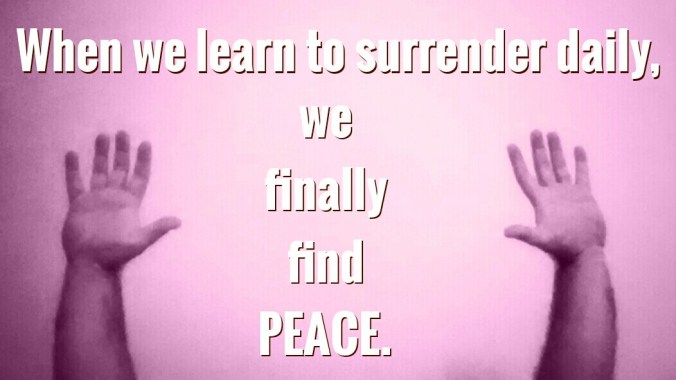
Except it never seems to turn out that way. When we truly make the effort to surrender ourselves – or even one tiny problem – to God, we find our burdens lightened and our real selves rising to the surface. Does “the effort to surrender” sound like an oxymoron? Isn’t surrender the opposite of doing something? If you’ve tried it, you know it’s not just an effort but an ongoing effort. When we learn to surrender daily, we finally find peace.

Psalm 33 tells us great armies, superior strength, and the mightiest resources ultimately do not save us. Our victory – our peace – lies in trusting the Lord. It’s so easy to convince ourselves our own plans must be God’s plans, and then because we can’t tell the difference, our disappointment robs us of our peace. C.S. Lewis said of prayer: “It doesn’t change God – it changes me.” Let us pray with an attitude of surrender, and trust God to reveal to us our best and most peaceful selves.

Comfort: We can trust that God accepts our surrender with our best interests at heart.

Challenge: What is one problem you need to surrender to God? Put in the work to let it go.