Lightly Salted

salt

Today’s readings (click below to open in new tab/window):
Psalms 98; 146, Exodus 32:21-34, 1 Thessalonians 1:1-10, Matthew 5:11-16


Has anyone born in America since 1920 not heard “This Little Light of Mine?” The lyrics are based on Christ’s words to his disciples: “Let your light shine before others, so that they may see your good works and give glory to your Father in heaven.” He tells them a shining city on a hill cannot be hidden, and a lamp hidden under a bushel is useless. He also tells them salt with no flavor has no purpose. Christ wants his followers to let the world see what God has done for and through us.

Progressive Christians can be tempted to put a dimmer switch on that lamp. We don’t want to be confused with “those” Christians who embarrass us (as though they aren’t part of the same body beloved by Christ), and find ourselves preaching only to the progressive choir – who don’t raise their voices too loudly either. We are more comfortable with sentiments like St. Francis’s “Preach the Gospel at all times; use words if you have to,” sometimes clinging to them so tightly any hint of good news is squeezed out. Some strong progressive voices like Sojourners and the United Church of Christ are reaching out to the larger culture, but by and large we are merely … polite.

Of course there is a balance. Light illuminates, but it also blinds. A sprinkling of salt enhances a dish, but an entire mouthful makes us ill. However we share Christ’s message, our intent should never be to overwhelm or obliterate, but to add love and faith to beautifully season what is already there. God has declared His creation good, so it’s not our job to point out what we believe to be everyone’s flaws, but rather to share with them the good news. We all need reminded of how beloved we are, because believing that can be almost impossible for some of us. Once that belief is solid, we shine from the inside out.

Don’t be afraid to let your light shine, because it will kindle the light in others. Don’t let your salt lose its flavor, because once others get a taste they’ll crave more.

Comfort: Your faith is worth showing people!

Challenge: Allow Christ’s light to shine through you into dark places without turning it on people like an interrogation lamp.

Prayer: God of love and light, thank you for all your good works. May others see them shine through me! Amen. 

Discussion: Are you ever tempted to “dim” your light? Or the reverse: blinding people with it? How might you change?

Join the discussion! If you enjoyed this post, feel free to join an extended discussion as part of the C+C Facebook group. You’ll be notified of new posts through FB, and have the opportunity to share your thoughts with some lovely people.

Blessed are those…

1460979157719.jpg

Today’s readings (click below to open in new tab/window):
Psalms 97; 145, Exodus 32:1-20, Colossians 3:18-4:6 (4:7-18), Matthew 5:1-10


Today’s passage from Matthew is commonly known as The Beatitudes. The word “beatitude” means supreme blessedness or happiness. Jesus is telling the people that God does not just sympathize with those who struggle, but places them first.

The words of The Beatitudes are famous well beyond Christian circles. “Blessed are the meek” and “Blessed are the peacemakers”  would be cliché if they weren’t still radical statements.

The Beatitudes describe a world where an oppressive imperial society (Roman or otherwise) is turned upside down by God’s love. We perceive them as blessings, but to anyone holding or seeking power over others, they are almost threatening. No wonder Jesus warns us those who benefit from the status quo or fear God’s justice will revile and persecute and slander the faithful: his message says that not only is their power illusory, they are ultimately irrelevant to us because our only dependence is on God.

Some critics of Christianity use texts like The Beatitudes to paint Christians as passive and long-suffering. The meek, the mournful, the poor, and the hungry – not anyone most of us would aspire to be. Even the merciful, the pure in heart, and the peacemakers can be caricatured as mere do-gooders or pacifiers.

The truth is, each of these states represents an active engagement in the world and a refusal to accept less than the fullness of God. Mourning is not mere sadness, but grappling with a world steeped in pain. Meekness is a choice of community over self. Peacemaking is a dangerous profession – ask any police officer called to a domestic dispute.

The Beatitudes spell out how we are to be in the world but not of it. We are not called to suffer for suffering’s sake, but may be called to do so when life in the kingdom of God clashes with the expectations of the world. How such persecution can be a blessing is a mystery, but no more a mystery than how the world can turn a deaf ear to God’s call to justice and love. Which of these mysteries do we want to live in?

Comfort: God’s ways are not the world’s ways. The poor in spirit have the kingdom of heaven.

Challenge: What do you think it means to be poor “in spirit?” Read this article and have a conversation with friends about it.

Prayer: Lord, I depend only on you for my spiritual wealth, only on you to satisfy my hunger for justice. Amen.

Discussion: How might it be spiritually dangerous to assume we are persecuted simply because we are Christian?

Join the discussion! If you enjoyed this post, feel free to join an extended discussion as part of the C+C Facebook group. You’ll be notified of new posts through FB, and have the opportunity to share your thoughts with some lovely people.
Skin in the Game

1460175754942.jpg

Today’s readings (click below to open in new tab/window):
Psalms 92; 149, Exodus 17:1-16, 1 Peter 4:7-19, John 16:16-33


Though the nation of Amalek shared a lineage with the nation of Israel, they were bitter rivals. When Israel was encamped at Rephidim, Amalek attacked. While they fought, Moses stood on a hill and held his staff in the air. As long as he kept it raised Israel prevailed, but when he tired and let it drop Amalek prevailed. Growing weary, Moses sat on a stone and  his brother Aaron and companion Hur held his hand steady. The whole incident is a little strange, as it paints Moses almost as some sort of magician casting a spell over the battlefield. If God wanted Israel to claim victory, why not just destroy the Amalekites like He had the Egyptian army? We can learn some valuable lessons from this story.

First, it seems God wants us to have some skin in the game. He gives us our freedoms, but they are ours to defend. When enemies storm the camp, we can’t assume God will take care of it all like a superhero. Of course we depend on Him for our strength, but actual effort is required. For example, if our enemy is hunger, we might remember words attributed to Pope Francis: “You pray for the hungry. Then you feed them. That’s how prayer works.”

Second, we have to be willing to receive and give help. Our leaders aren’t superheroes either. Aaron and Hur didn’t stand back and criticize Moses for failing to keep that staff aloft; they offered moral and literal support for as long as it was needed. They took turns because they were invested in the outcome, and leaders can’t do things alone. There was a measure of risk to getting involved: the people of Israel were fickle and quick to turn on their leaders, and if the battle had been lost Moses’s comrades would likely have paid a price. Like them, we need to shore up each other’s faith in difficult times, even when the outcome is uncertain.

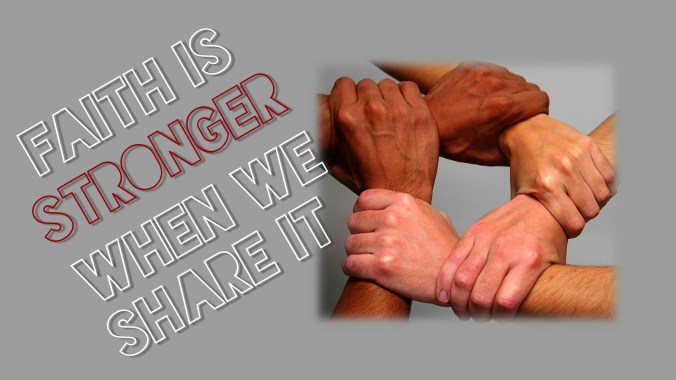
Faith is not a miracle factory. It is a source of strength that grows stronger as we share it with others.

Comfort: Not only do you not have to carry every burden alone, it’s a sign of strength to share it.

Challenge: When you can, be part of a solution instead of an observer of problems.

Prayer: Thank you, God, for the community of believers who supports me in my journey. May I pass on the strength you share with me to others who need it too. Amen.

Discussion: In what areas of your life are you passively waiting for God or some earthly leader to solve a problem? What could you be doing to help with it right now?

Join the discussion! If you enjoyed this post, feel free to join an extended discussion as part of the C+C Facebook group. You’ll be notified of new posts through FB, and have the opportunity to share your thoughts with some lovely people.
No Turning Back

faithforsafety

Today’s readings (click below to open in new tab/window):
Psalms 93; 150, Exodus 14:5-22, 1 John 1:1-7, John 14:1-7


Pharaoh quickly regretted his decision to free Israel and sent his army to bring them back. When Israel saw the approaching army, the people were frightened and declared it was better to live in servitude than to die in the wilderness. Moses assured them the Lord would save them if they stood firm.The Lord parted the Red Sea so Israel could pass through it, then He closed it over the Egyptian army of soldiers and chariots.

We often choose servitude when we should be trusting the Lord to lead us  through the wilderness. Maybe it’s the servitude of acceptance; we hide our true selves – the people God created us to be – when we fear the wilderness of judgment. Then there’s the servitude of success. Our culture tells us bigger (homes, cars, etc) equals better quality of life. How many of us would seriously consider scaling back our standard of living to find peace – or follow Christ? Servitude to safety is also common. Maybe we would die for our right to be Christians, but would we put ourselves in danger to actually follow the teachings of Christ?

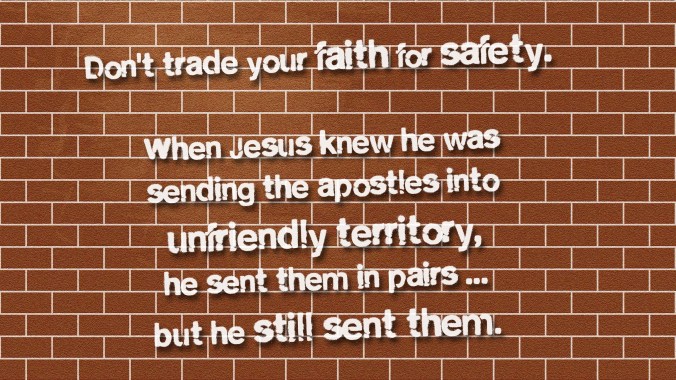
Most of us are comfortable briefly venturing into the wilderness of hunger, poverty, and sickness like tourists being led on a soup-kitchen safari, but – citing common sense and a need for security – we let others do the dangerous work of exploring that terrain and creating safe outposts for us to visit. We can strike a balance; because Jesus knew he was dispatching the apostles into unfriendly territory, he sent them in pairs … but he still sent them.

Facing an uncertain future, Israel quickly began to look back on centuries of slavery as “the good old days.” When we pine for the “simplicity” of the past, we tend to gloss over the bad parts like slavery, genocide, racism, sexism, disease, violence, and lack of indoor plumbing. Perhaps that’s because we are in the servitude of denial that all these things are still problems today.

Faith calls us to the wilderness. Fear tells us to turn back. Only one of those directions leads to the promised land.

Comfort: The future may seem uncertain to you, but it is all in God’s hands.

Challenge: God not promise us lives of ease or comfort.

Prayer: God of justice, help me embrace your freedom even when it frightens me. Thank you for leading me through the wilderness. Amen.

Discussion: Where do you feel drawn, but afraid, to serve?

Join the discussion! If you enjoyed this post, feel free to join an extended discussion as part of the C+C Facebook group. You’ll be notified of new posts through FB, and have the opportunity to share your thoughts with some lovely people.

Risen and Recognized

1459099239295.jpg

Easter readings (click below to open in new tab/window):
Acts 10:34-43, Psalm 118:1-2, 14-24, Acts 10:34-43, Luke 24:1-12

Today’s daily readings:
Psalms 93; 150, Exodus 12:1-14, John 1:1-18, Luke 24:13-35


Jesus Christ is risen today! Alleluia!

Where will we encounter him? Cleopas and another disciple (possibly his wife, who was present at the crucifixion) were on the road to Emmaus when they met him. Surprised that he didn’t seem to know about recent events in Jerusalem, they spoke of the crucifixion and the empty tomb. Though he interpreted for them the meaning of everything that had happened, they still did not know who he was. When he sat down to eat with them and blessed bread and broke it, “their eyes were opened” and they knew the risen Christ. “He had been made known to them in the breaking of the bread.”

Like the disciples who met him on the road, or the boat full of disciples who later saw him on the shore but didn’t recognize him, our vision of Christ can be limited by our expectations.

When we limit Christ to what we already know of him, we are not following the living Christ, but worshiping a lifeless photograph. Christ didn’t rise so we could wrap ourselves in a shroud-like faith that preserves but does not reveal.

To find the living Christ we often have to take time away from the safe and familiar worship at the foot of the cross – because he is no longer there!

The risen Christ may seem like a stranger, but we will recognize him by his love. When he breaks bread with our enemies. When he stands on a cold street corner protesting injustice. When he holds the hand of a lonely friend with a terminal diagnosis. When he digs a well on a desert reservation so people don’t have to drive two hours for water every day. When he welcomes refugees fleeing violence into his home for weeks at a time. Christ does all these things when we, as his only body here on earth, do these things. It is then when others who do not know him may see his nature revealed in us. It is then we can declare our redeemer lives.

Jesus Christ is risen today! Alleluia!

Comfort: Our savior lives, and he lives in us!

Challenge: Today of all days, greet everyone with love.

Prayer: Dear LORD I give thanks for the Risen Christ! May I live ever more deeply into the love you have shown us through his sacrifice and resurrection. Your grace and mercy are endless. May my praise be endless as well. Amen.

Discussion: Despite being a resurrection people, we often entomb our faith by confining it to church. How can you let yours free in the world?


Good News / Bad News

1458062295810.jpg

Today’s readings (click below to open in new tab/window):
Psalms 34; 146, Exodus 5:1-6:1, 1 Corinthians 14:20-40, Mark 9:42-50


We’ve all seen them: evangelists who go Full Brimstone attempting to convert non-believers. From the classic “If you’re wrong you’re going to hell!” to the modern “God Hates Fags” tactics deployed at military funerals and on cable, someone is always telling someone else why God is damning them to eternal suffering. Fear-based evangelism is notoriously ineffective except for fundraising from believers, but let’s give the benefit of the doubt to its practitioners and assume they are fumbling to share the core message of salvation through Christ. Then let’s meditate on some teachings of Paul and Jesus.

Paul advised the Corinthian that speaking in tongues impressed some believers, but to non-believers it was gibberish that at best said nothing and at worst confused or repelled them. He told those with the gift of prophecy to keep it reined in; believers and non-believers alike could be overwhelmed by more than two or three speakers at time. Zeal is admirable, but leading with the big guns doesn’t exactly tell people you come in peace.

Jesus told people it was better to cut off a hand or foot or to poke out an eye if those parts presented stumbling blocks to the little ones following him. This passage follows Christ’s rebuke of disciples who were unhappy to see strangers casting out demons in his name. Attacking their fledgling faith would have accomplished nothing, and may even have destroyed the good work they were doing.

Our convictions in Christ remain firm, but how we share them with others is important. When Jesus told the rich young man he would have to give up everything he owned to become a disciple … the rich young man walked away. If it doesn’t work for Jesus, it’s not going to work for us. The good news we have to share is not that hell is our default destination and we have the exclusive ticket out; the good news is God loves everyone enough to offer them eternal life. If that seems like a distinction without a difference, remember that famed dog- and horse-whisperers succeed because they teach by understanding their students, not forcing the students to understand them.

Comfort: There’s always another way to share the good news of our faith.

Challenge: Before sharing the Gospel, decide whether you’re trying to win souls or just win arguments.

Prayer: Loving God, thank you for the good news of Jesus Christ! Give me the courage and wisdom to share your word effectively with those who need to hear it. Amen.

Discussion: Are you comfortable speaking about your faith? Is any discomfort you have about what you believe, or about what you think you need to say to share it?

Join the discussion! If you enjoyed this post, feel free to join an extended discussion as part of the C+C Facebook group. You’ll be notified of new posts through FB, and have the opportunity to share your thoughts with some lovely people. Or feel free to comment here on WordPress, or even re-blog – the more the merrier!

Who Gives Speech to Mortals?

1457912343122.jpg

Today’s readings (click below to open in new tab / window):
Psalms 84; 150, Exodus 3:16-4:12, Romans 12:1-21, John 8:46-59


When God appeared to Moses from a burning bush and asked him to confront Pharaoh about freeing the Israelites, Moses was understandably hesitant. After all, the Egyptian king already wanted him dead, and Moses had spent the last forty years as a humble shepherd. How could he effectively present himself as God’s messenger? He wanted assurance the Egyptians would believe him.

To convince Moses that Pharaoh would listen, God commanded him to throw his staff to the ground. It became a serpent, and then a staff again when Moses grabbed it by the tail. The Lord then commanded Moses to tuck his hand inside his robe. When he drew it out again, it was white with leprosy. At God’s command he repeated the actions, and it was healed. Armed with these signs and more, Moses still resisted, insisting he was slow of speech and tongue. God, seeming almost exasperated by the this point, replied: “Who gives speech to mortals? Who makes them mute or deaf, seeing or blind? Is it not I, the LORD? Now go, and I will be with your mouth and teach you what you are to speak.”

Let’s consider for a moment the assurances God gave Moses. He didn’t arm Moses with magical amulets or enchanted weapons. Instead he said: show them your staff; show them your hands. God was telling Moses: “You are already equipped to do my work. Trust me.”

We often feel unwilling and ill equipped to do what God asks. Excuses come fast and easily. We lack finances. We lack time. We lack talent. But who gives us talent? Who makes us smart or senseless, rich or poor? When we answer the Lord’s call, he will equip us. This isn’t to say things will be easy. Moses experienced many trials both before and after his people left Egypt, and never entered the promised land himself, but God equipped him each step of the way.

Our gifts may seem completely ordinary until we trust God to use them, but when we do … who knows what miracles may happen and souls may be freed?

Comfort: You have been created with everything you need.

Challenge: Meditate on what you have to offer, no matter how small, that God could use.

Prayer: God of Creation, thank you for the many gifts you have given me. Teach me to see myself as you do: a child with limitless potential inspired by your love. Amen.

Discussion: What excuses do you use to avoid what’s asked of you?

Join the discussion! If you enjoyed this post, feel free to join an extended discussion as part of the C+C Facebook group. You’ll be notified of new posts through FB, and have the opportunity to share your thoughts with some lovely people. Or feel free to comment here on WordPress, or even re-blog – the more the merrier!

On The Dime

image


Today’s readings (click below to open in new tab/window):
Psalms 27; 147:12-20, Exodus 1:6-22, 1 Corinthians 12:12-26, Mark 8:27-9:1


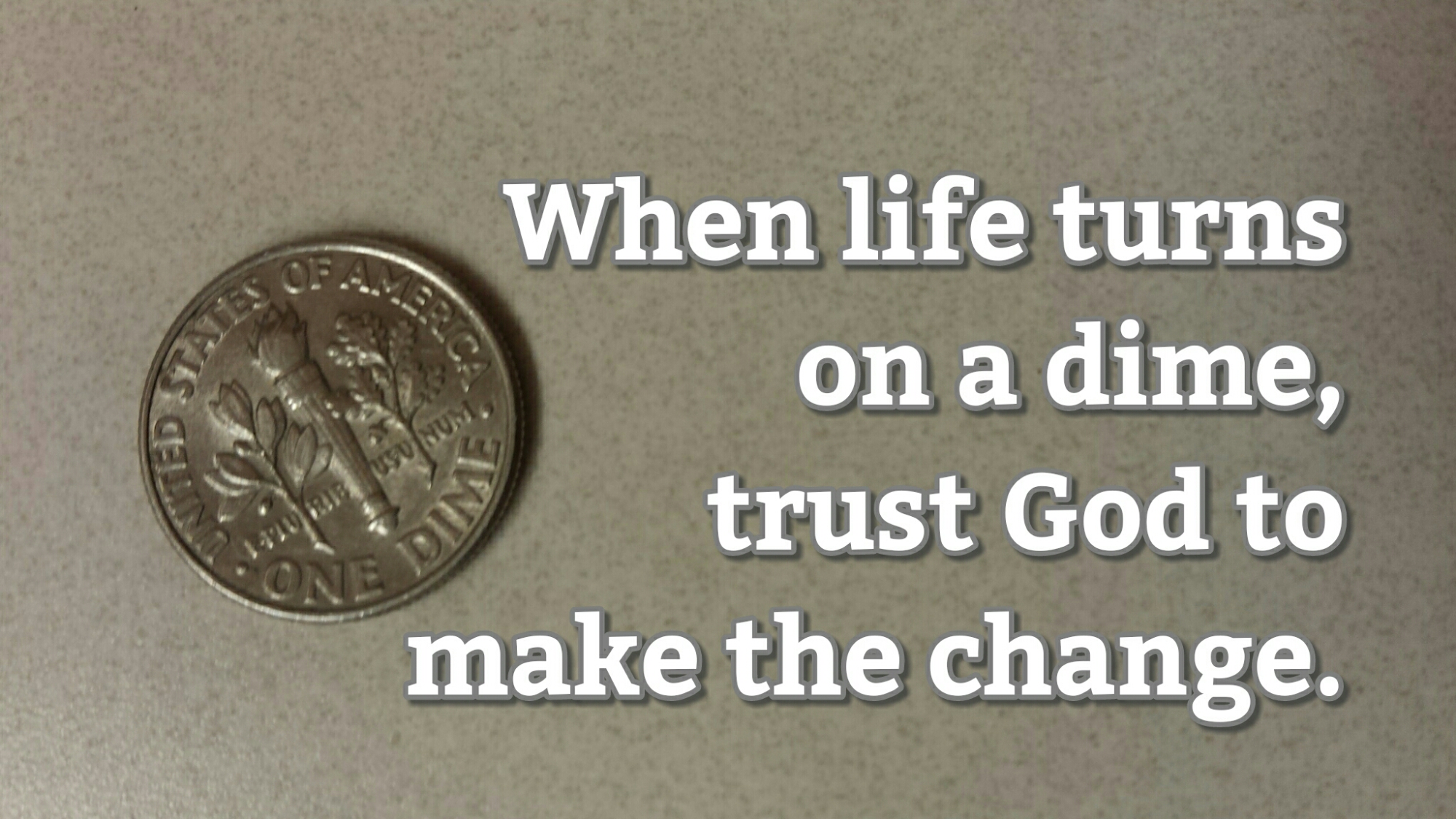
Have you ever heard the expression “life turns on a dime?” It refers to the way our fortunes can change with little to no warning. When a new king who did not know Joseph or Joseph’s family rose over Egypt, he did not look kindly on the Hebrews. This new king viewed them as a potential threat, should they decide to align with his enemies. To preempt any uprising, he put harsh taskmasters over them and turned them into a nation of slaves. He went so far as to tell the Hebrew midwives to kill any male children at birth. The midwives were clever, and said Hebrew women were strong and gave birth on their own before a midwife could arrive. In a generation, the Israelites went from famine to favor to fetters.

In what must have felt like a mid-stream change of course to the disciples, Jesus began to teach them he would have to undergo great suffering, die, and rise again to fulfill his mission as Messiah. After all the miraculous healing, multiplication of loaves and fishes, and adoration of the crowds, Peter couldn’t believe his ears. He tried to tell Jesus it didn’t need to be so, and Jesus famously responded: “Get behind me, Satan!”

Psychologists tell us change –– good or bad – is an enormous source of stress, and sudden change even more so. In truth, life is nothing but change. Our bodies are machines of change, transforming food and air into blood and thoughts. As we sleep, our planet moves around the sun and our sun turns with galaxies and we wake unimaginable distances from where we laid our head. Change is unceasing; only our awareness of it flickers.

At the center of it all is God. He is the fixed point on which all else pivots. No matter our fortune, no matter where in the universe we stand, Jesus is the north star of our faith, guiding us toward the loving creator at its heart. Whether we are showered with riches or stripped of dignity, focusing on the center keeps us from spinning out of control.

Comfort: Focusing on God keeps everything in perspective.

Challenge:  Talk with a friend about their perceptions of your ability to handle change.

Prayer: God of creation, you are my center and my focus. Thank you for your constant love. Teach me to keep your ways in focus. Amen.

Discussion: What changes do you find especially difficult? What makes you dig in your heels and say: “Enough!”

Join the discussion! If you enjoyed this post, feel free to join an extended discussion as part of the C+C Facebook group. You’ll be notified of new posts through FB, and have the opportunity to share your thoughts with some lovely people. Or feel free to comment here on WordPress, or even re-blog – the more the merrier!
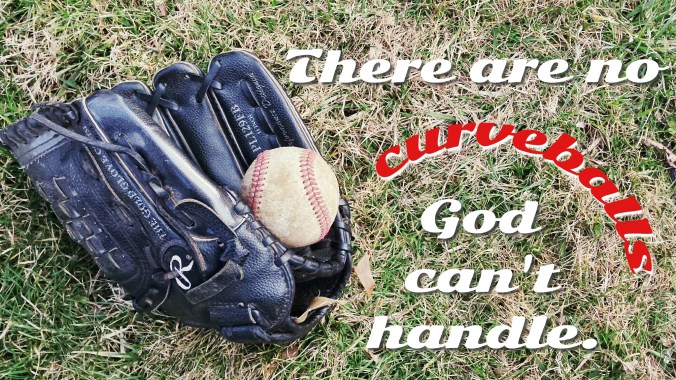
Curveballs

1457561126801

Today’s readings (click below to open in new tab/window):
Psalms 5; 147:1-11, Genesis 50:15-26, 1 Corinthians 12:1-11, Mark 8:11-26


Imagine you are Jesus. You’ve just miraculously fed four thousand people with no more than a few loaves and fishes. Not long before that you fed a greater crowd with fewer resources. Now you are in a boat with your disciples trying to use a parable about yeast to warn them about the pharisees and Herod. After a few minutes of pondering what you mean, they decide you are upset because … there is only one loaf of bread in the boat. If you were Jesus, would you have been a little frustrated that no one could seem to get past the lack of bread?

Are we wiser than the disciples? Do we treat every challenge like it’s the first one, or do we learn from our faith journey? No matter how many difficulties we’ve experienced, when new ones arise it can be hard to remember what we’ve survived. If God has seen us through illness, addiction, or betrayal are we able to trust He will see us through the newest crisis on the horizon? It’s not always easy, especially when we face the unfamiliar. Our first reaction is usually fear. But as the disciples eventually learned, trust in God can displace the fear. Trust may not completely eliminate the fear – we are only human! – but it changes our understanding of it. The trick is to remember that to God, this struggle is no worse than the ones that have come before.

Even the “best” lives are not free of challenges. As our faith matures, we begin to recognize huge challenges that didn’t register as important before. Issues of injustice, for example, become more obvious and less acceptable to us. If we can accept that life will never stop throwing us curveballs, that we have not failed because our lives aren’t perfected, maybe we can stop being surprised and devastated by them. If we are more in control of our reactions, we can surrender our troubles to God that much sooner. Some days we may ask how the bread could possibly be enough, but God is leading us to the bigger questions.

Comfort: You are not going through anything that God can’t see you through.

Challenge: When you are frightened by challenges, say prayers of thanks for all the situations God has already brought you through.

Prayer: Loving God, thank you for being with me in all situations. Forgive me when my fear interrupts my faith. Teach me to trust in you always. Amen.

Discussion: What things upset or frighten you because you can’t control them? Are you able to turn them over to God?

Join the discussion! If you enjoyed this post, feel free to join an extended discussion as part of the C+C Facebook group. You’ll be notified of new posts through FB, and have the opportunity to share your thoughts with some lovely people. Or feel free to comment here on WordPress, or even re-blog – the more the merrier!
The Truth about Crumbs and Dogs

1457351532294

Today’s readings (click below to open in new tab/window):
Psalms 119:73-80; 145, Genesis 49:1-28, 1 Corinthians 10:14-11:1, Mark 7:24-37


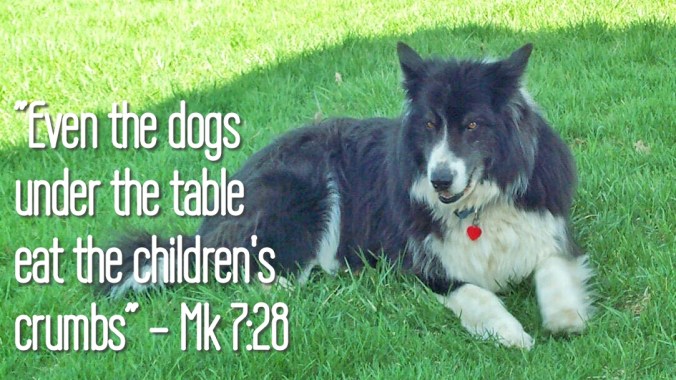
Not many people win an argument with Jesus. In Mark’s gospel there is only one example. She was both a Gentile and a woman, neither of which Mark’s audience would normally find persuasive. Yet she manages to change Jesus’ mind. When she asks him to rid her daughter of an unclean spirit, he tells her the food he offers should go to the children (of Israel) and not the dogs (a slur on her people). When she replies even the dogs get the children’s crumbs, her words stir him to help her daughter. What does it tell us that Jesus not only changed his mind, but was convinced to do so by someone considered a lowly outsider?

For one thing, it tells us we ought to be cautious about being overly sure of ourselves. If Jesus can change his mind, we can too. Closing our minds, especially when we are called to be merciful, betrays both the ministry of Jesus and what we ourselves are called to do. The moment we declare boundaries around the realm of God’s grace, we have placed our own wisdom above that of Christ.

It also tells us outsiders can be insightful critics. Individuals and communities often dismiss valid criticisms because they come from “outsiders” who couldn’t possibly understand, or perceive objective yet unflattering observations as attacks. Instead of absorbing facts and asking ourselves hard questions, we dig in our heels and counter-attack. And it doesn’t take much for us to tag someone as other: Christian communities do this both with non-Christians, and fellow believers who are in different denominations or understand scripture differently. Not so with Jesus. When an outsider presented a valid perspective, he responded not with defense or attack, but reconciliation and healing. That must be our model as well.

We don’t want to change our beliefs or practices like a reed swaying in the breeze of every opinion, but if continuing those beliefs and practices requires us to ignore or reject challenging truths … they were never very strong anyway. Weak faith shrinks by rejecting truth; strong faith expands by accepting it.

Comfort: Truth will only make your faith stronger.

Challenge: Consider how do you deal with challenges to your beliefs? Do you calmly consider other opinions, or do you immediately seek to dismiss or refute them?

Prayer: God, you alone know all truth. Help me to love the world as you have truly created it, and not as my limited human understanding has tried to define it. Amen.

Discussion: Some might argue Jesus already knew he was going to reconcile with the woman. If this is the case, why might he have at first denied her? Does it change our understanding of the lessons in the story?

Join the discussion! If you enjoyed this post, feel free to join an extended discussion as part of the C+C Facebook group. You’ll be notified of new posts through FB, and have the opportunity to share your thoughts with some lovely people. Or feel free to comment here on WordPress, or even re-blog – the more the merrier!