Get Fruity

1454216755992

Today’s readings (click below to open in a new tab/window):
Psalms 108; 150, Genesis 18:16-33, Galatians 5:13-25, Mark 8:22-30


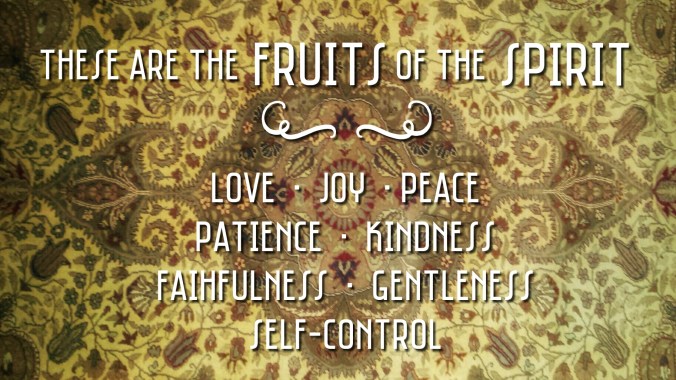
Paul’s letter to the church in Galatia introduced the phrase “fruits of the spirit.” He wrote this letter to the mostly Gentile church because they had fallen under the influence of Jewish evangelists who were persuading them they needed to observe Mosaic law to be good followers of Christ. Paul reminded the Galatians that salvation through Christ leads to changes in attitude and behavior, not the other way around. Over the centuries some Christians have ironically twisted Paul’s insights into a new set of rules and subverted his intent.

Why are we tempted to treat Paul’s list of the fruits of the Spirit and the works of the flesh like a checklist of do’s and don’ts, as though we are wrangling a spot on Santa’s Nice List? It’s always easier to follow specific rules than to do the hard work of learning how to truly love our neighbor. So we substitute a (rather subjective and conveniently curated) list of virtuous activities and evil vices and convince ourselves we are good because we do or don’t do them. We are right back to living for the law, and a second-rate law at that.

Performing good deeds to prove the Spirit is within us is like laying a bunch of apples on the ground and hoping a trunk forms in the middle to raise them all up; they are just going to lay there and eventually rot. Instead we must open ourselves to the Spirit as saplings open to the sun. As we mature in its presence, the resulting fruits – love, peace, generosity, kindness, self-control, etc. – sprout naturally and abundantly. We will act in love and joy because they grow from the inside out.

One last, important feature of fruit: when someone picks it, the branch is not diminished but freed up to create more. Fruit left to rot on the vine does no one any good. Life in the Spirit is not self-centered, but generous. True fruits of the Spirit not only nourish us, they contain the seeds that create a cycle of faith and growth. Our best testimony is the fruit we bear.

Comfort: God’s love for you does not depend on your ability to follow arbitrary rules.

Challenge: Learning to love our neighbors as Christ teaches us to love them takes dedication and hard work.

Prayer: Lord, I will treasure and share the fruits your Spirit has trusted to me.

Discussion: What kinds of rules are important to you? What are not?

Join the discussion! If you enjoyed this post, feel free to join an extended discussion as part of the C+C Facebook group. You’ll be notified of new posts through FB, and have the opportunity to share your thoughts with some lovely people. Or feel free to comment here on WordPress, or even re-blog – the more the merrier!


Attitude of Abundance

GRASPFUTURE

Today’s readings (click below to open in a new tab/window):
Psalms 88; 148, Genesis 17:15-27, Hebrews 10:11-25, John 6:1-15


Our culture promotes irony and cynicism. These can be useful and enlightening, but many times they simply mask an underlying state of fear. When push comes to shove, we tend to hoard the resources we have rather than trust them to God’s abundance. Even in faith communities simple optimism is often characterized as simple-mindedness.

God told Abraham and Sarah, at 100 and 90 years old respectively, they would conceive a child. Abraham laughed in disbelief. When their son was born, they did as God had instructed and named him Isaac, meaning “he laughs.” With God in the mix, irony became hope.

When thousands gathered at the Sea of Galilee to hear Jesus preach, he asked his disciple Philip where they could buy bread to feed everyone. We don’t know if Phillip laughed, but it’s easy to imagine a dismissive chuckle when he told Jesus they would need more than six months’ wages to buy enough food. And it seems likely there might have been some eye rolling when Andrew mentioned a boy with five loaves of bread and two fish. Yet from this tiny bit, upon Christ’s instructions, they managed to feed everyone with twelve baskets left over.

At first glance the common theme between these stories seem to be that God is most visibly present in the impossible. Unfortunately this idea pushes God outside our normal expectations into a realm where we can only experience his blessings through reality-warping events.

An important lesson in these stories is that God has created us not be starved by fear and doubt, but to feast on possibilities and faith. The approach we take affects the quality of our lives, and the lives of others. More than a simple “can-do” attitude, faith that God’s world is abundant opens us up to true generosity. If we stop worrying that what we have is not enough, we grow comfortable with being generous even in uncertain times. Individuals with this faith can have a positive impact, and communities that cultivate this attitude will find endless doors opening. Behind them is revealed God’s presence in our everyday lives.

The world teaches fear. An abundant faith – focusing not on scarcity and stinginess, but on hope and generosity – is countercultural and revolutionary. Live on the edge.

Comfort: You need less than you think you do. You can give more than you think you have.

Challenge: Embrace hope.

Prayer: Loving God, please help me to remember there is far more to your gifts in the world – seen and unseen – than I could ever comprehend. I will trust you. Amen.

Discussion: In what areas of your life – money, time, affection, etc. – do you take an approach of scarcity? How can you become more generous?

Join the discussion! If you enjoyed this post, feel free to join an extended discussion as part of the C+C Facebook group. You’ll be notified of new posts through FB, and have the opportunity to share your thoughts with some lovely people. Or feel free to comment here on WordPress, or even re-blog – the more the merrier!


Breaking the Law

image

Today’s readings (click below to open in a new tab/window):
Psalms 54; 146, Genesis 15:1-11, 17-21, Hebrews 9:1-14, John 5:1-18


The fourth commandment is “Remember to keep holy the Sabbath.” For most Christians Sunday is the Sabbath but after church is over it’s not much different than the rest of the week. We are free to go shopping, eat out, and do as we please. Therefore we may underestimate the enormity of Jesus’ decision to perform a healing miracle on the Sabbath. This wasn’t someone declining an opportunity to “take it easy” – it was an act of defiance punishable by death.

For observant Jews, the Sabbath is a day of rest and worship, beginning at sunset on Friday and ending with the appearance of the first three stars on Saturday evening. Sabbath is rich with traditions, prayers, obligations, and rules. One key Sabbath concept is that no work is to be done: even candles must be lit and food prepared in advance. Today it is a strictly religious tradition observed more closely by some Jews than others, but among Jesus’ contemporaries there was no distinction between religious and secular law.

What might have been important enough to Christ to merit this act of disobedience? Mercy.

Could he have waited to heal the ailing man? Possibly. People had walked past and over this lame man for decades. Jesus didn’t break rules just for the sake of breaking them: by choosing mercy over law on the Sabbath, he demonstrated that mercy is always God’s highest priority. No excuse – our own need to be “holy” or even the threat of punishment – justifies withholding it.

For all our claims to be a people freed of legalism, Christians have developed plenty of rules to stand between us and mercy. From baptisms to funerals and everything between, we have our own unclean persons, our own restricted privileges, and our own inviolable traditions. Conscience tells us when mercy is the right response, but fear of breaking the rules and being punished by our social group may keep us from exercising it. When the Spirit prompts us, let’s be brave enough to break a rule or two and touch that “untouchable” person with our hands, hearts, and words.

Comfort: The Lord wants us to love mercy – that means receiving as well as giving.

Challenge: Critically consider whether  rules you have set up for yourself get in th way of being merciful to others.

Prayer: Lord Jesus Christ, Son of God, have mercy on me, a sinner.

Discussion: What does our willingness (or unwillingness) to show mercy say about our relationship with Christ?

Join the discussion! If you enjoyed this post, feel free to join an extended discussion as part of the C+C Facebook group. You’ll be notified of new posts through FB, and have the opportunity to share your thoughts with some lovely people. Or feel free to comment here on WordPress, or even re-blog – the more the merrier!

Sleeping with the Enemy

WEAKRESOLVESTRONGFAITH

Today’s readings (click below to open in a new window):
Psalms 56; 149, Genesis 12:9-13:1, Hebrews 7:18-28, John 4:27-42


How do we approach people we assume to be our enemies? Today’s readings feature two stories about people traveling through presumably hostile territory. They start with very different mindsets, and have very different results.

When Abram and his beautiful wife Sarai arrived in Egypt, he instructed her to pose as his sister so the Egyptians who wanted to woo her would treat him well. Otherwise, he feared, they might murder him to take her. Word of her beauty reached Pharaoh and soon she was living in his home. Displeased with this situation, God afflicted Pharaoh’s household with great plagues. His lie thus revealed, Abram was forced to flee with Sarai.

While passing through Samaria, Jesus stopped at a well. He had a very candid though compassionate conversation with a woman he met there. Once he revealed himself to be the messiah by showing he knew undisclosed details of her life, she was not afraid to challenge him about his relationship with non-Jews. After the people of her town heard her story, they invited Jesus to stay and he spent two days with them. As a result many Samaritans became believers.

Abram told an easy lie, and Jesus told hard truths. The Egyptians treated Abram well for a while, but no relationship was established. In the end, the lie forced him away. The Samaritan woman respected Jesus because he told the truth, and returned his frankness. The initial conversation between them does not read as comfortable, but in the end he formed an unexpected and important relationship with the Samaritan people.

The world tells us never to trust our enemies, and to do unto them before they do unto us. Jesus teaches and shows us another way. It is a more risky path, as we can never be sure of our enemy’s intentions, but it also opens a door to the possibility of reconciliation. If we refuse to hear someone’s story, or respond with judgment, that door stays closed. Being the first to offer a hand in peace is not a sign of a weak resolve, but of a strong faith.

Comfort: Jesus doesn’t want a relationship with your Sunday best, he wants one with your honest everyday self.

Challenge: Do you have any enemies you could get to know better? Try to do so.

Prayer: Prince of Peace, teach me the ways of peace. Amen.

Discussion: Who do you consider your enemies? How do you communicate with them?

Join the discussion! If you enjoyed this post, feel free to join an extended discussion as part of the C+C Facebook group. You’ll be notified of new posts through FB, and have the opportunity to share your thoughts with some lovely people. Or feel free to comment here on WordPress, or even re-blog – the more the merrier!

Worship Well

DCP_0580

Today’s readings (click below to open in a new tab/window):
Psalms 130; 148,Genesis 11:27-12:8, Hebrews 7:1-17, John 4:16-26


Samaritans and Jews shared common roots but also shared a bitterness – even a hostility – over religious differences. When Jesus passed through Samaria, he sat by a well to rest while his disciples went into town for food.  He asked a local woman for a drink of water, and as a result of the conversation that followed she recognized him as a prophet. Then, for the first time in John’s gospel, Jesus identified himself as the Messiah. John the Baptist and the disciples already believed this but, according to John’s narrative, Jesus had not confirmed it. So why would he choose to reveal himself openly to this non-Jewish woman in this non-Jewish place?

The well where they met was Jacob’s well, a site significant to both Jewish and Samaritan history. When Jesus said those who drank its waters would be thirsty again, but those who drank the living water he offered would never thirst again, he was saying eternal life was not found in or bound to any material source but in the truth. When the woman pointed out that Jews worship in Jerusalem and Samaritans on Mount Gerizim, he responded: “the hour is coming when you will worship the Father neither on this mountain nor in Jerusalem […], when the true worshipers will worship the Father in spirit and truth.”  His words told her, and tell us today, God is greater than any constraints of tradition or culture.

What constraints do Christians place on God and worship today? We insist on creeds and denominations that are more products of political history than spiritual necessity. Within denominations we have yet more division among groups who believe they own more truth than others. Like a person who believes nothing exists beyond what can be seen through a single window, we can mistakenly use the Bible to limit our understanding of God rather than accept truth wherever it is found.

Unexpected revelation from God occurs not when we are certain and comfortable, but when we are questioning and in strange – perhaps enemy – territory. Sometimes we have to leave our temple or mountain to find where the living waters flow.

Comfort: God is greater than any box we try to put him in.

Challenge: Think critically about your own assumptions, including those taught to you.

Prayer: God of all creation, forgive me when I don’t love all you have made. Amen.

Discussion: What restrictions do you try to place on God? Who do you exclude as a result?

Join the discussion! If you enjoyed this post, feel free to join an extended discussion as part of the C+C Facebook group. You’ll be notified of new posts through FB, and have the opportunity to share your thoughts with some lovely people. Or feel free to comment here on WordPress, or even re-blog – the more the merrier!

Decrease to Increase

YourBest

Today’s readings (click below to open in a new tab/window):
Psalms 15; 147:1-11, Genesis 9:18-29, Hebrews 6:1-12, John 3:22-36


The ministry of John the Baptist was a big success. Business was so good he had customers lined up from Bethany to Aenon, where he moved because it had more water to let him do his job. He had his own disciples and irritated all the right authorities. Yet when Jesus arrived on the scene, John willingly gave it all up. John knew something we often forget: successful ministry is not determined by numbers or longevity, but by how well it advances the message and mission of Christ. When John’s followers began flocking to Jesus, John didn’t start planning how to win them back. Instead he said of Jesus: “He must increase, but I must decrease.”

Christian ministry is not a competition, but our competitive nature can sneak into it. Choir solos, sermons, fundraisers, offerings, praise hands, potluck contributions – sometimes we can’t help comparing these things, especially if we are good at them. If healthy competition pushes us to do our best work, the ministry may benefit. When we start thinking of our collaborators as rivals, we do a disservice to everyone, and undermine the community and the ministry. Whether an individual or church, we let our lights shine to illuminate the love of Christ, not to put a spotlight on ourselves. Even if we are the very best at something, sometimes we must intentionally step aside to let others play their parts. Being our best – not the best – is what matters.

Mature preachers will say praise and criticism are the same. In other words, they hear feedback, but do Christ’s work for the sake of the work, not the reaction. Praise does not swell their heads, and criticism does not defeat them. This ego-free attitude requires cultivation, but our work will be the better for it. There’s nothing wrong with enjoying a compliment for a job well done, but if our focus moves from Jesus to acquiring compliments (or members, or money, or readers), our work suffers.

For others to increase, sometimes we must decrease. But if we do it to help Jesus increase, we rise along with him.

Comfort: The best ministries are collaborations; you don’t have to do everything yourself.

Challenge: Whenever you feel competitive with someone, ask yourself whether it is healthy or unhealthy.

Prayer: Gracious God, teach me to appreciate the diversity of the Body of Christ. Amen.

Discussion: Where do you find yourself competing when you could be cooperating?

Join the discussion! If you enjoyed this post, feel free to join an extended discussion as part of the C+C Facebook group. You’ll be notified of new posts through FB, and have the opportunity to share your thoughts with some lovely people. Or feel free to comment here on WordPress, or even re-blog – the more the merrier!

Math Nerd Theology

1452489798883

Today’s readings (click below to open in new tab/window):
Psalms 5; 145, Genesis 2:4-9 (10-15) 16-25, Hebrews 1:1-14, John 1:1-18


First, a short math lesson. When you square any number, positive or negative, the result is always a positive number: 3 x 3 = 9 and -3 x -3 = 9. Fairly straight forward, yes? (If not, don’t worry; there won’t be a quiz). However, some equations can’t be solved without finding the square root of a negative number. Since such a number does not exist, mathematicians invented an imaginary unit named i. Perhaps it’s more correct to say they discovered it; philosophers have debated for centuries whether mathematical concepts are invented or discovered. In either case, the square of i is -1. No one can hold up i fingers or charge $i for a pound of bananas, but i is necessary to calculate the square root of -9, which is 3i. 

End of math lesson. But what was the point?

The Gospel of John tells us that in the beginning, there was the Word, and the Word was with God, and the Word was God. In the original Greek, John uses the term logos, which means “word” but also means “reason.” John’s logos is Christ, so John is claiming Christ has been present and co-existent with God from before the beginning of the world. How can this be? Like i, faith in the logos solves an otherwise impossible problem. John has no direct evidence for it, but he invents/discovers it to make sense of God’s relationship with the world expressed through Christ. Some may call it imaginary, but it is also necessary.

Critics of faith often mock it for lacking reason. If your faith comes under fire for being unreasonable, think of i (but not too hard, or your brain may start to itch). Just because something can’t be pointed to or counted doesn’t mean it’s not essential to the fabric of the universe. We don’t call the entire field of mathematics a sham because it relies on an “imaginary” unit. The claim of Hebrews 11:1 that “faith is the evidence of things unseen” is our version of i, the necessary but unknowable solution for morality, eternity, and the soul.

And we thought algebra would never be good for anything.

Comfort: Faith isn’t about seeing, but believing.

Challenge: Call your algebra teacher and apologize for not paying more attention.

Prayer: All powerful Creator, I thank you for being present in the world, though your mystery is beyond my understanding. Amen.

Discussion: Have you ever found a use for something you thought would be useless when you learned it?

Join the discussion! If you enjoyed this post, feel free to join an extended discussion as part of the C+C Facebook group. You’ll be notified of new posts through FB, and have the opportunity to share your thoughts with some lovely people. Or feel free to comment here on WordPress, or even re-blog – the more the merrier!


Telescope or Kaleidoscope?

1452400078790

Today’s readings (click below to open in new tab/window):
Psalms 104; 150, Genesis 1:1-2:3, Ephesians 1:3-14, John 1:29-34


The first Biblical account of creation tells the story of God creating for six days and resting on the seventh. That story is immediately followed by a second one that differs in detail but still ends with the first human beings in a garden paradise. When we recall the stories, we often blur the lines between them, taking a six-day schedule from one, a borrowed rib from another. The Biblical creation accounts don’t stop with Genesis. Proverbs, Job, John, multiple Psalms – these and other passages provide widely varied accounts of how God went about creating the world. How is it they can be so different, yet part of a unified whole?

The Gospels are similar. Each tells the story of Jesus from a different viewpoint, so they are similar but not the same. Studies show that eyewitness accounts are notoriously unreliable, yet sometimes our legal system still depends on them. The more witnesses who can corroborate key details, the better. A telescope is accurate but limited by its singular field of vision; a kaleidoscope gives us many angles of the same view.

Let’s consider our own histories. When we and our siblings or friends reminisce about childhood, we don’t all recall it the same way. Ever listen to a married couple tell a story jointly? There is quite a bit of give and take, argument and correction as they navigate their way through the tale. Witnesses, friends, or partners, they are all working toward finding truths that can only be reconstructed by layering multiple perspectives and insights.

When we dive into the big questions – Who am I? Why am I here? What’s it all about? – no single story tells us all we need to know. The compilers of the Bible were not concerned that the creation stories “agree” because that’s not the point. Even the “conflict” between Genesis and science disappears when we consider facts and truth are not revealed in a single snapshot, but in multiple exposures over a long period of time. If we insist that only one story is factual, we’ll never know which ones are true.

Comfort: We don’t have to have all the answers.

Challenge: We have to keep asking the questions.

Prayer: God of Creation, help me to value your truth more than my own certainty. Amen.

Discussion: Every family has its own mythology. What’s one of your family’s most meaningful stories? If you don’t have a family, what makes a story meaningful to you?

Join the discussion! If you enjoyed this post, feel free to join an extended discussion as part of the C+C Facebook group. You’ll be notified of new posts through FB, and have the opportunity to share your thoughts with some lovely people. Or feel free to comment here on WordPress, or even re-blog – the more the merrier!

Sowers Gonna Sow

seeds-1117851_1920

Today’s readings (click below to open in new tab/window):
Psalms 12; 146, Ezra 5:1-17, Revelation 4:1-11, Matthew 13:1-9


In the Parable of the Sower, a man casts seeds across many types of ground. Some of it is a bare path where the birds can snatch it up. Some of it is rocky and rootless. Some is thorny and inhospitable. And finally, some of it is good soil. The different types of ground, Jesus eventually explains to his disciples, represent the different types of people who hear the Gospel.

Not much is said about the sower, who may be Jesus, but who may also be anyone (or everyone) spreading the Good News. Would we consider this sower a good steward of his responsibilities? It sounds like an awful lot of seed went to waste. Why weren’t his efforts more focused? Was he unable to tell good soil from bad? Maybe. Maybe not. In the end, each type of soil yielded or did not as was its nature … but the sower left no ground without potential.

When it comes to spreading grace, or acts inspired by grace, stewardship takes on a new dimension. Funds may be limited, but generosity is not. Physical resources may be limited, but love is not. Time and talents may be limited, but forgiveness is not. So why be stingy with generosity, love, or forgiveness? Even if they don’t yield what we would hope, we don’t run out of them. They are meant to be cast about widely – almost irresponsibly – because they aren’t about what we get back.

Are some people going to take advantage of our good nature? Almost certainly. Are some people never going to “get it together” despite our best efforts to support them? Definitely. Is it our job to size them up in advance and decide whether or not to waste our efforts? Or to withhold that seed in a clenched fist, as though there’s a finite supply, until we find the exactly right spot to sow it?

If we want to be sowers like the one in the parable … it is not. So sow.

It’s a balancing act. We want to be wise about how we steward finite resources to meet needs, but we also want to be wise about which resources were never ours to keep anyway.

Comfort: The more generous you are, the less you will need.

Challenge: When you find yourself withholding what you have received through grace, meditate on why.

Prayer: Because the poor are despoiled, because the needy groan, may the Lord now rise up, and may we follow. (based on Psalm 12:5)

Discussion: Do you think your definition of who “deserves” grace is the same as God’s?

Join the discussion! If you enjoyed this post, feel free to join an extended discussion as part of the C+C Facebook group. You’ll be notified of new posts through FB, and have the opportunity to share your thoughts with some lovely people. Or feel free to comment here on WordPress, or even re-blog – the more the merrier!

Enforced Belief (And Other Myths)

Ghirlandaio,_Domenico_-_Calling_of_the_Apostles_-_1481

Commissioning the Twelve Apostles depicted by Domenico Ghirlandaio, 1481

Today’s readings (click below to open in new tab/window):
Psalms 135; 145, Jeremiah 36:11-26, 1 Corinthians (13:1-3) 13:4-13, Matthew 10:5-15


When Jesus sent out the Twelve to spread the Gospel to the “lost sheep of the house of Israel,” he gave them several instructions. They were to accept no payment for any of the healing they did. They were to take not much more than the clothes on their backs, for the people should show them hospitality. When they reached a town or village, they were to select a worthy home to stay in, and “let [their] peace come upon it.” If the house turned out not to be worthy, they were to “let [their] peace return to [them].” And if any town or house would not welcome them, they were to shake its dust from their feet as they left it.

Note the absence of any type or coercion or retaliation. The fate of anyone who rejected the Gospel was ultimately between them and God. Of course the Twelve had no legal authority to enforce belief, but then again “enforced belief” is an oxymoron. Without the power of an empire behind them Jesus and his disciples were an all-volunteer movement. So how did Christianity become less about sacrificing and suffering for our beliefs and more about making others suffer for not agreeing to share them?

Jesus asks us to share the Gospel, but he doesn’t ask us to enforce it. When the Twelve met resistance, they simply withdrew the only thing they had to offer, which was the peace they knew. If someone doesn’t want to embrace the message, there’s not much we can do about it. Petty pressures like trying to wring a “Merry Christmas” out of a  cashier in a setting that is essentially a temple to commerce only reinforces the stereotype that Christians are intolerant. Do such actions seem like the love Paul describes in Corinthians – a love which is patient, kind, and does not insist on its own way? Real evangelizing begins with vulnerability.

A Christianity consumed with exerting the upper hand is far removed from the Beatitudes, the Apostles, and the greatest who seek to be least. Jesus said we are blessed when we are persecuted for his name’s sake, not when we persecute in his name. When emperors (and their admirers) claim to be wearing Christian clothes but are more interested in destroying perceived enemies than loving them, speaking the naked truth in humility may be the most powerful witnessing we can do.

Comfort: Jesus is a comfort to the afflicted…

Challenge: …and an affliction to the comfortable.

Prayer:  Rejoice in the LORD, O you righteous,
and give thanks to his holy name! (Psalm 97:12)

Discussion: Do you think there is such a thing as a Christian nation?

Join the discussion! If you enjoyed this post, feel free to join an extended discussion as part of the C+C Facebook group. You’ll be notified of new posts through FB, and have the opportunity to share your thoughts with some lovely people. Or feel free to comment here on WordPress, or even re-blog – the more the merrier!