Pie(ty) in the Face

people-2585962_1920

Today’s readings (click below to open in new tab/window):
Psalms 143; 147:12-20, 2 Kings 9:1-16, 1 Corinthians 6:12-20, Matthew 6:1-6, 16-18


If a Christian prays in a forest and nobody hears, does she or he make a sound?

Maybe the answer to that question is, “God hears either way.”

Jesus taught his disciples not to be flashy about their faith, unlike the people who fasted and made sure to look miserable, or the alms-givers who literally trumpeted about their gifts, or the people who offered long and loud prayers on street corners. Instead he instructed them pray privately, fast discreetly, and give secretly. Ostentatious faith gathers the reward of attention, but not a heavenly reward.

It’s once we leave the seclusion of the spiritual forest that we learn whether we’ve spent our time there wisely learning to live and spread the gospel, or simply trying to persuade God to notice us. Flamboyant demonstrations of faith move the spotlight off of Christ and onto us. The evidence of a heart transformed by Christ is in how we love people, regardless of whether anyone ever acknowledges or even knows we’ve loved them. Is it possible to spread a gospel containing the idea the last are first and the first are last if we always seem to be going for gold in the piety Olympics?

When Elisha dispatched a young prophet to tell Jehu in private that God had anointed him to depose King Joram and become the new king of Israel, Jehu played it down to his fellow commanders. He dismissed it by saying, “You know how those prophet types are!” but his colleagues forced a confession out of him. Though he died about 800 years before Christ was born, Jehu understood the power of spiritual humility.

In her song These Old Bones, Dolly Parton sings about a woman with a prophet-like gift for seeing the truth. The woman says, “But unless somebody just plain out and asked me, well, I just figured there ain’t no point goin’ around actin’ like you know everything, just ’cause you might.” Humble authenticity, not an overwhelming display, is the key to winning people over. Though our witness is certainly part of our evangelistic toolkit, the moral of our story is not “Christ saved me,” but “Christ’s sacrifice was for everyone.”

Comfort: You don’t have anything to prove to anyone.

Challenge: So stop trying.

Prayer: Lord where there is despair, let me sow hope. Amen.

Discussion: Where and how do you like to pray?

Join the discussion! If you enjoyed this post, feel free to join an extended discussion as part of the C+C Facebook group. You’ll be notified of new posts through FB, and have the opportunity to share your thoughts with some lovely people. Or feel free to comment here on WordPress, or even re-blog – the more the merrier!

Bad Judgment

mind-2197437_1920

Today’s readings (click below to open in new tab/window):
Psalms 56; 149, 2 Kings 2:1-18, 1 Corinthians 4:1-7, Matthew 5:17-20


Judgment is a difficult practice to avoid. We try, but it is a persistent demon. When we’re lucky we meet it face-to-face and recognize it for what it is. Though we might fail we at least recognize we aren’t to judge others for what we consider their faults and failures. But sometimes that demon comes at us sideways or sneaks up on us from behind. Isn’t judging someone’s behavior as good or worthy still a form of judgment? And isn’t claiming we would do better under the same circumstances a way of passing judgment on ourselves and others over things that are merely hypothetical?

When Paul learned the people of Corinth were practically looking for excuses to pass judgments on each other, he told them: “What do you have that you did not receive? And if you received it, why do you boast as if it were not a gift?” Paul offered himself as an example of someone who judged himself neither favorably nor poorly: he left that up to God’s final judgment, saying: “I am not aware of anything against myself, but I am not thereby acquitted.”

Living without some judgments is impossible. We have to decide – among many other things – whom to trust, whose company we should value and whose we should avoid, and whether someone’s behavior is helpful or harmful to themselves, us, and the community. The difference between lower-case, every day judgment and Judgment with a capital J is whether or not we approach it with an assumption that we understand more than we do. Other people’s motives, struggles, and limitations are largely not just unknown but unknowable to us. Only God can judge, because only God knows the entire truth.

It’s not our place to determine whether other people are using their gifts as well as they should or could be. It’s our job to figure out how we should be using our own gifts, and never be complacent about whether we are. Perhaps the most nefarious disguise Judgment can wear is a reflection of our own face, telling us what we’d like to hear.

Comfort: God will get around to judging what needs to be judged…

Challenge: … and very little of it may end up being to our satisfaction or expectation.

Prayer: I will give thanks to the LORD with my whole heart, in the company of the upright, in the congregation. (Psalm 111:1)

Discussion: When have you realized you judged someone wrongly or harshly?

Join the discussion! If you enjoyed this post, feel free to join an extended discussion as part of the C+C Facebook group. You’ll be notified of new posts through FB, and have the opportunity to share your thoughts with some lovely people. Or feel free to comment here on WordPress, or even re-blog – the more the merrier!

Will they follow?

ducks-in-a-row-1316756-1598x1062

Today’s readings (click below to open in new tab/window):
Psalms 63; 149, 1 Kings 12:1-20, James 5:7-20, Mark 15:33-39


Every leader, from a shift manager at a burger joint to the president of the United States, eventually faces the same problem: how to lead when your people are dissatisfied. Almost as soon as Solomon’s son Rehoboam became king, the people of Israel confronted him to lift the heavy burdens placed on them by his father. Rehoboam consulted the older men of his court, and they advised him: “If you will be a servant to this people today and serve them […] then they will be your servants forever.” Rehoboam didn’t like that answer so he asked his younger friends who told him to say: “My father disciplined you with whips, but I will discipline you with scorpions.” Rehoboam chose to double-down with the scorpions, and the House of David went out of the king business when his people killed his enforcers and drove him out of Israel.

Rehoboam clung to the mistaken belief that a show of power is the same as a show of strength. His fear of appearing weak overrode the wisdom of his senior advisors. Like an inexperienced horseman who tries to lead by force, a fearful leader grips the reins of power too tightly and the people buck. Many businesses, rather than operating on the classic model of imposing decisions and punishing those who disagree, have adopted a habit of asking their employees how to improve productivity, working conditions, and profits before making decisions. Employees (or citizens or congregations) are more invested in an organization and leader they believe values them.

The servant leader doesn’t capitulate to every whim of every person she or he leads. Jesus did not compromise his principles to make the disciples happy – otherwise he would have never ended up on the cross. Servant leaders set aside ego and fear to make the best decisions for their people, even when that means setting aside power and embracing vulnerability. As a result the leader may be loved or despised – usually both – but it does not affect the leadership. True leadership has authority because it displays the strength of sacrificial love.


Comfort: When you are called to lead, you aren’t called to control. 

Challenge: Pay attention to people’s leadership styles. What does it tell you about them?

Prayer: Merciful God, I am in  your service always. Amen. 

Discussion: Whose leadership have you respected, and why?

Join the discussion! If you enjoyed this post, feel free to join an extended discussion as part of the C+C Facebook group. You’ll be notified of new posts through FB, and have the opportunity to share your thoughts with some lovely people. Or feel free to comment here on WordPress, or even re-blog – the more the merrier!
… and the creeks don’t rise.

holding-hands-1308211-1599x1066

Today’s readings (click below to open in new tab/window):
Psalms 84; 148, 1 Kings 11:26-43, James 4:13-5:6, Mark 15:22-32


My paternal grandmother had a habit of concluding any talk about future plans with a “God willing.” As a kid I thought it seemed unnecessarily pessimistic and cast any life events more than a couple weeks out under the shadowy gloom of imminent death. At times it seemed almost superstitious, like tossing spilled salt over your shoulder – except it was a spill of hopes and dreams that needed protecting. Had I paid more attention to the Epistle of James, I might have felt differently:

Come now, you who say, “Today or tomorrow we will go to such and such a town and spend a year there, doing business and making money.” Yet you do not even know what tomorrow will bring. What is your life? For you are a mist that appears for a little while and then vanishes. Instead you ought to say, “If the Lord wishes, we will live and do this or that.”

Grandma didn’t have an easy childhood, and knew hardship well into adulthood. She had more than her share of disappointments and regrets, of dreams and hopes which evaporated like mist, many of which I didn’t appreciate or learn about until I was an adult. Using “God willing” like ending punctuation was more than a superstition; it was a reflection of her life experience. The negativity I associated with it? That was on me.

Today I understand “God willing” as a humble admission of our own limitations. A prayer even. Not a reflexive, superstitious prayer like knocking wood to stave off bad luck, or crossing yourself to ward off the malocchio. More a moment of deference to a God we love and trust whether or not our plans materialize – because our plans are frail things to stand on and our God is powerful and loving enough to catch us when they shred beneath our feet. A brief prayer approaching perfect contemplation when we are grateful and content with what we have in the present moment and expect nothing further.

As the future unfolds into the present, let us pray such prayers. God willing, of course.


Comfort: Whether or not your plans work out, God is with you. 

Challenge: Talk with a parent, grandparent, or other older relative about something they do which doesn’t make sense to you. Do this in a spirit of trying to understand.

Prayer: Thy will be done. Amen. 

Discussion: Are there any things about your family that make more sense to you now than they did when you were younger?

Join the discussion! If you enjoyed this post, feel free to join an extended discussion as part of the C+C Facebook group. You’ll be notified of new posts through FB, and have the opportunity to share your thoughts with some lovely people. Or feel free to comment here on WordPress, or even re-blog – the more the merrier!

Defenseless and Naked

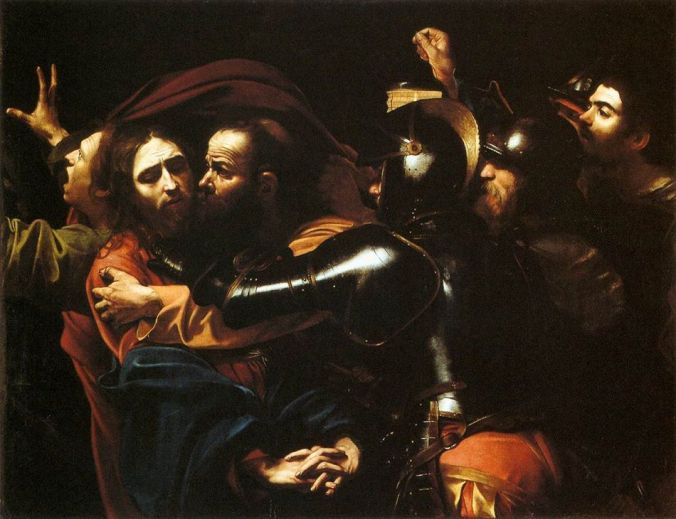
the-taking-of-christ-1602

The Taking of Christ (Judas’ Kiss), Caravaggio, 1602

Today’s readings (click below to open in new tab/window):
Psalms 122; 149, 1 Kings 7:51-8:21, Acts 28:17-31, Mark 14:43-52


The Garden of Gethsemane was a place Jesus often met with his disciples. It’s no surprise that Judas, leading a band of Jewish leaders and armed Roman soldiers,  knew to find him there. The kiss Judas placed on Christ’s cheek is the most obvious moment of betrayal in this famous scene, but betrayal was everywhere.

Beforehand the disciples had fallen asleep when Jesus needed company, and afterward Peter would deny knowing him – events that bookended a series of betrayals small and large. In a betrayal of Christ’s mission, as well as his lessons, one of the disciples struck the slave of the high priest with a sword and cut off his ear. All the disciples fled, and one young man in particular left behind the linen cloth that was all he’d been wearing.

None of us wants to think we would abandon or betray Jesus, but these were his closest friends and even they couldn’t follow him all the way to the cross.

We want to defend Christ, but following him means abandoning our weapons. Sometimes those are actual weapons, but sometimes they are weapons of anger, pride, and force we think we are using to attack his opponents without understanding attacking is not serving.

We don’t want to admit we’ve strayed – or even fled – from Christ, but that moment of spiritual nakedness, when our weakness or sin is uncovered and on display, eventually catches up to us. Often it’s revealed by our enemies who use it to expose our hypocrisy, and other times we sabotage ourselves; either way the shame is real.

Defenseless and naked. We can end up there through poor choices and weak excuses.

Or we can volunteer.

When we volunteer, when we follow Christ to the foot of the cross and humbly lay our betrayals there, when we lay down the weapons, armor, intellect, strength, or self-righteousness which we have called discipleship without understanding what that truly means … our new life begins.

We enter life defenseless and naked. It’s a kind of spiritual symmetry that’s how we and the apostles would be reborn in Christ.


Comfort: Christ is our strength and hope. 

Challenge: Be sure what you do in the name of Christ is what Christ would have you do.

Prayer: Merciful Lord, I seek to be born anew each day. Amen. 

Discussion: The apostles had chances to commit and re-commit to Christ. Have you ever felt the need to re-commit to your faith?

Join the discussion! If you enjoyed this post, feel free to join an extended discussion as part of the C+C Facebook group. You’ll be notified of new posts through FB, and have the opportunity to share your thoughts with some lovely people. Or feel free to comment here on WordPress, or even re-blog – the more the merrier!

Where there’s a will, there’s a weighing.

lincoln-memorial-at-night-1-1235393-1599x1066

Today’s readings (click below to open in new tab/window):
Psalms 104; 149, 1 Samuel 4:1b-11, Acts 4:32-5:11, Luke 21:20-28


According to one anecdote about Abraham Lincoln, someone once said to the President he hoped that regarding the Civil War, God was on their side. Lincoln allegedly replied:

Sir, my concern is not whether God is on our side; my greatest concern is to be on God’s side, for God is always right.

This quote, which can’t actually be sourced directly to Lincoln, distills many of his ideas about the role God did or did not play on the larger stage of human affairs. Lincoln was not convinced that because he sought the will of God that he knew or performed the will of God. Most of us will never carry the fate of a nation on our shoulders, but may we maintain the same humility in our conscience. There’s a difference between praying to do the right thing, and praying that the thing you do is right.

When the soldiers of Israel faced down the army of the Philistines, they couldn’t understand why they were losing since surely the God of Israel favored them. They sent for the Ark of the Covenant to be brought from the temple to their camp – literally placing God on their side of the battlefield. Not only did they lose, the corrupt sons of their high priest were killed, and the Ark was captured by the enemy.

We might easily assume that calling ourselves God’s people means what we do in good faith is God’s will. Yet time and again, God used foreign nations to further the plan when Israel failed to do so. Let’s always remain humble enough to consider that even people who seem bent on destroying us are not outside God’s providence.

But we need not despair from uncertainty. Thomas Merton famously prayed:

[T]he fact that I think that I am following your will does not mean that I am actually doing so. But I believe that the desire to please you does in fact please you. And I hope I have that desire in all that I am doing.

Whatever we do, let us humbly fear and trust the Lord.

Read more on today’s passage from Acts in Mellow Harshed.

Comfort: God understands your intentions and inner conflicts.

Challenge: Read or listen to the whole version of Thomas Merton’s prayer.

Prayer: See the challenge.

Discussion: When have you realized you might have made some bad assumptions?

Join the discussion! If you enjoyed this post, feel free to join an extended discussion as part of the C+C Facebook group. You’ll be notified of new posts through FB, and have the opportunity to share your thoughts with some lovely people. Or feel free to comment here on WordPress, or even re-blog – the more the merrier!

TV or not TV?

realityshow

Today’s readings (click below to open in new tab/window):
Psalms 97; 147:12-20, 1 Samuel 2:27-36, Acts 2:22-36, Luke 20:41-21:4


There are two kinds of people who tell you they don’t own a television. (OK, there are probably more but they don’t help further this illustration). The first mention it matter-of-factly because it is pertinent to the conversation. The second deliver the information kind of smugly, often unnecessarily, and their tone lets us know they feel a bit superior about it.

The scribes Jesus criticized fell into that second camp. Televisions weren’t an option, but their public prayers were overloud and overlong, their tasseled robes (a symbol of piety) hung longer than necessary, and they generally made sure the world knew they were that little bit extra. Jesus told them the recognition they sought in this life would be the only reward they received.

Our expression of faith should not be a performance. There’s no medal to be won in the piety olympics, and we don’t get a better table in heaven because we looked down our noses at non-believers. On the other hand, we shouldn’t make an idol of humility either. Everyone knows the martyr who just won’t die – the person who constantly abases him or herself unnecessarily and obviously. The one who misses dessert at every church social to personally wash the two hundred dirty dishes – even if they have to block the kitchen door to do it.

So if we are to live lives holy and apart, yet not be showy, what’s the balance?

Maybe it’s not spending any time at all worrying about whether or not people see what you do. Say grace in a restaurant, but keep it to the table. List volunteering at the homeless center on your resume,  but don’t humblebrag it. Share stories about your church group’s mission trip, but tell them in a way that glorifies God, not your self-actualization. Work with disadvantaged youth, but don’t use them as props in selfies. Wash the dishes, but welcome the help.

Jesus praised the widow who quietly gave her last cent. When we serve as faithfully as she did, we stop focusing on our own pride or humility and start focusing on Christ.

Read more on today’s passage from Luke in Puzzling It Out.

Comfort: God knows your heart. That is enough.

Challenge: Think less about yourself.

Prayer: God, I humbly offer my hands and heart for the work you would have me do. Amen.

Discussion: Have you ever done something for the wrong reasons?

Join the discussion! If you enjoyed this post, feel free to join an extended discussion as part of the C+C Facebook group. You’ll be notified of new posts through FB, and have the opportunity to share your thoughts with some lovely people. Or feel free to comment here on WordPress, or even re-blog – the more the merrier!

Why did the Christian cross the road?

chicken

Today’s readings (click below to open in new tab/window):
Psalms 89:1-18; 147:1-11, 1 Samuel 2:12-26, Acts 2:1-21, Luke 20:27-40


Most comedians try to follow the rule “don’t punch down.” In other words, no cheap shots at the expense of people whose circumstances put them at a disadvantage relative to yourself. For instance, able-bodied people making jokes about people with disabilities (which differs from crafting humor in solidarity) is not appropriate. “Don’t punch down” is a good rule to follow for everyone. Generally speaking, our gains should not place unwelcome financial, physical, or emotional burdens on those who are less fortunate.

The sons of Eli, the head priest at the temple of Shiloh, didn’t seem to get that memo. They also served as priests, but abused their authority terribly. They stole for their own tables the best portions of the meat their fellow Israelites brought for sacrifice. They forced themselves on women who served the temple. Sadly they got away with these things because their supposed moral authority intimidated those they were meant to serve.

When we find ourselves at the wrong end of a punchline, we may be tempted to play the victim. At those times it’s important to learn to take a joke, unpack it, and accept the sting of any truth it contains. We don’t always realize who or how we exploit until someone points it out to us.

Like good comedy, good religion doesn’t punch down. It doesn’t increase the bounty of the already well-to-do – particularly clergy – at the financial expense of the poor or the social expense of the marginalized. This might seem like common sense, but too many religious leaders have grown rich and pews full by exploiting the vulnerable. A popular (but debatable) notion says that in ages past the court jester could use humor to speak truth to power without suffering the same consequences as would more political members of the court. Shaming common sinners takes neither courage nor conviction; confronting a hypocritical and corrupt establishment requires both and more. If, as Paul says, we are to be fools for Christ, let us be the type of fool who shines a light on abuses of power and gives voice to the voiceless.

Read more on today’s passage from Luke in Puzzling It Out.

Comfort: Christ opens his arms wide to those who are foolish for him.

Challenge: Learn to laugh at yourself.

Prayer: God, give me the courage to seek justice, and the humor to survive it. Amen.

Discussion: What’s your favorite joke?

Join the discussion! If you enjoyed this post, feel free to join an extended discussion as part of the C+C Facebook group. You’ll be notified of new posts through FB, and have the opportunity to share your thoughts with some lovely people. Or feel free to comment here on WordPress, or even re-blog – the more the merrier!

Thorn In My Side

thorns-419688_1280

Today’s readings (click below to open in new tab/window):
Psalms 116; 147:12-20, Song of Solomon 1:1-3, 9-11, 15-16a; 2:2-3a, 2 Corinthians 12:1-10, Luke 19:28-40


Have you ever heard the expression “thorn in my side?” It means a persistent, often painful difficulty. We get this phrase from the Apostle Paul, who wrote to the church in Corinth:

Therefore, to keep me from being too elated, a thorn was given me in the flesh, a messenger of Satan to torment me, to keep me from being too elated. Three times I appealed to the Lord about this, that it would leave me, but he said to me, “My grace is sufficient for you, for power is made perfect in weakness.”

We don’t know the exact nature of Paul’s metaphorical thorn. His ailment could have been physical, spiritual, or emotional. Whatever it was, he had to learn to live with it. Paul chose to accept this thorn as an instrument of humility, one that kept him from becoming too full of himself.

We all suffer from something (or maybe several somethings) we’d rather be rid of. From ADD to sexual temptation to lumbago, everyone has a weakness. Paul provides an example of how we might approach such weakness in a positive way. Rather than become resentful or defensive about it, we can let it serve as a reminder to be charitable toward the struggles of others. When we see someone wrestling with the same demons we do, we can judge them (though we are really judging ourselves) or we can be empathetic and supportive. If someone struggles with an issue that gives us no problems at all, we should remember another person might easily pluck out a thorn that has rooted deeply in our own flesh.

“Power is made perfect in weakness” because it illustrates how God is never limited by the same things we are, but also because our weakness, properly considered, tempers our pride.

Our thorn – perhaps from the same branch that circled the head of Christ – is a sign that true love for the suffering is never pity, but solidarity. Though we don’t have to enjoy our weaknesses, let us give thanks for the blessings of humility and love that wouldn’t exist without them.

Comfort: You are not defined by your weakness.

Challenge: When you see others struggle, especially with something you’ve overcome, remember your own thorns.

Prayer: Thank you God for teaching me to rely on you in all things. Amen.

Discussion: How do you react to your own weakness?

Join the discussion! If you enjoyed this post, feel free to join an extended discussion as part of the C+C Facebook group. You’ll be notified of new posts through FB, and have the opportunity to share your thoughts with some lovely people. Or feel free to comment here on WordPress, or even re-blog – the more the merrier!

Saying Grace

blur-1867402_1280

Today’s readings (click below to open in new tab/window):
Psalms 88; 148, Deuteronomy 26:1-11, 2 Corinthians 8:16-24, Luke 18:9-14


Jesus told a parable about two men praying at a temple, one a Pharisee – a citizen of high standing – and the other a tax collector – a Jew who worked for the occupying Roman empire. The Pharisee thanked God that he was not like sinners such as the tax collector, and reminded God that he fasted twice a week and tithed a tenth of his income. The tax collector humbly asked God for mercy. Jesus said the tax collector was the one who went home justified.

This parable is a bit of a paradox. We probably do want to try to live a life that looks more like the Pharisee’s than the tax collector’s. Avoiding sin and practicing spiritual disciplines – such as tithing and fasting –are good choices. Helping exploit the oppressed is not as good a choice. Yet according to Jesus, the state of our heart is at least as important as our actions.

Exalting ourselves is a good indicator we’ve forgotten to be grateful. The Pharisee could tithe and fast because he was in a comfortable position, yet he thanked God for nothing but his own (self-) righteousness. Someone without enough food or money would not have had the luxury of tithing and fasting. We don’t know anything about the tax collector’s circumstances, but we do know he was grateful for the mercy of his creator.

When the Jewish people reached the promised land, they began sacrificing the first fruits of each harvest to the Lord. As they did so, they recited the story of how God liberated them from slavery in Egypt and delivered them to the land of milk and honey. No matter how hard they toiled in the field, they did not take credit for their own well-being, but expressed gratitude to God for making it all possible. Somewhere along the line, the Pharisee seemed to have forgotten this important lesson.

Let’s remember where we came from. While we rejoice that God loves us, let’s also remember God’s love is a gift, not a reward for good behavior. We say grace before we eat, not after.

Comfort: Remember that God loves you.

Challenge: Remember that all you have comes from God.

Prayer: God, be merciful to me, a sinner!

Discussion: Are you ever tempted to compare yourself to other people? If so, how does it usually make you feel?

Join the discussion! If you enjoyed this post, feel free to join an extended discussion as part of the C+C Facebook group. You’ll be notified of new posts through FB, and have the opportunity to share your thoughts with some lovely people. Or feel free to comment here on WordPress, or even re-blog – the more the merrier!