East, West, and In Between

always north

Today’s readings (click below to open in new tab/window):
Psalms 97; 145, Joshua 1:1-9, Ephesians 3:1-13, Matthew 8:5-17


One of the great things about being a Christian is knowing your salvation is in the bag.
Or is it?

A Roman centurion once approached Jesus and asked him to heal an ailing servant. Jesus offered to come and cure the servant, but the centurion said it wasn’t necessary to go there: he had faith that if Jesus said it would happen, it would happen.

Jesus was amazed (the Bible’s words, not an exaggeration) at the faith of the centurion. He told his followers:

“Truly I tell you, in no one in Israel have I found such faith. I tell you, many will come from east and west and will eat with Abraham and Isaac and Jacob in the kingdom of heaven, while the heirs of the kingdom will be thrown into the outer darkness, where there will be weeping and gnashing of teeth.”

Mind you these followers were all Jews, and therefore considered heirs of the kingdom. The centurion was an integral cog in the Roman machine which oppressed them. That had to chafe.

There’s a saying that being in church doesn’t make you a Christian any more than being in a garage makes you a car. We don’t inherit the kingdom by being born into a Christian family; we enter the kingdom through grace and faith. If the centurion is any example, our assumptions about what makes a faithful Christian may not be the same as Christ’s – and his is the opinion that counts. Is it possible that agnostics from the east coast and new agers from the west coast might find their way to the table with Abraham, Isaac, and Jacob before we middle of the road Christians do?

The lesson here is not “it doesn’t matter what you believe.” It’s more like “don’t be too quick to make assumptions either way.” In a kingdom where the first are last and the last are first, discipleship can be a balancing act; humility is the narrow beam we must walk. Rather than insist we already know each twist and turn leading to Christ, let’s unfold the map together.

Comfort: You are officially relieved of the duty of deciding whether someone is Christian enough.

Challenge: Listening to people who disagree with your beliefs is not a threat.

Prayer: Gracious and merciful God, set my feet on the path toward salvation. Amen.

Discussion: What can you learn from other faith traditions? What do you think Jesus might say about it?

Join the discussion! If you enjoyed this post, feel free to join an extended discussion as part of the C+C Facebook group. You’ll be notified of new posts through FB, and have the opportunity to share your thoughts with some lovely people.

Foundation

dostoesvsky

Today’s readings (click below to open in new tab/window):
Psalms 96; 148, 1 Samuel 2:1-10, Ephesians 2:1-10, Matthew 7:22-27


In Fyodor Dostoevsky’s novel The Brothers Karamazov, brothers Ivan and Aloysha engage in long and compelling arguments about the nature of God, faith, and the problem of evil. At one point Ivan asks his brother if, to create a utopia where humanity was eternally happy and at peace, he could justify torturing a blameless infant to death.

Of course Aloysha says no. In the context of the novel his answer has many meanings, but let us consider it in light of Christ’s parable in Matthew about the man who built his house on a foundation of stone, versus the man who built his house on a foundation of sand. Naturally the house built on sand crumbled, while the one on the stone foundation endured. The strong foundation results from following Christ’s teachings, the weak foundation from ignoring them.

Foundations matter. The ends do not always justify the means. When we build lives, families, churches, and communities our intentions mean nothing if our methods are corrupt. Houses built on sand and stone may appear equally grand for a short while, but eventually the underpinnings will be revealed. If we have sacrificed the least among us to build monuments, no matter how grand, they magnify not the Lord but our weakness.

Also in Matthew Christ said:

[M]any will say to me, ‘Lord, Lord, did we not prophesy in your name, and cast out demons in your name, and do many deeds of power in your name?’ Then I will declare to them, ‘I never knew you; go away from me, you evildoers.’

History is full of innocents sacrificed in the name of religion. Many monuments but not a single utopia has sprung from their “unavenged tears” (to quote Dostoevsky). But the one innocent who sacrificed himself willingly ushered in the Kingdom of Heaven. That is our model for a foundation of stone: a willingness to sacrifice ourselves to serve the kingdom. According to psalmists and prophets, God measures us not by how many we have persecuted on His behalf but by the holy sacrifice we have made of our own lives.

Comfort: Christ was the sacrifice that assures us the Kingdom.

Challenge: If what you desire requires someone else to make a sacrifice you do not have to make, you are very likely desiring the wrong thing.

Prayer: God of strength, teach me to build on the firm foundation of Christ, that my efforts may be lasting testaments to your glory. Amen.

Discussion: What clubs, associations, teams, or other groups do you belong to? Have you ever let them persuade you to accept a questionable means to justify a desirable end?

Join the discussion! If you enjoyed this post, feel free to join an extended discussion as part of the C+C Facebook group. You’ll be notified of new posts through FB, and have the opportunity to share your thoughts with some lovely people.

Higher

with you always

Today’s readings (click below to open in new tab/window):
Psalms 47; 147:12-20, Daniel 7:9-14, Hebrews 2:5-18, Matthew 28:16-20

Ascension readings:
Acts 1:1-11, Psalm 47:1-9, Ephesians 1:15-23


Today is Ascension Thursday, the feast when we celebrate the gospel accounts of the resurrected Christ’s ascent into heaven. Theologians understand this event in many ways, from a literal rising into heaven, to a symbolic reunion of Christ with the Creator God. Whatever our personal understanding, there is a common paradox: by departing from all of us, Christ is able to be with any of us.

In Matthew’s gospel, Christ shared these words with his disciples shortly before he departed: “I am with you always, to the end of the age.” After the resurrection, Christ appeared to many people, yet his presence was still limited to those in his immediate vicinity. The idea of every follower building a personal relationship with Christ may have been inconceivable – when he was busy walking and talking with others, he was by definition not walking and talking with you. But the risen and ascended Christ? That is a transcendent and inexhaustible presence not limited by time or space. You and I and everyone else have equal access to him all the time.

If a transcendent Christ seems too abstract to relate to, remember that for a time he shared all our human experiences. The letter to the Hebrews tells us: “Because he himself was tested by what he suffered, he is able to help those who are being tested.” Feeling temptation? Don’t beat yourself up about it; so did Christ. Feeling angry? The gospels give us several examples of an angry Jesus. Feeling despair? On the cross Christ asked why God had forsaken him. Feeling afraid? In the garden of Gethsemane, Jesus sweat blood while asking if the cup he was to bear could be taken from him. Whatever terrible thing you feel, Jesus has felt it also. And – living in human form – he overcame. We don’t have to be superhuman to imitate Christ, but we do have to follow his teachings to be fully human in a way that transcends the flesh.

We are a resurrection people. We are an ascension people. We are Christ’s body on earth, and therefore can never be apart from him.

Comfort: Christ is with us to the end of the age.

Challenge: Meditate on the wonder of the Ascension.

Prayer: God of life and possibility, I will trust you to be with me at all times. Amen.

Discussion: What does the Ascension mean to you?

Join the discussion! If you enjoyed this post, feel free to join an extended discussion as part of the C+C Facebook group. You’ll be notified of new posts through FB, and have the opportunity to share your thoughts with some lovely people.

Not So Obvious

persepective

Today’s readings (click below to open in new tab/window):
Psalms 99; 147:1-11, Leviticus 26:27-42, Ephesians 1:1-10, Matthew 22:41-46


Jesus certainly seemed to enjoy stumping the Pharisees. When he asked them whose son the Messiah was, they confidently answered “David.” But when asked them how David could call the Messiah “Lord” if he was also his son, they had no answer and were afraid to ask any more questions. What had been obvious to them moments before was no longer so. There’s a certain satisfaction in reading about Jesus puncturing the Pharisees’ balloon of smugness. Maybe that’s partly because at one time or another we’ve all been on the receiving end of something similar; we’ve probably also been on the giving end.

One of the words most likely to undermine effective communication is “obvious.” When something seems obvious to us, we treat it like an objective reality. If someone else can’t see or understand it, we question their powers of observation and / or comprehension. The truth is, we all bring different perspectives to life. Draftspersons create two-dimensional orthographic drawings and three-dimensional isometric drawings to illustrate the complete dimensions of an object. Without representation from all sides, otherwise “obvious” details are easy to miss. Consider a cylinder: from the end it looks like a circle, but from the side it looks like a rectangle. Both are equally true and equally incomplete. When we think something is obvious and someone else does not, it is not a reason for ridicule, but a signal that one or both of us could learn from an additional perspective.

Since we aren’t Jesus talking to the Pharisses, it’s probably better if we don’t get a reputation for providing withering responses to questions or different opinions. We might like to interpret that as people thinking we are clever, but it more likely means they think we are close-minded. You don’t have to shut down a co-worker, friend, or spouse too many times by arrogantly pointing out the “obvious” to them before the lines of communication collapse.

In any given situation, we may be seeing only the end of the cylinder. While it’s obviously a circle, insisting that’s the sole and obvious truth is a rejection of the glorious diversity God has created.

Comfort: Your truth adds to the sum of truth.

Challenge: Try to strike the word “obvious” from your conversations.

Prayer: Glorious Creator, open my mind to all the wonders of your creation. Show me the truths I can’t see from my perspective. Amen.

Discussion: When have you missed something which was obvious to someone else? And vice versa?

Join the discussion! If you enjoyed this post, feel free to join an extended discussion as part of the C+C Facebook group. You’ll be notified of new posts through FB, and have the opportunity to share your thoughts with some lovely people.

Logs and Specks

do-not-judge

Today’s readings (click below to open in new tab/window):
Psalms 96; 148, Leviticus 23:1-22, 2 Thessalonians 2:1-17, Matthew 7:1-12


[H]ow can you say to your neighbor, ‘Let me take the speck out of your eye,’ while the log is in your own eye? You hypocrite, first take the log out of your own eye, and then you will see clearly to take the speck out of your neighbor’s eye.

Matthew 7:3-5

Hypocrisy is one of Jesus’s biggest targets. When he criticizes the hypocrisy of religious leaders, we cheer him on. However, his admonitions are not limited to authority figures: they apply to us also. When he spoke of logs and specks, it was to his followers in general.

We are still quick to point out the hypocrisy of politicians, religious leaders, and the self-righteous, but we are often slow to recognize it in ourselves and even try to rationalize it away. Some of the most blatant examples are in politics. When the “other” side uses dirty tricks or displays unethical behavior, we point condemning fingers and demand accountability. When “our” side does something similar we attempt to explain it away or justify it as a necessary evil – often blaming the behavior of the other side as forcing our hand. Cliched as it may be, two wrongs don’t make a right. A principle we are willing to sacrifice for convenience or expedience is not a principle at all. “They did it first!” is a child’s excuse.

We can also be quick to judge others for qualities we don’t like about ourselves. Maybe that’s why there is no shortage of “family values” candidates caught in adulterous affairs and other unseemly behaviors. But our eagerness to judge them in kind (or worse to celebrate their undoing) is a hypocrisy of its own. The line between personal accountability and unholy judgment can easily blur. To bring it into focus, we can look at it through a lens of compassion: reconciliation may require consequences, but the former is a priority and the latter merely a tool.

Regarding judgment Christ tells us: “the measure you give will be the measure you get.” Being honest about our own flaws makes us less likely to judge others.

Comfort: Judging others is exhausting. Let it go, and feel yourself refreshed.

Challenge: Be slow to judge. Maybe so slow you forget about it.

Prayer: Merciful God, teach me to be humble and merciful. Have mercy on my soul. Amen.

Discussion: What are the flaws you are most likely to condemn in others? What does that say about you?

Join the discussion! If you enjoyed this post, feel free to join an extended discussion as part of the C+C Facebook group. You’ll be notified of new posts through FB, and have the opportunity to share your thoughts with some lovely people.

Gleaning Compassion

OLYMPUS DIGITAL CAMERA


Today’s readings (click below to open in new tab/window):
Psalms 99; 147:1-11, Leviticus 19:1-18, 1 Thessalonians 5:12-28, Matthew 6:19-24


Sometimes it can feel difficult to reconcile the God of the Old Testament with the God of the New Testament. Even if we consider Christ’s sacrifice a watershed event (the moment when we were freed from the law and its harsh demands), the God who wiped out entire nations to make room for the Israelites seems very far from the God of Christ who wants us to love our enemies. But even in the hundreds of laws laid out in Leviticus and Deuteronomy we see glimpses of Christ’s teachings.

Amid rules like being cast out for eating sacrificed food after three days, God commands his people not to harvest to the edge of their fields, and not to pick up the fallen crops and grapes. This is so the poor and alien among them – those whom Jesus might call “the least of these” – can find food. This practice, called gleaning, was a mandate to the nation. God tells his people to render justice impartially, without regard to poverty or wealth, foreshadowing Paul’s message that in Christ there is no slave or free. Perhaps most tellingly, God instructs them to “love your neighbor as yourself.” When most people use that phrase they’re thinking of the Gospels, not rule-laden Leviticus.

In 1 Thessalonians Paul advises: “test everything; hold fast to what is good.” When tackling difficult portions of the Old Testament, the standard against which we can test them is Christ’s message of love. Even though Christ tells us to refrain from judgment, we must be careful not to set the standard as “all is forgiven so anything goes.” The Old Testament, even the parts that seem barbaric by modern standards, contains many valuable lessons and we do ourselves a disservice if we dismiss or ignore them. At the very least, they help us understand how our perception of and relationship to God has evolved over the years.

Paul also tells them “to admonish the idlers, encourage the faint hearted, help the weak, be patient with all of them.” From gleaners to Thessalonians, in every age God teaches us to love and care for all his children.

Comfort: God always loves us.

Challenge: Be open-minded about weakness, whether yours or another’s.

Prayer: Loving God, thank you for allowing me to test all things. Teach me what is good, that I may hold fast to it. Amen.

Discussion: Are you patient with people you see as weak, idle, or fearful? What weaknesses do you have that you wish you could hide from others?

Join the discussion! If you enjoyed this post, feel free to join an extended discussion as part of the C+C Facebook group. You’ll be notified of new posts through FB, and have the opportunity to share your thoughts with some lovely people.
Balancing Act

buildeachotherup.jpg

Today’s readings (click below to open in new tab/window):
Psalms 98; 146, Leviticus 16:20-34, 1 Thessalonians 5:1-11, Matthew 6:7-15


Paul told the Thessalonians the Day of the Lord would arrive like a thief in the night or the pains of labor. Those living in darkness – that is, without the light of Christ – would be caught unawares in a false sense of security and suffer the consequences. Those living in the light would be prepared and rejoice. But how exactly is one to prepare? First century Christians expected Jesus to return any moment, and abandoned many earthly pursuits. As a couple thousand years passed, it became more apparent Christ’s return would be less … immediate.

Every century – maybe every decade – had its share of “prophets” declaring the end was nigh. So far they are batting triple zero. Even today some Christians believe Jesus is returning so soon it may be foolish to buy groceries a week in advance. Most of us are a little more skeptical. Should we be?

Living in anticipation of the Day of the Lord is a balancing act. On the one hand, experience says we probably have a way to go, and should steward our resources wisely. On the other hand, any one of us could meet Jesus tomorrow, if only individually. Does anyone want to have to explain why that never-touched rainy day fund was a better use of our money than charity would have been?

Perhaps that tension is useful. When we lose that sense of immediacy, it’s easy to slip into a comfortable routine which resembles resignation more than anticipation. If we’re so zealous that we focus only on “the end times,” we lose sight of doing the things Christ asked us to do – feed the hungry, visit the sick, etc. A while back there was a popular humorous but pointed bumper sticker: “Jesus is coming. Try to look busy.” Are we merely busy, or are we about the business of discipleship? If Jesus shows up today, would you be happy with where he finds you? If we live today as through Christ could show up tomorrow, and he doesn’t … let’s try not to be too disappointed we’ve made the world a little better.

Comfort: Whether Jesus returns tomorrow or in a thousand years, the Kingdom of God is at hand.

Challenge: Set aside some time to contemplate or discuss the balance between faith and works in world waiting for Christ’s return.

Prayer: Eternal God, thank you for the promise of the future, and the opportunity of the present. Amen.

Discussion: Where can you strike a better balance between what is practical and what is faithful?

Join the discussion! If you enjoyed this post, feel free to join an extended discussion as part of the C+C Facebook group. You’ll be notified of new posts through FB, and have the opportunity to share your thoughts with some lovely people.
Keep it in the Closet

1461629354844.jpg

Today’s readings (click below to open in new tab/window):
Psalms 97; 145, Leviticus 16:1-19, 1 Thessalonians 4:13-18, Matthew 6:1-6, 16-18


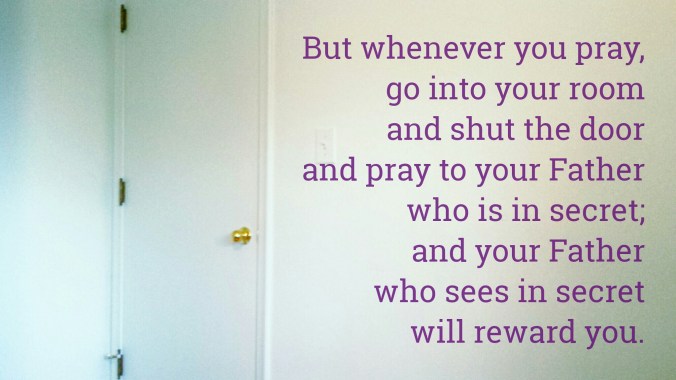
Other than during a tornado watch, when is the last time any of us prayed in a closet? Most of us would probably answer: “Never.” Yet that is exactly what Christ advised his disciples to do: “whenever you pray, go into your room and shut the door and pray to your Father who is in secret; and your Father who sees in secret will reward you.”

Most translations use the word “room” but the Greek is closer to “inner room” – or closet. Of course Christ’s point was not the architecture, but the privacy. Even in Christ’s time, public prayer was often more a bid for the admiration of people, rather than communion with God.

We’ve all heard prayers that sound like the person praying was being paid by the word. Christ tells to pray privately, and not heap on words as if desperately trying to tip some divine scale. Ideally prayer is not a monologue, so it needs a lot of silent time to leave room for God.

When Christ says those who pray or give alms in a public manner have already received their reward, he is commenting on motive. People who make a show of piety in order to win admiration have their reward when someone notices, but not beyond.

On the other hand, going too far the other way and making a show of hiding our deeds is still missing the point. People seeking a relationship with God pray or fast only as an expression of their love for God, and attention (or its lack) doesn’t matter. God isn’t a trophy wife, so Christ teaches us to behave in ways that don’t sully the relationship by making it about other people’s opinions.

From the time we are assigned our first 200-word essay, we are taught the number of words we use is important. One of the toughest lessons for any professional writer is to cut, and cut again, until only meaningful words remain. Perhaps this is why writer Anne LaMott’s two favorite prayers are: “Help me, help me, help me” and “Thank you, thank you, thank you.”

Comfort: God knows what we need before we speak.

Challenge: Find an isolated place to pray.

Prayer: Compassionate God: help me. Thank you.

Discussion: What do you feel is the role of public prayer?

Join the discussion! If you enjoyed this post, feel free to join an extended discussion as part of the C+C Facebook group. You’ll be notified of new posts through FB, and have the opportunity to share your thoughts with some lovely people.

Carpenter’s Son

Rabies 008

Today’s readings (click below to open in new tab/window):
Psalms 93; 150, Leviticus 8:1-13, 30-36, Hebrews 12:1-14, Luke 4:16-30


How do you feel about high school reunions? Your answer probably depends on how much you enjoyed your high school experience. The older we get the less we are like our high school selves, but stepping into those locker-lined hallways and through those gymnasium doors shifts a part of our brain back into those teenage dynamics. Some part of us expects people to be like they were then, and they expect the same of us. When we know someone as a youth, we can have trouble seeing how they are different as adults. All of us are both victims and perpetrators of this phenomenon.

Jesus had the same problems. His ministry began with a big splash in Capernaum, and then he returned to his hometown of Nazareth. In Nazareth people wanted to see the signs he’d performed in Capernaum. Part of this might have been excitement over the hometown boy made good, but some of it was because they couldn’t imagine the son of Joseph the carpenter as the Messiah. Anticipating their doubt, Jesus told them: “no prophet is accepted in the prophet’s hometown.” After he got warmed up and started doing what prophets do – namely telling them what they needed to change – “all in the synagogue were filled with rage.” They drove him out of town and tried to push him off a cliff.

In the end, Jesus “passed through the midst of them and went on his way” as though they weren’t there. Now there’s a lesson in maturity. Jesus did not surrender to the outdated expectations of people who couldn’t see him in the present. It can be tempting to lower ourselves to expectations (“I cheated because I got tired of you accusing me of it!”) and blame others. Jesus knew what he was about, and also knew Nazareth would hold him back. At one point even his own family called him crazy, but he just kept doing what needed to be done. What only he could do. Don’t settle for the expectations the world places on you; graduate into the person God has prepared you to be.

Comfort: Other people may not see you for who you are, but God does.

Challenge: If you are tempted to blame someone else for your failings, spend some time in prayer about it.

Prayer: Thank you, loving God, for allowing me to grow into the gifts you have given me. Help me to see others as you see them, not through the lens of my preconceptions. Amen.

Discussion: Do you react maturely in the face of low expectations?

Join the discussion! If you enjoyed this post, feel free to join an extended discussion as part of the C+C Facebook group. You’ll be notified of new posts through FB, and have the opportunity to share your thoughts with some lovely people.
Sunshine and Rain

Jun02 031

Today’s readings (click below to open in new tab/window):
Psalms 92; 149, Exodus 40:18-38, 1 Thessalonians 4:1-12, Matthew 5:38-48


Turn the other cheek. When sued for your cloak, offer your coat too. If forced to go one mile, go a second one. Give to everyone who begs from you. Loan to anyone who asks. Love your enemies. Pray for those who persecute you. In these teachings, Jesus is telling his followers, I know you know the minimum legal requirements, and that’s fine, but actually loving involves so much more

Who actually does these things – all or any of them – all the time?

Would it be unfair to say “Nobody?”

We spend a lot of effort justifying why we don’t  do them, and throw around words like “enable” and “systemic” and “accountability.” We make our giving conditional on the perceived worthiness of the recipients. In the same passage Jesus tells us God “makes his sun rise on the evil and on the good, and sends rain on the righteous and on the unrighteous.” If God is not doling out sunshine and rain based on merit, maybe we aren’t as qualified to make those distinctions as we’d like to believe. Resenting that our generosity is “wasted” on someone says more about our ego and need for control than it does about their worthiness.

Of course we should steward our resources wisely when battling systemic poverty and need, but that is not in opposition to the individual acts that Jesus promotes. Loving our enemies, turning the other cheek, and parting with our money are not just about helping other people: they are about perfecting the state of our hearts. Love is sacrificial. If our every act of generosity involves an intake evaluation and a cost-benefit analysis, we’re simply swapping one set of rules for another, creating divides between the clean and unclean. Since we are as dependent on God for our own gifts as we are for the sun and rain, should we really be acting as if we know better than God who does or does not deserve them? Love is humble. Jesus says so.

Ironically, selfless love has selfish benefits. As we learn to love unconditionally, we better understand just how much God loves us – worthy or not.

Comfort: You have God’s love, regardless.

Challenge: God expects you to love others, regardless.

Prayer: Loving God, may my love for others reflect your love for them also. Amen.

Discussion: Is your generosity ever tinged with resentment?

Join the discussion! If you enjoyed this post, feel free to join an extended discussion as part of the C+C Facebook group. You’ll be notified of new posts through FB, and have the opportunity to share your thoughts with some lovely people.