The dog ate my excuse.

Image result for dog ate my homework meme

Today’s readings:
Psalms 22; 148, Deuteronomy 10:12-22, Hebrews 4:11-16, John 3:22-36


In the letter to the Hebrews, the evangelist writes:

“We do not have a high priest who is unable to sympathize with our weaknesses, but we have one who in every respect has been tested as we are, yet without sin. Let us therefore approach the throne of grace with boldness, so that we may receive mercy and find grace to help in time of need.”

Isn’t that a comfort? Our high priest, Jesus, knows exactly how difficult temptation is. After forty days in the wilderness before his ministry began, he resisted the devil’s promises of power. On the cross, he forgave those who crucified him. In between, he faced every manner of temptation the rest of us do. His triumph over temptation could seem intimidating since none of us can hope to live up to it, but it is an assurance  of sympathy, mercy, and grace.

On the other hand, it gives him an excellent baloney detector.

Certainly he was tempted to make excuses just like we do. To pretend having no pleasant choice is the same as having no choice. To write off the difficult as the impossible. To blame other people for our own behavior. To dismiss those who opposed him as wicked.

Jesus chose the cross; we choose the bottom line. Jesus turned Paul the Christian-hunter into his greatest evangelist; we won’t hire an ex-felon. Jesus entered enemy territory to share bread and salvation; we create an economy dependent on foreign laborers then vilify them for accepting our invitation. Jesus showed grace to his executioners; we legislate against those who don’t share our dogma “for their own good.”

Grace and mercy aren’t granted because we cling to convincing excuses; they are available when we humbly admit no excuse is good enough. It is impossible to seek forgiveness while justifying our sin. When we fail to the love the poor, the sick, or the alien among us – even if we feel they persecute us – we must not blame them for our failure.

Grace is ours for the asking. We just have to stop explaining why we deserve it.

Comfort: Jesus understands your trials.

Challenge: For one week, don’t justify your mistakes to anyone. Just own them.

Prayer: Merciful God, boldly I approach you, humbly I lay my sins before you. Shine your merciful face upon me. Amen.

Discussion: When are you prone to make excuses? How do you react when others make excuses?

Join the discussion! If you enjoyed this post, feel free to join an extended discussion as part of the C+C Facebook group. You’ll  have the opportunity to share your thoughts with some lovely people. Or feel free to comment here on WordPress, or even re-blog – the more the merrier!


Temptation Situation

1460687563612.jpg

Today’s readings (click below to open in new tab/window):
Psalms 47; 147:12-20, Exodus 20:1-21, Colossians 1:24-2:7, Matthew 4:1-11


A friend once said no matter how obviously stupid a behavior is, if there’s a law against it someone has tried it. So the Baltimore, Maryland law against taking a lion to the movies really gives one pause. A more sobering example, child labor laws exist because not enough people found it otherwise important not to exploit children. My friend also said if we passed a law against drinking bleach, Clorox speakeasies would pop up everywhere. It can be hard to tell whether rules were made to be broken, or  made for the broken.

After God announced the Ten Commandments at Mount Sinai, the people of Israel fled from the foot of the mountain and begged Moses not to let God speak to them directly. They said they feared hearing God’s voice would kill them, but it probably also shamed them. Indirectly God was saying: “I know what’s in your hearts: murder, adultery, theft. Just don’t.” When Moses said God was trying to put fear into them so they would not sin, he really meant fear. Sometimes it’s all that keeps us in line.

Whether or not we are optimistic about human nature, Jesus demonstrates we can be better. Preceding his ministry, he fasted in the desert for forty days. Afterward, when he was at his weakest, the devil tried to tempt him.

Turn the stones to bread?
Man lives on every word from the mouth of God. 

Prove yourself by leaping off this cliff and letting angels save you?
Don’t test the Lord.

Worship me and rule all you see?
Worship no one but God.

Jesus said these things were written, and they were, but except for the third they weren’t hard and fast rules. There was no law about turning stones to bread, no specific definition of testing the Lord. Christ consistently showed us obedience to the law was only the beginning of being faithful to God. He tells us love is stronger than fear. He invites us to be more than followers of law, but lovers of God and humankind. When love trumps fear, obedience is not a burden but a joy.

Comfort: Everyone is tempted. We can depend on Christ to help us resist.

Challenge: We like to believe willpower should be enough to handle temptation, and can be pretty hard on ourselves when we feel we’ve failed. Read this article on the limitations of willpower and how to make real change.

Prayer: Gracious God, thank you for loving me enough to set rules, and trusting me enough to live beyond them. Teach me to rely on your love to make good and just choices. Amen.

Discussion: How can you implement the principles you read about in the challenge link?

Join the discussion! If you enjoyed this post, feel free to join an extended discussion as part of the C+C Facebook group. You’ll be notified of new posts through FB, and have the opportunity to share your thoughts with some lovely people.

From Fear to Faith

IMG_20180205_074320

Today’s readings (click below to open in new tab/window):
Psalms 5; 145, Genesis 25:19-34, Hebrews 13:1-16, John 7:37-52


Delayed gratification.

It’s not something that comes naturally to most of us. As a matter of fact, it’s often the opposite of our nature. We spend our lives in bodies that are convinced death lies around every corner. Because our bodies don’t know when food might be available again, they tell us to store energy by overeating now. Because they don’t know whether pain and discomfort will stop, they demand relief in the form of drinks and pills. Because they are desperate to reproduce they talk us into mistaking lust for love and connection.

Bodies can feel like temples to the gods of despair, where we sacrifice the future to survive the present.

Esau and Jacob were the twin sons of Isaac and Rebekah. “When the boys grew up, Esau was a skillful hunter, a man of the field, while Jacob was a quiet man, living in tents.” (Gen 25:27) One day Esau returned famished from the field, and demanded Jacob share his food. Jacob instead offered to sell it to his brother – in exchange for Esau’s birthright as the older son. Esau, caught up in his body’s hunger, agreed. “Thus Esau despised his birthright.” (v 34)

How often do we – like Esau – sell ourselves short to satisfy an immediate longing?

And yet … Christ’s promise of eternal life helps us to rise above the limitations of our mortal bodies. Perhaps part of being born again is reclaiming the birthright we have despised through sin. When we the hungry know the assurance of the bread of life and the living water, we are no longer driven by fear, but by love. Our bodies, gifts from God, become instruments of service rather than masters of need.

To become servants in the image of Christ, we have to learn to put the needs of others before our own desires – to take that which was once first to us and make it last. Our longings may still tempt us, but we can choose better when not gripped by fear. We can be cooperative instead of competitive. Our temptations can help us develop empathy for those who still fear, for we were once in their place and it was humble love, not force or intimidation or arrogance, that saved us.

Delaying gratification for the purpose of retaining our birthright will always be a struggle, but that struggle is where we can identify in some small way with Christ crucified. It is where we learn to be more than bodies and find the fulfillment of being part of The Body. It is where perfect love casts out fear “So we can say with confidence ‘The Lord is my helper; I will not be afraid. What can anyone do to me?’” (Heb 13:6)

Comfort: God’s love will deliver us from fear.

Challenge: Ask yourself what temptations you find hardest to resist, then ask what need is still not being met by giving in to them.

Prayer: In you O Lord I seek refuge and peace. Amen.

Discussion: What fears drive your behavior?

Join the discussion! If you enjoyed this post, feel free to join an extended discussion as part of the C+C Facebook group. You’ll be notified of new posts through FB, and have the opportunity to share your thoughts with some lovely people. Or feel free to comment here on WordPress, or even re-blog – the more the merrier!
Naked and Unashamed

apple-1122537_1920

Today’s readings (click below to open in new tab/window):
Psalms 42; 146, Genesis 3:1-24, Hebrews 2:1-10, John 1:19-28


“Who told you that you were naked?”

That’s the question God asks Adam and Eve when He finds they have covered themselves in fig leaves because they are ashamed. No one had to tell them; they knew as soon as they ate the fruit from the Tree of Knowledge of Good and Evil. What exactly about their nakedness was shameful? Minutes earlier it hadn’t bothered them – or God – at all. Perhaps it wasn’t the physical nakedness that shamed them, but the spiritual nakedness. That’s a lot harder to cover up.

Was there really anything special about the fruit? If God had commanded them not to sit in the Lawn Chair of the Knowledge of Good and Evil, the serpent would have reminded them how tired their legs were. It was inevitable.

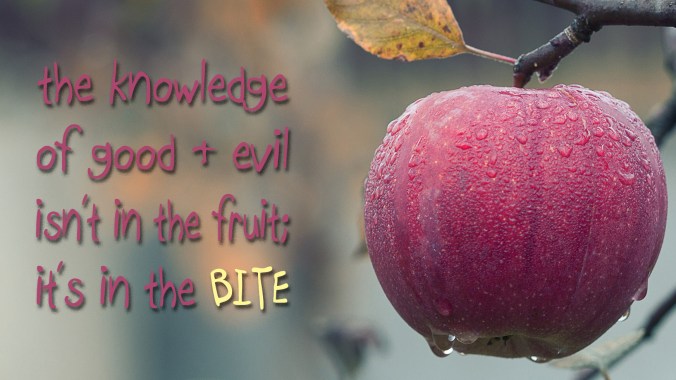
Our reason for desiring “forbidden fruit” always seems solid … right up until we begin to pay the consequences. Like every human being, Adam and Eve already had the capacity for good and evil, but because they had not been disobedient, they did not have the knowledge of it. Immediately upon disobeying God they became aware of how deeply flawed they actually were. Like any one of us, they didn’t want those flaws exposed to the world or to God. Fumbling to conceal themselves only made mistakes more apparent. Whether or not we believe in a literal Eden, the story teaches us that as soon as we are aware of our disobedience, we feel separated from God.  The knowledge is not contained in the fruit, but in the bite.

It took a Christ who was willing to die on our behalf to reveal to us that God loves and forgives us despite our flaws. Our vain and impossible attempts at perfecting ourselves – our fig leaves – only further separate us from God, because we inevitably fall short and condemn ourselves. We’d be better off never having covered up at all. Christ invites us to drop the fig leaves and return to God on God’s terms – spiritually naked and humbly dependent. Christ uncovers our shame, and covers us in love.

Comfort: God loves you just as you are.

Challenge: In what ways are you still trying to prove yourself to God? How can you let go of these “fig leaves?”

Prayer: Loving Creator, I present myself humbly before you. I trust that you love me despite my sins and failures. I thank you for Christ who strengthens and redeems me. Amen.

Discussion: What tempts you? How do you feel after you give in?

Join the discussion! If you enjoyed this post, feel free to join an extended discussion as part of the C+C Facebook group. You’ll be notified of new posts through FB, and have the opportunity to share your thoughts with some lovely people. Or feel free to comment here on WordPress, or even re-blog – the more the merrier!

An Old-Fashioned Sin

i-want-yours-1321387-1279x907

Today’s readings (click below to open in new tab/window):
Psalms 135; 145, 1 Kings 21:1-16, 1 Corinthians 1:1-19, Matthew 4:1-11


Covet isn’t a word we use a lot unless we are quoting the Ten Commandments. It can be a difficult concept for us to wrap our brains around. We often treat it as a synonym of envy or desire, but it’s more intense than that. Those are feelings, and God’s commandments don’t waste time telling us what to feel. We can’t covet something unless it belongs to someone else. When we covet our neighbor’s livestock or spouse, we don’t just wish we had one of those too, we dwell on the idea that the one they have should be ours. It’s more than wanting it – it’s convincing ourselves we somehow have more right to it than they do.

King Ahab coveted the land of a man named Naboth. The land, which Naboth used as a vineyard, was his ancestral inheritance. Ahab wanted to turn it into a garden so he offered to buy or replace it, but Naboth declined his offer. Ahab – who as king was wealthy beyond measure and could have built more gardens than he could have visited in a lifetime – became so depressed he wouldn’t eat or leave his bed. Ahab’s wife Jezebel was having none of it. She arranged for false charges of blasphemy to be brought against Naboth and the people stoned him. Ahab didn’t waste any time taking possession of the land.

Coveting may be an old-fashioned word, but it has many modern practitioners. Nations justify war by convincing themselves they deserve what someone else already has. Gentrification drives poor people from their homes into even poorer neighborhoods. In some cases when a person can’t get what they covet – a relationship, a reputation, or even peace of mind – they settle for destroying it.

Coveting isn’t a passing glance or stray thought. It’s a cultivated intention. It’s replacing the only true object of our devotion with something that will not only fail to satisfy, but ultimately diminish us.

Perhaps if we are tempted to covet, we can remember Jesus being tempted by the devil in the desert. Jesus drove him away saying, “Away with you, Satan! for it is written, ‘Worship the Lord your God, and serve only him.’” We can’t control our thoughts, but we can choose which ones to follow.

Comfort: Coveting is something  you can avoid.

Challenge: Once a day say a prayer of gratitude for something you have.

Prayer: Merciful God, teach me to be content with what you have seen fit to entrust to me. Amen. 

Discussion: What do you think of when you hear the word covet?

Join the discussion! If you enjoyed this post, feel free to join an extended discussion as part of the C+C Facebook group. You’ll be notified of new posts through FB, and have the opportunity to share your thoughts with some lovely people. Or feel free to comment here on WordPress, or even re-blog – the more the merrier!

‘Fess Up

apple-464182_1920

Today’s readings (click below to open in new tab/window):
Psalms 19; 150, 1 Samuel 4:12-22, James 1:1-18, Matthew 19:23-30


While nearly all Christian denominations now consider the Book of James an official part of the New Testament canon, it can still be controversial. It mentions Christ only twice, and never in the context of his resurrection, but does refer to many of his sayings. Scholars don’t agree on its author, timing, or structure. Still it contains great wisdom which doesn’t rely on complex theological understandings (though it is not without its own theological stance). Simply put, James wants us to live with the integrity of a disciple of Christ.

Not everyone embraces this common-sense approach. Here’s some of what James has to say about temptation:

No one, when tempted, should say, “I am being tempted by God”; for God cannot be tempted by evil and he himself tempts no one. But one is tempted by one’s own desire, being lured and enticed by it; then, when that desire has conceived, it gives birth to sin, and that sin, when it is fully grown, gives birth to death.

We like to push the blame for our temptations onto external sources. It’s part of the earliest stories of our faith, when Eve blamed the serpent and Adam blamed Eve. We blame the devil. We blame God. Yet James tell us we can’t be tempted by something we didn’t want to begin with.

If we dodge responsibility for our own temptations, we never overcome them. It’s like denying a need for bifocals by saying the television won’t focus any more.

When we say confession is good for the soul, we’re usually talking about sins already committed. What if we practiced confessing our temptations before they matured into sins? Shame tells us to shove them in the closet, but then we end up struggling so hard to keep them behind the door that they consume all our energy and eventually wear us down, escape, and trample our lives.

Confessing a temptation to a trusted friend or counselor helps us put it into perspective and manage it. If, as Justice Brandeis said, sunlight is the best disinfectant, let’s not suffer alone in the darkness.

Read more on today’s passage from Acts in Camels and Needles.

Comfort: Temptation is a part of life. It doesn’t make you a bad person.

Challenge: Be brave enough to deal with your temptations before they become reality.

Prayer: Let the words of my mouth and the meditation of my heart be acceptable to you, O LORD, my rock and my redeemer (Psalm 19).

Discussion: How do you fight temptation?

Join the discussion! If you enjoyed this post, feel free to join an extended discussion as part of the C+C Facebook group. You’ll be notified of new posts through FB, and have the opportunity to share your thoughts with some lovely people. Or feel free to comment here on WordPress, or even re-blog – the more the merrier!
Just one bite …

1474513132673.jpg

Today’s readings (click below to open in new tab/window):
Psalms 65; 147:1-11, Esther 6:1-14, Acts 19:1-10, Luke 4:1-13


Ever long for the day when your faith is so strong, temptation will never taunt you again? Spoiler alert: it will be a long wait. Even Jesus, when he spent forty days in the desert preparing for his ministry, felt the devil’s temptations to abandon his ministry for a life of worship and power.

Temptations can shame us. We think we are the only people tempted to think or act a certain way. Ironically we are especially reluctant to confess to those who could counsel us best, because we want to keep their respect. Instead we battle urges in silence and solitude, and the very thing we try to avoid – food, sex, gossip, drugs, alcohol – becomes the center of our attention because we have nowhere to banish it. Scriptures like Matthew 5:28 (“anyone who looks at a woman lustfully has already committed adultery with her in his heart”) convince us temptation has already condemned us.

When we speak openly to trusted counselors or support groups about our temptations we find that we are not alone. We also find speaking the truth unlocks the mental prison where we are trapped alone and wrestling with guilt. We learn scriptural words like “lust” and “covet” don’t refer to casual thoughts, but to ungoverned desire. We learn to check casual thoughts before they become ungoverned desire. Most importantly, we learn sunlight is the best disinfectant even for spiritual ailments.
When we pray “lead us not into temptation but deliver us from evil” what are we really asking? To avoid all instances of temptation? Unrealistic. We are acknowledging temptation is part of life, and that we depend on God to help us cope. Tempted until the end of his ministry, Jesus prayed in the Garden of Gethsemane that his burden might pass. The important lesson is that he submitted his will to God’s.

Don’t be discouraged – experiencing temptation doesn’t mean we’ve already lost the battle! Resisting temptation in small things helps us build strength in case serious temptations arise. Let’s follow the example of Jesus, and acknowledge our temptation, but choose to submit to God.

Comfort: God is greater than temptation; we just have to invite him in.

Challenge: If you struggle with temptation, find a place to talk about it.

Prayer: God of strength, deliver us from evil. Amen.

Discussion: How do you deal with temptation?

Join the discussion! If you enjoyed this post, feel free to join an extended discussion as part of the C+C Facebook group or follow @comf_and_chall on Twitter. You’ll  have the opportunity to share your thoughts with some lovely people. Or feel free to comment here on WordPress, or even re-blog – the more the merrier!