Justice Evolution

heartofflesh

Today’s readings (click below to open in new tab/window):
Psalms 92; 149, Ezekiel 36:22-27, Ephesians 6:1-24, Matthew 9:18-26


“Slaves obey your earthly masters with fear and trembling.”

We can thank Saint Paul for that gem. Sure he also said “in Christ there is no slave or free” and instructed masters to be merciful to their slaves because they ultimately served the same master in heaven, but neither of those satisfactorily addresses the fact that at no time did Paul (or Jesus, for that matter) explicitly condemn slavery. For most of Christian history, slavery was taken for granted, and that verse has been used to justify it.

Once the idea of slavery became unacceptable to almost all mainstream Christians, we weren’t sure what to do with Jesus’s seeming acceptance of it. Some of us tried to differentiate the experience of Biblical slavery versus pre-Civil War slavery in the United States, but in the end all slavery boils down to owning human beings as property. Shouldn’t Jesus have a problem with that?

Of course that question implies Jesus is OK with the way most Christians do things now, and that can be a dangerous assumption. Every human system is flawed. America seems to all but worship capitalism, lumping it in with democracy and Christianity as a kind of US-bred holy trinity, but capitalism itself is amoral and by definition favors the rich above the poor. Not that communism has a fantastic human rights track record. Democracy is subject to mob rule and corruption, and monarchy to tremendous abuses of power. No earthly economic or government system has or can eradicate poverty, oppression, and injustice.

Christ’s message (and consequently Paul’s) transcends these human structures. As the church matures, each generation expands its concept of justice. The past does not invalidate the message, so much as prompt us to look at the present with a more critical eye. Christians led the fight against slavery. The church has evolved from feeding the hungry to tackling the systemic problems which starve them in the first place. What are the next steps in learning to love our neighbors as ourselves? Our job is not to perform theological contortions to explain away the inexcusable; it is to determine how we are to apply Christ’s message today.

Someone will always be waiting to be freed by the gospel.

Comfort: You don’t have to try to excuse the inexcusable things of the past…

Challenge: … but you can’t ignore the inexcusable things of the present.

Prayer: God of love, teach me to shine your light on injustice. Amen.

Discussion: What commonly accepted practices do you think future Christians will look back on in moral embarrassment?

Join the discussion! If you enjoyed this post, feel free to join an extended discussion as part of the C+C Facebook group. You’ll be notified of new posts through FB, and have the opportunity to share your thoughts with some lovely people.

Universal Precautions

righteous_sinners

Today’s readings (click below to open in new tab/window):
Psalms 96; 148, Jeremiah 31:27-34, Ephesians 5:1-32, Matthew 9:9-17


“As Jesus was walking along, he saw a man called Matthew sitting at the tax booth; and he said to him, ‘Follow me.’ And he got up and followed him.” – Matthew 9:9

What does “tax collector” mean to you? In Capernaum where Jesus met Matthew, tax collectors were not exactly IRS agents. They were Jews who collaborated with the occupying forces of Rome to tax the Jewish people for the privilege of being oppressed. If you’re of a Libertarian bent you may not think that’s so different from the modern tax collector, but many Jews considered them traitors to the nation of Israel. The Pharisees lumped them into the same category as the other “sinners” Jesus frequently dined with and challenged the disciples about his choice of companions.

Jesus responded by saying: “Those who are well have no need of a physician, but those who are sick. […] For I have come to call not the righteous but sinners.”

Paul warned the members of the Ephesian church not to associate with those who are disobedient to God. Paul named many kinds of disobedience – so many, in fact, that most of us have been guilty of at least one. Between Jesus dining and drinking with sinners, and Paul warning us to avoid them altogether, what example are we to follow?

When a physician or nurse tends to patients, s/he takes certain precautions to avoid infection. These universal precautions are applied equally whether a patient is obviously ill or not, because one never knows all the facts. Healers can do their work while avoiding contamination, but not while avoiding contact. Every sick patient deserves the dignity of being treated as a person, but boundaries are crucial. So it is with the gospel. We are called to share it with those who need its healing message. To do that, we need to go where they are. We need to share with them common human experiences such as meals, conversation, tears, and laughter. In no way are we permitted to treat them with less dignity than Christ would. We probably shouldn’t even think in terms of “them” as it only fosters dehumanizing division.

We can’t offer comfort to the sick without knowing them, or without recognizing it is only by grace – not our own superiority – that we ourselves have been healed. Faith is not a barrier to isolate us from them, but the protective gear that makes contact possible.

Comfort: No matter how sick you are, Jesus wants you to be well.

Challenge: Don’t shun anyone Jesus didn’t shun.

Prayer: Gracious and loving God, thank you for the healing presence of Christ, and for the opportunity to share it with others.  Amen. 

Discussion: When do you find yourself avoiding people instead of loving them?

Join the discussion! If you enjoyed this post, feel free to join an extended discussion as part of the C+C Facebook group. You’ll be notified of new posts through FB, and have the opportunity to share your thoughts with some lovely people.
Word Power

1463002415138.jpg

Today’s readings (click below to open in new tab/window):
Psalms 47; 147:12-20, Zechariah 4:1-14, Ephesians 4:17-32, Matthew 9:1-8


Speech has the power to build up or to tear down. We might claim words are only words, but they impact the world around us and inside us in real ways. The words our parents speak to us in childhood can enhance or undermine confidence throughout our lives. Gossip can destroy reputations. Journalists can topple empires and poets can terrify dictators. As people following Christ, we are called to use our words constructively.

As Paul wrote to the Ephesians: “Let no evil talk come out of your mouths, but only what is useful for building up, as there is need, so that your words may give grace to those who hear.”

Gossip may be the low-hanging fruit of evil talk, but it is a bumper crop. Not every truth needs to be spoken to every person, especially uninvolved parties. On the occasions we find it necessary to share a harsh truth, our words can be direct without being vindictive. A message that shames or belittles for our momentary satisfaction is not necessary to offer correction or guidance. As rhetoric grows more divisive in this age of anonymous internet comments and confrontational “reality” television, we are encouraged to have an opinion about everything. In matters where we lack knowledge or have no stake, it’s perfectly acceptable to have no opinion at all and stick with it. When we “tell it like it is,” consequences be damned, we reveal more ignorance than wisdom. Bernard Meltzer advises us to ask ourselves if what we are about to say is true, necessary, or kind; if it’s none of these, perhaps we should practice silence.

Yes we must speak up to confront injustice. To share the gospel. To teach each other. But always – always – we are speaking to other children of God.

Words matter because they are manifestation of thoughts, and therefore ignite action. Let silence be a dam between your thoughts and your lips. Release their power in a controlled fashion so as not to leave chaos in your wake. What you hold back represents potential; what you spill can not be reclaimed.

Comfort: Your words have the ability to give grace to those who hear.

Challenge: This week, be especially mindful of when you are silent and when you speak.

Prayer: Loving God, be present in my thoughts, on my lips, and in my heart. Amen.

Discussion: How many of your unnecessary, unhelpful, or unkind words could be replaced with better words or silence?

Join the discussion! If you enjoyed this post, feel free to join an extended discussion as part of the C+C Facebook group. You’ll be notified of new posts through FB, and have the opportunity to share your thoughts with some lovely people.

Body(building) of Christ

off the couch

Today’s readings (click below to open in new tab/window):
Psalms 99; 147:1-11, Isaiah 4:2-6, Ephesians 4:1-16, Matthew 8:28-34


One of Paul’s favorite descriptions of the Church is a body with Christ at its head. In his letter to the Ephesians, he explains how all the gifts of the community work together, just as all the parts of the body work together. He also says the Body of Christ needs to grow into maturity and unity. This growth requires exercise.

Why do we exercise our bodies? Is it just to look good, or is it to keep ourselves fit to accomplish more important tasks? Smart bodybuilders never sacrifice fitness for appearance. Lazy bodybuilders – and churches – do. It’s nice to show off our muscles – be they big biceps or beautiful buildings – but we should never prize them above the overall health of the body. Like healthy bodybuilders, healthy churches achieve results through hard work and good choices; shortcuts result in unsustainable outcomes and dangerous consequences. A body that serves no purpose but to promote itself is not a healthy one.

Bodybuilders are acutely aware of proper proportion. It is easy to focus efforts on areas that respond quickly, don’t tire us, or attract attention. Doing so exclusively, however, leaves key areas neglected. The boring parts are just as important. A church can have a dynamic and popular worship experience, but if it sucks away the energy that could go into mission, the body is out of balance. For bodybuilders such imbalance doesn’t just lose them tournaments, it increases their risk of injury. If the efforts of our Christian body are imbalanced, in the long run we hurt ourselves.

Prevention is the best way to manage injury and illness, but even the most diligent of us may get sick. When that happens, the worst thing to do is ignore it. Far too many people avoid the doctor because of embarrassment or fear. The body of Christ has the same tendencies. We often choose to protect our reputation rather than admit to real problems. Such behavior can be fatal. But it doesn’t have to be. Let’s be sure to take care of the Body in all the right ways!

Comfort: Flex the spiritual muscle you’ve been given – it’s important to the health of the body!

Challenge: Sometimes we think the things that are important to us need to be important to everyone. Try to understand what other people bring to the table that you can’t.What gifts might you undervalue or belittle?

Prayer: God of all good gifts, teach me to make choices to promote the health of the Body. Amen.

Discussion: What gifts – whether yours or someone else’s – might you undervalue or belittle?

Join the discussion! If you enjoyed this post, feel free to join an extended discussion as part of the C+C Facebook group. You’ll be notified of new posts through FB, and have the opportunity to share your thoughts with some lovely people.
Burying The Dead

burythedead

Today’s readings (click below to open in new tab/window):
Psalms 98; 146, 1 Samuel 16:1-13a, Ephesians 3:14-21, Matthew 8:18-27


One day, when Jesus was preaching on the shore, the crowds grew so large he told them to move to the other side of the lake. One of the disciples wanted to first bury his father. Jesus replied:

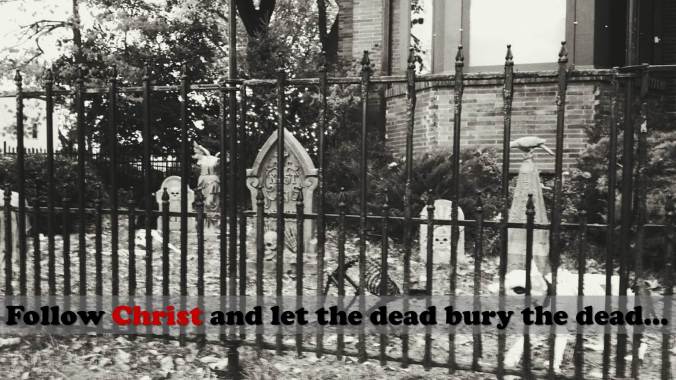
“Follow me, and let the dead bury the dead.”

There are different opinions on the context and meaning of this odd phrase. One is that the man’s father was not yet dead, so the time until his burial was uncertain. Another is that “burying” him would have included acting as executor for his father’s affairs. The common theme across these theories is that to follow Christ is to pursue life, and that postponing our discipleship for the affairs of the world and tarrying among others doing the same is to wallow in death. When Christ calls we are to follow. Period.

If we are honest with ourselves, can we admit that deep down (or maybe not so deep) we know our lives will never be completely in order? Yet we use that reasoning as an excuse for putting off all kinds of things: starting families, launching new careers, jettisoning bad habits, getting in shape, going back to school, pursuing dreams, etc. We pretend there is a noble purpose of order behind our stalling tactic because it’s easier than admitting to laziness or fear. All too often the end result of our self-delusion is that we never get around to what we’d rather be doing, and our lives are still not orderly.

Your life will always be messy. There almost certainly will never be a “right time” – or even a better time – to walk away from the trappings of death and follow life. Voices – both internal and external – will tell you not to shirk your worldly responsibilities; these are the moans of ghosts who can’t move on and don’t want to be left behind and alone. Our true responsibilities are to the priorities Christ has taught us, and it is following him that makes us feel truly alive.

Christ does not cruelly demand we abandon our lives; he graciously invites us to find them.

Comfort: Christ has given you permission to let go of the things that keep you from true life.

Challenge: Egyptians pharaohs were buried with household goods, pets, servants, and even family members. They could not imagine life that didn’t look like what was actually holding them back. Pick one thing in your life that you could put down to lighten your load when following Christ. If it feels good, pick another…

Prayer: God of freedom, I will follow wherever you lead me. Amen.

Discussion: What do you need to put down before you can follow Christ unhindered? What’s stopping you?

Join the discussion! If you enjoyed this post, feel free to join an extended discussion as part of the C+C Facebook group. You’ll be notified of new posts through FB, and have the opportunity to share your thoughts with some lovely people.

East, West, and In Between

always north

Today’s readings (click below to open in new tab/window):
Psalms 97; 145, Joshua 1:1-9, Ephesians 3:1-13, Matthew 8:5-17


One of the great things about being a Christian is knowing your salvation is in the bag.
Or is it?

A Roman centurion once approached Jesus and asked him to heal an ailing servant. Jesus offered to come and cure the servant, but the centurion said it wasn’t necessary to go there: he had faith that if Jesus said it would happen, it would happen.

Jesus was amazed (the Bible’s words, not an exaggeration) at the faith of the centurion. He told his followers:

“Truly I tell you, in no one in Israel have I found such faith. I tell you, many will come from east and west and will eat with Abraham and Isaac and Jacob in the kingdom of heaven, while the heirs of the kingdom will be thrown into the outer darkness, where there will be weeping and gnashing of teeth.”

Mind you these followers were all Jews, and therefore considered heirs of the kingdom. The centurion was an integral cog in the Roman machine which oppressed them. That had to chafe.

There’s a saying that being in church doesn’t make you a Christian any more than being in a garage makes you a car. We don’t inherit the kingdom by being born into a Christian family; we enter the kingdom through grace and faith. If the centurion is any example, our assumptions about what makes a faithful Christian may not be the same as Christ’s – and his is the opinion that counts. Is it possible that agnostics from the east coast and new agers from the west coast might find their way to the table with Abraham, Isaac, and Jacob before we middle of the road Christians do?

The lesson here is not “it doesn’t matter what you believe.” It’s more like “don’t be too quick to make assumptions either way.” In a kingdom where the first are last and the last are first, discipleship can be a balancing act; humility is the narrow beam we must walk. Rather than insist we already know each twist and turn leading to Christ, let’s unfold the map together.

Comfort: You are officially relieved of the duty of deciding whether someone is Christian enough.

Challenge: Listening to people who disagree with your beliefs is not a threat.

Prayer: Gracious and merciful God, set my feet on the path toward salvation. Amen.

Discussion: What can you learn from other faith traditions? What do you think Jesus might say about it?

Join the discussion! If you enjoyed this post, feel free to join an extended discussion as part of the C+C Facebook group. You’ll be notified of new posts through FB, and have the opportunity to share your thoughts with some lovely people.

Burn

KONICA MINOLTA DIGITAL CAMERA

Today’s readings (click below to open in new tab/window):
Psalms 93; 150, Exodus 3:1-12, Hebrews 12:18-29, Luke 10:17-24


Burnout is a reality of modern life. We can experience burnout at work, at church, and even with our family. When we become burned out, our motivation, dedication, and productivity all suffer. More than fatigue which saps our physical and emotional strength, burnout saps our spiritual strength. Exhaustion is the inability to go on; burnout is the unwillingness to.

In Exodus, Moses first encounters God when he notices a bush that is burning but is not consumed. From the flames, God speaks to Moses about how He plans to use this exiled Egyptian Jew to free the nation of Israel. In the decades that followed, Moses might have felt a lot like that bush. Igniting him to a higher purpose, the power and will of God infused him with a spiritual fire that led the people out of Egypt and through forty years in the desert, yet he was able to endure it all without being consumed. Sometimes an exhausted Moses might have wished for it all to be at an end, but God sustained him.

When we suspect we are beginning to burn out, it is time to reevaluate what we are doing. Is it really our job or family that is burning us out, or is it our attitude? If it’s the former, we can seek an external change. If it’s the latter, we must work on internal change. Either way, let’s consider one of the first things God said to Moses: “Remove the sandals from your feet, for the place on which you are standing is holy ground.” It’s not enough to simply stop what we’re doing. We need to find a way to make contact with the holy ground God would have us walk. We need to strip bare not just our feet, but our souls, emotions, fears, and desires until we hear God’s call again. Maybe he will start us on a new journey, or maybe he will fortify us for the next forty years.

Every place we stand is holy ground, if we are listening for the voice of God. Let us hear. Let us burn.

Comfort: When you are tired or unsure, bare yourself to God for renewal.

Challenge: Where in your life are you most subject to burnout? Work? School? Home? Pray about what you can do to transform your situation from an out of control wildfire to a burning bush.

Prayer: Ever loving God, grant me the wisdom to find the path you have laid out before me, and the strength to follow it faithfully. Amen.

Join the discussion! If you enjoyed this post, feel free to join an extended discussion as part of the C+C Facebook group. You’ll be notified of new posts through FB, and have the opportunity to share your thoughts with some lovely people.

Beyond Tolerance

abolished law

Today’s readings (click below to open in new tab/window):
Psalms 92; 149, Numbers 11:16-17, 24-29, Ephesians 2:11-22, Matthew 7:28-8:4


Paul’s letter to the Ephesians addressed the concerns of a church whose members were divided over the issue of circumcision. Jews practiced circumcision as a sign of the sacred covenant between God and their people. Greeks did not practice it. The church had members of both cultures, but many Jews felt circumcision was a requirement to enter into the faith of a Jewish Jesus. Paul taught them both ways were acceptable, because through Christ they had been made into one humanity.

More than a lesson in tolerance, this is a lesson in the artificiality of boundaries.

One modern parallel is the current division between self-identified liberal and conservative Christians. Another is the structure of denominations. If Paul is right, being one body doesn’t mean “conservative and liberal Christians have equally valid viewpoints” or “Presbyterians are just as Christian as Catholics.” It means those divisions … simply … don’t … exist.

We want them to exist though. We like to be able to point to our “tribe” of like-minded individuals for support and affirmation. While we should certainly stand firm on our principles and beliefs, those principles and beliefs can’t be about creating division within the Body. Nor can they be about bending people to our will. When we let that happen, it’s not long until we think we’re qualified to decide who is “in” and who is “out” of the Body based on tribal affiliations rather than personal commitment to Christ.

Labels exist to divide us. They say, “I am this and you are not,” or “you are that and I am not.” What starts as an objective naming of qualities inevitably devolves into a dangerous, tribalistic mindset that declares: “We are worthy and you are not.” When our allegiance to a label takes priority over our allegiance to the Body (and just look at American politics to see how that plays out), we suffer from a kind of spiritual auto-immunity, attacking parts of our own Body and destroying its health.

Tolerating each other is not the same as loving each other. The first reinforces division, and the second helps to erase it.

Comfort: The existence of other people’s beliefs does not threaten yours.

Challenge: Be sure to recognize the difference between being persecuted for your beliefs, and not being allowed to persecute others for your beliefs.

Prayer: Loving God, help me to love my neighbor as your child, and to remember we are both equally beloved by you. Amen.

Discussion: What social boundaries have decreased or increased in importance for you?

Join the discussion! If you enjoyed this post, feel free to join an extended discussion as part of the C+C Facebook group. You’ll be notified of new posts through FB, and have the opportunity to share your thoughts with some lovely people.

Foundation

dostoesvsky

Today’s readings (click below to open in new tab/window):
Psalms 96; 148, 1 Samuel 2:1-10, Ephesians 2:1-10, Matthew 7:22-27


In Fyodor Dostoevsky’s novel The Brothers Karamazov, brothers Ivan and Aloysha engage in long and compelling arguments about the nature of God, faith, and the problem of evil. At one point Ivan asks his brother if, to create a utopia where humanity was eternally happy and at peace, he could justify torturing a blameless infant to death.

Of course Aloysha says no. In the context of the novel his answer has many meanings, but let us consider it in light of Christ’s parable in Matthew about the man who built his house on a foundation of stone, versus the man who built his house on a foundation of sand. Naturally the house built on sand crumbled, while the one on the stone foundation endured. The strong foundation results from following Christ’s teachings, the weak foundation from ignoring them.

Foundations matter. The ends do not always justify the means. When we build lives, families, churches, and communities our intentions mean nothing if our methods are corrupt. Houses built on sand and stone may appear equally grand for a short while, but eventually the underpinnings will be revealed. If we have sacrificed the least among us to build monuments, no matter how grand, they magnify not the Lord but our weakness.

Also in Matthew Christ said:

[M]any will say to me, ‘Lord, Lord, did we not prophesy in your name, and cast out demons in your name, and do many deeds of power in your name?’ Then I will declare to them, ‘I never knew you; go away from me, you evildoers.’

History is full of innocents sacrificed in the name of religion. Many monuments but not a single utopia has sprung from their “unavenged tears” (to quote Dostoevsky). But the one innocent who sacrificed himself willingly ushered in the Kingdom of Heaven. That is our model for a foundation of stone: a willingness to sacrifice ourselves to serve the kingdom. According to psalmists and prophets, God measures us not by how many we have persecuted on His behalf but by the holy sacrifice we have made of our own lives.

Comfort: Christ was the sacrifice that assures us the Kingdom.

Challenge: If what you desire requires someone else to make a sacrifice you do not have to make, you are very likely desiring the wrong thing.

Prayer: God of strength, teach me to build on the firm foundation of Christ, that my efforts may be lasting testaments to your glory. Amen.

Discussion: What clubs, associations, teams, or other groups do you belong to? Have you ever let them persuade you to accept a questionable means to justify a desirable end?

Join the discussion! If you enjoyed this post, feel free to join an extended discussion as part of the C+C Facebook group. You’ll be notified of new posts through FB, and have the opportunity to share your thoughts with some lovely people.

Higher

with you always

Today’s readings (click below to open in new tab/window):
Psalms 47; 147:12-20, Daniel 7:9-14, Hebrews 2:5-18, Matthew 28:16-20

Ascension readings:
Acts 1:1-11, Psalm 47:1-9, Ephesians 1:15-23


Today is Ascension Thursday, the feast when we celebrate the gospel accounts of the resurrected Christ’s ascent into heaven. Theologians understand this event in many ways, from a literal rising into heaven, to a symbolic reunion of Christ with the Creator God. Whatever our personal understanding, there is a common paradox: by departing from all of us, Christ is able to be with any of us.

In Matthew’s gospel, Christ shared these words with his disciples shortly before he departed: “I am with you always, to the end of the age.” After the resurrection, Christ appeared to many people, yet his presence was still limited to those in his immediate vicinity. The idea of every follower building a personal relationship with Christ may have been inconceivable – when he was busy walking and talking with others, he was by definition not walking and talking with you. But the risen and ascended Christ? That is a transcendent and inexhaustible presence not limited by time or space. You and I and everyone else have equal access to him all the time.

If a transcendent Christ seems too abstract to relate to, remember that for a time he shared all our human experiences. The letter to the Hebrews tells us: “Because he himself was tested by what he suffered, he is able to help those who are being tested.” Feeling temptation? Don’t beat yourself up about it; so did Christ. Feeling angry? The gospels give us several examples of an angry Jesus. Feeling despair? On the cross Christ asked why God had forsaken him. Feeling afraid? In the garden of Gethsemane, Jesus sweat blood while asking if the cup he was to bear could be taken from him. Whatever terrible thing you feel, Jesus has felt it also. And – living in human form – he overcame. We don’t have to be superhuman to imitate Christ, but we do have to follow his teachings to be fully human in a way that transcends the flesh.

We are a resurrection people. We are an ascension people. We are Christ’s body on earth, and therefore can never be apart from him.

Comfort: Christ is with us to the end of the age.

Challenge: Meditate on the wonder of the Ascension.

Prayer: God of life and possibility, I will trust you to be with me at all times. Amen.

Discussion: What does the Ascension mean to you?

Join the discussion! If you enjoyed this post, feel free to join an extended discussion as part of the C+C Facebook group. You’ll be notified of new posts through FB, and have the opportunity to share your thoughts with some lovely people.