Give It Up

1488341824024-01.jpeg

Daily readings:
Psalms 5; 147:1-11, Jonah 3:1-4:11, Hebrews 12:1-14, Luke 18:9-14

Ash Wednesday readings:
Isaiah 58:1-12, Psalm 51:1-17, 2 Corinthians 5:20b-6:10, Matthew 6:1-6, 16-21


“What are you giving up for Lent?”

Every year this is a hot topic among the Sunday School crowd. Many children (and some adults) give up candy or other treats. Lately the social media “fast” has been gaining popularity as people log out for forty days.

Other people, rather than (or in addition to) giving something up, add an activity they find meaningful. Some set aside extra time for prayer or other devotional pursuits.  Fans of efficiency might piggyback personal improvements they’ve been wanting to make, such as diet or exercise, onto the season.

Whether we’re subtracting or adding, Lent centers on discipline and sacrifice as a means of spiritual enrichment. However, it’s easy to let the means – skipping a chocolate bar or committing a daily charitable act – become the end. The purpose of Lenten activities is to prepare for Holy Week and Easter, when we re-commit ourselves to the mystery of Christ’s death and resurrection. Psalm 51 tells us: “The sacrifice acceptable to God is a broken spirit; a broken and contrite heart.”

Regarding sacrifice and fasting, Jesus tells us in the Gospel of Matthew: “whenever you fast, do not look dismal, like the hypocrites, for they disfigure their faces so as to show others that they are fasting […] put oil on your head and wash your face, so that your fasting may be seen not by others but by your Father who is in secret.”

It’s not so much what we give up, but how we do it. Lent is not goal-oriented; we aren’t meant to be “new and improved” at the end of it. Lent is an opportunity for sacrificial excavation – for clearing space in our lives meant to be re-occupied not by a sense of accomplishment but by the presence of Christ.

What are you giving up for Lent?

It may taste like chocolate or spend like a dollar, but it’s whatever takes up room where Christ could be. Ego. Pride. Self-righteousness. Anger. Fear. Greed. Christ emptied himself unto death for us. Let us sweep the ashes of death from our hearts to make room for the life he brings.

Comfort: Though it seems far, the day of the Lord is near.

Challenge: This Lenten season, make a meaningful sacrifice.

Prayer: Loving God, all that I have and all that I am is yours. Amen.

Discussion: What makes a sacrifice meaningful?

Join the discussion! If you enjoyed this post, feel free to join an extended discussion as part of the C+C Facebook group. You’ll  have the opportunity to share your thoughts with some lovely people. Or feel free to comment here on WordPress, or even re-blog – the more the merrier!

Cracked

usefulbroken

Today’s readings:
Psalms 116; 147:12-20, Isaiah 54:1-10 (11-17), Galatians 5:1-15, Mark 8:27-9:1


It’s always darkest before the dawn. You can’t make an omelet without breaking a few eggs. No pain, no gain. These and other clichés remind us most successes are preceded by a period of hard work, struggle, and failure. We usually hear these when someone is trying to offer us  comfort, or when we are doing the same for someone else. Unfortunately, they aren’t always helpful when we are in the thick of the darkness, the brokenness, or the pain.

As Jesus neared the end of his ministry, he spoke more bluntly with his disciples. He knew hard times were coming and he wanted them to be prepared. They had not been especially insightful when he taught through parables, so he told them in no uncertain terms he was going to suffer, be killed, and rise again.

The disciples didn’t welcome this news. Peter went so far as to pull him aside and rebuke him, prompting Jesus to utter his famous reply: “Get behind me, Satan!” Jesus knew fulfillment of his mission would require great sacrifice, and Peter’s misguided attempt at redirection embodied all the temptation he had resisted from the beginning of his ministry.

Are we willing to face the work and struggle it takes to follow Jesus (or any worthwhile goal), or are we listening to the Peters in our lives who may mean well but misdirect us to an easier but ineffectual path? Maybe our own inner voice is our Peter, the Satan loudly rebuking us in one ear while our more angelic conscience whispers urgently in the other.

It’s always easier not to voice the unpopular opinion, not to deny ourselves something we desire, not to risk losing what we’ve worked so hard for. The easy way is indeed tempting, and on extremely lucky days it may be the right way, but those cliches are common because they are true: success – especially spiritual success – requires sacrifice. Sacrifice of ego, comfort, money, time … whatever it is that stands between us and God. We have to crack that shell before we can get to the gold.

Comfort: This too shall pass.

Challenge: We offer clichés when we don’t know what else to say. Sacrifice a little time to think about and prepare for what you might say the next time someone you know is experiencing a difficult time.

Prayer: Thank you God for giving me the strength to endure so I may be triumphant in you. Amen.

Discussion: What’s something you’ve worked hard to achieve?

Join the discussion! If you enjoyed this post, feel free to join an extended discussion as part of the C+C Facebook group. You’ll  have the opportunity to share your thoughts with some lovely people. Or feel free to comment here on WordPress, or even re-blog – the more the merrier!

So. Much. Bread.

somuchbread

Today’s readings:
Psalms 96; 147:1-11, Isaiah 52:13-53:12, Galatians 4:21-31, Mark 8:11-26


If we experienced an event – not once but twice – where a few loaves and fishes miraculously fed a multitude, would it have a lasting impact on us?

Today’s Gospel reading takes place after that second feeding of the multitudes, yet the disciples don’t seem quite able to process the meaning of what has happened. Does their thick-headedness frustrate us? Certainly Jesus felt frustrated as his time on earth grew shorter and his need to teach them more urgent. When they later mistake Jesus’s metaphor of yeast for yet another bread shortage, he responds:

“Why are you talking about having no bread? Do you still not perceive or understand? Are your hearts hardened? Do you have eyes and fail to see? Do you have ears and fail to hear? And do you not remember? […] Do you not yet understand?”

In other words, “What are you not getting about all this bread?!”

While the disciples were amazed both times the loaves and fishes multiplied, they failed to internalize the accompanying lesson: God’s abundance frees us for concerns beyond bread. It seems the impact of miracles on our faith and spiritual maturity is fleeting at best. This is an easy lesson to forget, because so many “ministries” promise a life full of miracles if we pray, repent, or donate enough. So much so, that when we don’t experience logic-defying miracles in our lives, we think something is wrong. Signs and wonders, or more accurately the lack of them, become an impediment to faith.

Who can say with authority why, when, or if miracles happen? They don’t define our faith – if they did, wouldn’t miracles alone have been sufficient for the disciples? Rather, Gospel miracles illustrate what life is like in God’s kingdom.

Apart from the odd cursed fig tree, Jesus’s miracles are about healing, abundance, and wholeness. We don’t have to be able to cure by laying on hands to contribute to this kingdom. When we forgive others, nurture the sick and feed the hungry, or embrace the alienated, we build God’s kingdom. When we live in Christ, each of us is a miracle waiting to bless the world.

Comfort: Our God is abundant in love and grace.

Challenge: God’s abundance can be expressed through our generosity; ask yourself where you might be more generous.

Prayer: Thank you God for filling me with the Bread of Life and satisfying me with Living Waters. Amen.

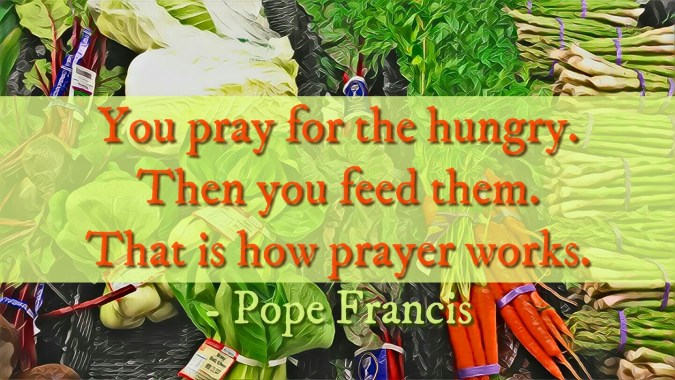
Discussion: Sadly, many people are genuinely in need of bread and clean water. How would you speak with them about God’s abundance?

Join the discussion! If you enjoyed this post, feel free to join an extended discussion as part of the C+C Facebook group. You’ll  have the opportunity to share your thoughts with some lovely people. Or feel free to comment here on WordPress, or even re-blog – the more the merrier!
Thanks In Advance

steadfastlove

Today’s readings:
Psalms 12; 146, Isaiah 52:1-12, Galatians 4:12-20, Mark 8:1-10


From childhood we are taught to sprinkle conversations with a generous seasoning of “thank yous” until they become more of a reflex than a thoughtful response. But why do we say “Thank you?”

Usually we say it after we’ve received something, such as a gift or a compliment,  but the sentiment behind our thanks can vary in meaning. Maybe most of the time we are genuinely grateful for what we’ve received. Other times we are humbled. And then there are those times we feel unworthy of what we’ve been given. Like many phrases which seem simple and easy to interpret, “Thank you” can turn out to be quite complicated.

When Jesus asked the disciples to feed thousands of people with a few fish and loaves of bread (for the second time), he began the meal by giving thanks to God. This may seem little different than the grace said before a church pot luck, but there is one important difference: Jesus hadn’t received anything yet. When we say grace in advance of a meal, we know there is a meal waiting to be had. For what was Jesus thankful? Perhaps for the faith that God would provide.

Some people believe pre-emptively thanking God or the universe is a formula for actualizing your desires. Beginning from a place of thanks is simpler than that: it helps us acknowledge that what we have is enough – and when we have enough we find it easier to share with those who do not.

The origin of saying grace is tied to meals because long ago before eating (and before the FDA) people would pray the food would not literally kill them. What if we said a prayer of thanks before a wider range of activities? Thanking God for the time, money, resources, and love in our lives – in advance of the time we receive, need, or share them – can greatly improve our attitudes and outlook.

Let’s not reserve our thanksgiving until after we have received. Let’s give thanks in advance for whatever it is God may place in our lives, and we will be prepared to put those gifts to use in ways beyond imagining.

Comfort: Gratitude can change your life.

Challenge: Even on bad days, try to find one thing for which you can offer a prayer of thanks.

Prayer: Thank you for being a loving and generous God. I will trust in your abundance. Amen.

Discussion: What do you take for granted?

Join the discussion! If you enjoyed this post, feel free to join an extended discussion as part of the C+C Facebook group. You’ll  have the opportunity to share your thoughts with some lovely people. Or feel free to comment here on WordPress, or even re-blog – the more the merrier!
Riding out the Storms

stormyseas

Today’s readings:
Psalms 88; 148, Isaiah 50:1-11, Galatians 3:15-22, Mark 6:47-56


The Gospels contain a few different versions of stories about Jesus walking on water. In today’s reading from Mark, he begins striding across the Sea of Galilee when he notices the disciples in their boat are struggling against the waves. He came towards them to reassure them, but the shortest sentence in this story may be the most revealing: “He intended to pass them by.”

Jesus climbed into their boat only after they grew afraid because they thought he was a ghost. Until that point, it seemed he expected they would be capable of fending  for themselves. Only a few minutes away from his presence, and they lost courage and – it seems – the ability to recognize him. When we are struggling and afraid, it’s easy to lose our clear line of sight toward Christ and imagine all manner of horrors are approaching.

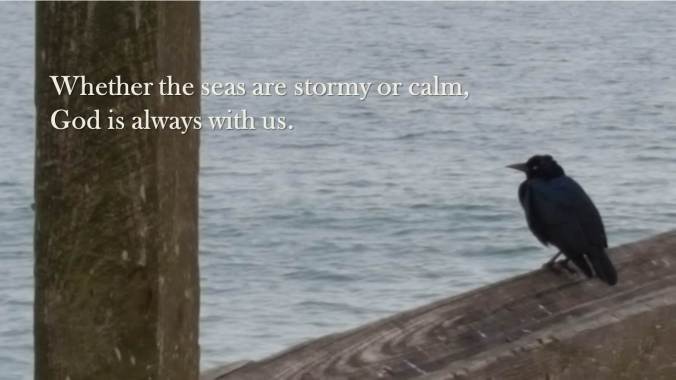
In those times, we need to remind ourselves and each other God has not abandoned us. What if – like Jesus walking past the disciples in the boat – God has more faith in our ability to weather the storms than we do? Our strength derives from the knowledge (if not necessarily the feeling) God is always with us, but he does not literally need to be in the same boat. Could it be possible that when God is moving in a direction we don’t expect, particularly one that is diverging from us, we might fail to recognize the movement as His?

Jesus was teaching his disciples more than how to follow him: he was teaching them to lead others to him. He left them (and us) the Holy Spirit, but he also left them with the reassurance he believed they were capable of feeding his sheep (John 21:15-17). It took a lot of stormy moments – culminating in the crucifixion – for the disciples to understand this lesson. If we are to be witnesses for the good news, we must not despair every time the boat rocks. During the worst storms, even if we are to drown, God walks the waters to lift us out.

Comfort: God is with us. Always.

Challenge: Try to live into the spirit of Courage which God has given us.

Prayer: God, I trust that even when you see far away, you are closer than I can imagine. Amen.

Discussion: Are you a worrier? If so, what about?

Join the discussion! If you enjoyed this post, feel free to join an extended discussion as part of the C+C Facebook group. You’ll  have the opportunity to share your thoughts with some lovely people. Or feel free to comment here on WordPress, or even re-blog – the more the merrier!

“You feed them!”

1485478388869.jpg

Today’s readings:
Psalms 143; 147:12-20, Isaiah 49:13-23 (24-26), Galatians 3:1-14, Mark 6:30-46


Effective teachers and parents know when it is time to stop instructing and let a child act on the lesson. Until we actually do something ourselves, we haven’t really learned. Some would say we haven’t mastered a thing until we can teach that thing to someone else.

After a long day of preaching and healing, Luke tells us, the disciples thought the crowd of five thousand men (perhaps ten thousand people counting women and children) needed to disperse into the surrounding area to find food and lodging. When they asked Jesus to dismiss the crowd, he surprised them by saying: “You feed them.” How five loaves and two fish then fed the multitude is one of the Gospel’s most famous miracles. The miracle sometimes overshadows another important element of the story: Jesus told the disciples to do it themselves.

Folk wisdom says God answers all prayer, and sometimes the answer is “No.” Let’s expand on that; maybe sometimes the answer is: “Great idea! Get to it!” At some point we need to move beyond listening to and talking about faith, and get to living it. Jesus does not offer a faith of heady concepts, but one of relationship and love. He does not teach a faith limited to Bible study, bake sales, and church attendance, but one of being present and caring for “the least” of our sisters and brothers. Understanding what Christ wants us to do is only the beginning of getting it done.

The apostles were not a particularly perceptive lot. They were probably either hungry themselves, or beginning to hear rumblings from the people gathered. The concern they brought to Christ seemed overwhelming, but with God’s help it was not beyond their abilities. How many of the concerns we bring to Christ might be addressed by opening ourselves to the possibility of God working through us? If God doesn’t seem to answer our prayer, maybe God is waiting on us. If we entrust our actions to God, and if we make an effort to be perceptive, the answer to a prayer may start when we get off our knees.

Comfort: God leaves us to our own devices out of trust, not neglect.

Challenge: Be ready to act on the lessons of the Gospel.

Prayer: Loving God, make me ready to be the answer to a prayer. Amen.

Discussion: When have you learned that the only thing standing between you and what you wanted or needed … was you?

Join the discussion! If you enjoyed this post, feel free to join an extended discussion as part of the C+C Facebook group. You’ll  have the opportunity to share your thoughts with some lovely people. Or feel free to comment here on WordPress, or even re-blog – the more the merrier!

Keepin’ It Real

goodfriend3

Today’s readings:
Psalms 65; 147:1-11, Isaiah 49:1-12, Galatians 2:11-21, Mark 6:13-29


Do you know anyone who doesn’t tolerate your nonsense? Most of us know at least one person – maybe a friend, a co-worker, or a rival – who won’t let us get away with anything. For Peter, the rock upon whom Jesus built his church, that person was the apostle Paul. (Before Paul it was Jesus, but those are other scriptures…)

Peter, Paul, and James the brother of Jesus were the leaders of the early church. All of them had different ideas about how to spread and live out the gospel, so while they were brothers in Christ, they were also caught up in a little game of power politics.

When Paul visited Peter (called Cephas in Aramaic), he found him socializing and eating with gentiles. Many Jewish Christians – including James! – would have found this behavior intolerable. After word came that James, who was not yet convinced anyone but Jews could be Christians, was going to visit, Peter and his followers quickly resumed their Jewish customs and rituals so as not to give James any political ammunition to use against them. Paul, who was very invested in spreading the Gospel to the gentiles, didn’t hesitate to call Peter out on his hypocrisy by saying: “If you, though a Jew, live like a Gentile and not like a Jew, how can you compel the Gentiles to live like Jews?”

We all need a friend (or frenemy?) like Paul to keep it real with us. A good friend knows when to offer a shoulder to cry on, and when to tell us the hard truth no one else will. In the workplace, a yes-man may be good for stroking the ego, but strong servant-leaders surround themselves with people who aren’t afraid to respectfully speak their minds when needed. Across the conference table or over a beer, the truth may sting a little (or a lot), but it’s often an inoculation against future mistakes.

Find that friend. Be that friend. The friend who shines light on the darkness not to expose or humiliate, but to clarify and disinfect. Christ was that kind of friend (and of course infinitely more), and as “little Christs” we can be too.

Comfort: You can be honest with your friends.

Challenge: Your friends can be honest with you.

Prayer: Thank you God for good friends, and please help me to be a friend like Christ. Amen.

Discussion: What’s a hard truth you had to hear from a friend?

Join the discussion! If you enjoyed this post, feel free to join an extended discussion as part of the C+C Facebook group. You’ll  have the opportunity to share your thoughts with some lovely people. Or feel free to comment here on WordPress, or even re-blog – the more the merrier!

A Burden Shared

burdenshared

Photo Credit: John (“Dad”) Schultz

Today’s readings:
Psalms 54; 146, Isaiah 48:12-21 (22), Galatians 1:18-2:10, Mark 6:1-13


When Jesus felt the disciples were finally ready to travel and spread his teachings, he dispatched them in pairs. He told them to bring nothing extra: no food, no luggage, no extra clothes, and no money. For shelter they were to rely on the hospitality of the communities they visited, and in its absence they were to rely on the open road. Though his commands sounded harsh, Mark reports the disciples had successful journeys depending only on the bare minimum.

As technology evolves, the “bare minimum” has become anything but: smart phones, tablets, fitness bands, bottled water, etc, etc.  Today we can barely imagine going on a mission trip without a GPS and the Bible on an e-reader. Imagine Jesus unpacking your purse or backpack or luggage and saying: “You won’t be needing this charger. Or this phone. Or different shoes for hiking and digging. Or this pencil. Or…” until eventually you have nothing but a walking stick, the clothes on your back, and a single companion.

Yet what a gift it is when two people are separated by no distractions and joined by a dedication to the Good News. On our own we can easily wander down the wrong path, but a companion keeps us accountable and on track. Our fear is less when someone has our back, and our strength is greater when we are responsible for and with another. Scriptures contain many examples of prophets and leaders who were at their best when they had a partner sharing the burden: Moses and Aaron, David and Jonathan, Ruth and Naomi, Elijah and Elisha.

Relationships are formed in the absence of distractions. Being fully present with another person while you both are working for the Kingdom of God is a uniquely bonding experience. That work can be anything from digging wells in Africa to praying together for someone in need. It can’t be done as well if we are juggling unnecessary items that distract us from the task at hand. Jesus teaches us again and again that we don’t need possessions to be content. Even more he teaches us we do need each other.

Comfort: You are designed to go it alone, so don’t feel like you have to.

Challenge: Be intentional about being present to those around you, particularly during shared experiences such as meals or worship. This may mean putting away your phone, camera, or other distractions for longer than you’re used to.

Prayer: God of peace, shape me into a suitable companion for those who would walk with me to share your Word. Amen.

Discussion: Even within Christianity there are divisive factions. Have you ever found yourself joined in a common purpose with someone  you had previously considered an opponent?

Join the discussion! If you enjoyed this post, feel free to join an extended discussion as part of the C+C Facebook group. You’ll  have the opportunity to share your thoughts with some lovely people. Or feel free to comment here on WordPress, or even re-blog – the more the merrier!

Long Suffering

Hogarth, William, 1697-1764; Christ at the Pool of Bethesda

Christ at the Pool of Bethesda – William Hogarth (1697-1764)

Today’s readings):
Psalms 67; 150, Isaiah 47:1-15, Hebrews 10:19-31, John 5:2-18


Today’s reading from John is significant for several reasons.

First, Jesus performs a healing on the Sabbath, which – according to the Pharisees – breaks the Mosaic Law. In this way he establishes that he understands the law better than they do.

Second, he commands the man he heals to get up and carry the mat he’d been lying on. This was also prohibited, so Jesus assumed authority to exempt others from the law.

Finally, Jesus refers to God as his Father, declaring himself beyond their ability to understand or judge. This only intensified the Pharisee’s desire to see him killed.

John tells us the man Jesus healed was only one of many invalids lying by a pool with alleged healing properties. When Jesus learned the man had been suffering for 38 years, Jesus asked him if he wanted to be made well, and the healing and its ensuing controversy unfolded.

But what about all the other sick people by the pool?

John skips ahead in the story so we have no idea whether Jesus interacted with anyone else. The Gospels tell us several times that Jesus healed crowds of people, but not this time. Yet it doesn’t seem likely Jesus simply wasn’t concerned with them.

The truth is, not everyone is healed. Most of us are more likely to find ourselves among the long-suffering than miraculously made whole.  Some theologians would blame it on a lack of faith. Others would say each healing miracle serves a specific purpose in Christ’s ministry.

We can find ourselves caught between seemingly contradictory ideas telling us on one hand that faith will heal us and on the other that suffering brings us closer to Christ. Can both be true?

We must remember that whatever our plight, Jesus still sees and hears us. He still moves among us. His love and compassion for us are as great as they are for anyone else who seems more “blessed.”

Until he died, even Paul suffered an unnamed malady, which he called the “thorn in his side.” Rather than torture himself about why, he considered his weakness a perfection of his strength.

Suffering is not a sign of disfavor. No one gets to impose their own meaning on your suffering, but both illness and health present opportunities to grow closer to God. Whatever the state of your life, God loves you and is with you.

Comfort: In sickness and health, God is with us.

Challenge: Do something – volunteer, donate, etc. – to support people with chronic illness.

Prayer: God of compassion, I will seek you even in my suffering. Amen.

Discussion: Have you ever found meaning in suffering? If so, how?

Join the discussion! If you enjoyed this post, feel free to join an extended discussion as part of the C+C Facebook group. You’ll  have the opportunity to share your thoughts with some lovely people. Or feel free to comment here on WordPress, or even re-blog – the more the merrier!

In Equity

birds-1169748-1920x1440

Today’s readings:
Psalms 56; 149, Isaiah 46:1-13, Ephesians 6:10-24, Mark 5:1-20


In his various letters, Paul reminds us again and again that in Christ all are equal. However, he also recognized that isn’t the way the world works. In his letter to the Ephesians, Paul tells husbands to respect and love their wives, and wives to obey their husbands. By modern standards that’s a sexist stance, but at the time – when women were the property of their husbands – it was radical. He tells children to obey their parents, and fathers not to provoke their children to anger. In Christ, any authority granted us by culture is not ours to exploit or wield ruthlessly, but to execute justly.

Paul’s words for masters and slaves were controversial then and now, but for different reasons. He told slaves to obey with fear and trembling, and to serve with enthusiasm, and he told masters to stop threatening slaves and to “do the same to them.” Since he didn’t demand outright that slaves be freed, some people who aren’t fans of the Christian faith drag out this passage as if it we an overall Christian endorsement of slavery. (It may not help that some defenders of slavery actually did use this and similar scripture passages to support their position.)

We don’t know what Paul’s feelings about slavery were, since addressing slavery wasn’t his mission (though we do know he intervened on behalf of at least one runaway slave). Paul was introducing the gospel to people in their present circumstances; because he believed the return of the Lord was imminent, restructuring society would have been immaterial.

Of course slavery is utterly indefensible (and its abolition in the west was due in large part to Christian efforts), but let’s remember we still live with many social injustices that are dismissed even – and sometimes especially – by Christians as “the way things are.” From exploiting labor to dumping industrial waste on communities too impoverished to fight it, we are part of a world that turns blind eyes toward injustice. Changing society may be like turning the Titanic around, but what we are willing to tolerate or promote in our lives indicates how closely we take the gospel to heart.

Authority and privilege should be used – and if necessary sacrificed – in service to those who lack them. Unequal roles may be unavoidable, but expressing love, dignity, and spiritual equality within them is always an option.

Comfort: In God’s eyes, you are not defined by your position in life.

Challenge: Exercise any authority or privilege you possess as through it was entrusted to you for the purpose of spreading God’s love … because it was.

Prayer: God of mercy, teach me to be merciful. Amen.

Discussion: Has anyone shown you mercy when they didn’t have to?

Join the discussion! If you enjoyed this post, feel free to join an extended discussion as part of the C+C Facebook group. You’ll  have the opportunity to share your thoughts with some lovely people. Or feel free to comment here on WordPress, or even re-blog – the more the merrier!