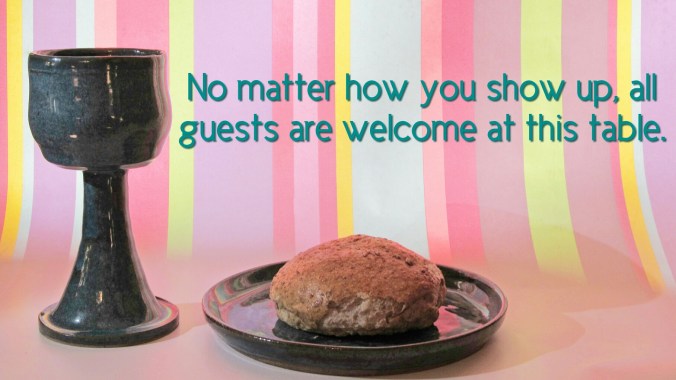
Showing Up

1478568508003-01.jpeg

Today’s readings (click below to open in new tab/window):
Psalms 135; 145, Joel 1:15-2:2, Revelation 18:15-24, Luke 14:12-24


It’s no secret that Jesus was fed up with the priestly class, but he didn’t dismiss them out of hand. He was present in the synagogues, and each time they challenged him he gave them an opportunity to hear him and accept him as messiah (though he was careful about using that word). How frustrating must it have been for him when, time and time again, they not only rejected him but remained willfully deaf to his invitation to repent and truly serve God and God’s people?

He told a parable about a man who threw a great dinner and invited many people. Each of the invitees had an excuse for not attending: I just bought some property; I’m a newlywed; I have new oxen to test-drive. The host was very angry, and sent his servants to “bring in the poor, the crippled, the blind, and the lame.” These new banquet guests were the inheritors of the kingdom, and no one who was invited got to taste a bite.

Why do we cater to the people who never show up? Many a church exerts so much energy on attracting new people (or “giving units”) that it has little left for the needs of the faithful regulars. Hours are wasted on figuring out how to placate those dedicated (but affluent) malcontents who always seem to have one foot out the door because of one imagined slight or another, instead of asking engaged people why they stay and what they need. The poor, the blind, the lame; they aren’t merely the beneficiaries of the church – they are the church. We are the church. Every one of us is in need. There’s nothing we have to offer God that is not already God’s, so when any of us shows up, it’s with hat in hand, starving for grace. Any other posture is a rejection of the invitation. Let yourself be dragged into the banquet.

If you reject Christ’s invitation because the church is too hypocritical, judgmental, or old-fashioned, you just might be missing the opportunity to fill the seat that will change it.

Comfort: Church doesn’t exist for its leadership, but for its people.

Challenge: Are you showing up? Think about ways you might be rejecting the invitation.

Prayer: Thank you, loving God, for the invitation to life in your kingdom. I am grateful for it and accept it anew every day. Amen.

Discussion: Have you ever been disappointed by a poor turnout?

Join the discussion! If you enjoyed this post, feel free to join an extended discussion as part of the C+C Facebook group or follow @comf_and_chall on Twitter. You’ll  have the opportunity to share your thoughts with some lovely people. Or feel free to comment here on WordPress, or even re-blog – the more the merrier!

Invitation: Chunk

1474225611872.jpg

Several weeks ago I was having dinner with friends and the conversation turned to childhood memories, specifically memories of dinner time. Our experiences were somewhat different. One of my friends explained how in his large family the younger children were lucky to get much, as the father took his food first, and then the oldest children, and so on. By the time the youngest ate, there was always something left, but it could be pretty meager. My own experience was different. We did not think of ourselves as wealthy – my father brought home a teacher’s salary and worked part time in a grocery store – but whether we ate at home or out, we three children were served or could order portions equal to that of the adults. I remembered it being the same way at my grandparents’ table, and with my aunts, uncles, and cousins as well. This, I said, seemed much more fair. Then my friend explained that in his family if his father didn’t keep up his strength and ability to work, there wouldn’t have been food on the table at all. Suddenly I was confronted by the reality of my own privilege, and reminded how wealth is always a relative condition.

In my term as an Elder of my church, I had the privilege of serving communion many times to many people. With another elder I would hold bread or the cup as people walked up to break off a chunk and dip it in the juice. One thing that always amused me was how ninety percent of the people always seemed to tear off the smallest possible piece of bread. I was never sure why this was: we always had plenty left over, and the tiny pieces were obviously difficult to manage based on the number that ended up floating in the cup. If the bread was especially crusty and wouldn’t tear easily, some people shrugged and smiled apologetically for not being able to rip off a smaller portion.

After my dinner conversation, I now wonder if people’s idea of how much communion bread they’re entitled to reflects the abundance or scarcity of their life experience, or if maybe it reflects their perception of what they bring to the table relative to others. The next time I invite people to Christ’s table for communion, I want to tell them Jesus wants them to help themselves to a big ol’ chunk of his grace. At Christ’s table we are all equal, and there’s enough to go around. Don’t be shy – be hungry. Hungry for love. Hungry for forgiveness. Hungry for mercy. Jesus wants us to be stuffed to the gills with all these things. The less you think you deserve them, the more you should consume. Tearing off a morsel that you might actually have to chew on a while isn’t an indulgence … it’s the whole point. Christ didn’t die for us so we could live on crumbs; he died so we could feast on grace.

May the Peace of our Lord Jesus Christ be with you all.

Invitation: Garlic Bread

1473008663798.jpg

Several years ago I was part of a mission trip to New Orleans, where we helped with the rebuilding effort in the Ninth Ward after Hurricane Katrina. A few Northern Indiana area churches drove down together, and we stayed at a mission station with another, larger group from Tennessee. The different churches rotated through some of the housekeeping activities: cleaning the bathrooms, preparing meals, doing laundry, and evening worship. Worship always involved communion, so the meal shoppers made sure bread was available.

Even the best schedules can fall apart, and one day the worship team members (all youth) were stuck at a work site an hour longer than they had planned. As the lasagna finished baking, they quickly pulled together a short but meaningful order of worship and selected some hymns. While we were cleaning up after the meal, a whisper traveled from table to table: there had been a mix-up, and all the bread had been basted in garlic and butter for the meal. There was no time to run to the Winn-Dixie before worship. What to do?

One of the young people suggested using the garlic bread. “Hey, Jesus used what was on the table,” he said. So that was what they did. Now in the Disciples of Christ we often distribute communion by intinction, which means the person takes bread and then dips it into the cup before eating it. At youth camp they call it rip-and-dip, or chunk-and-dunk.

As it turns out, garlic bread dipped in grape juice is less than appetizing. Not terrible, but weird and mildly unpleasant. Not things one generally associates with communion. No one said anything at the time, but as the evening wore on, several people began to grumble about how “disrespectful” it had been for the worship group to use garlic bread. One of the adults decided they needed to have a “talk” with the youth about how inappropriate their selection had been. As he offered his opinion, the kids looked deflated and started to apologize until one of the pastors interrupted him. “Excuse me,” she said, “these kids worked really hard today to make sure someone could get back in their home as early as possible. Not everything has to be someone’s fault. The communion wasn’t ideal, but perhaps we should focus on why we’re all here. And make sure we have bread for tomorrow.”

We have this idea that the holy should be pretty and palatable. But the sweaty work those kids did that day was holy. The stink they gave off because they decided to use their limited time to plan worship instead of showering … was holy. When we commune, all we can ever bring is what’s available to us. Some of us have the luxury of buying new whatever we need, and others find the holy in what is on the table, because God has provided it. When we say: “what you have to bring isn’t up to snuff,” what we are really saying is: “I refuse to see the holy in you.”

I’ll take weird garlicky communion that’s offered in love, over bland chunks that confuse respectability for holiness, every time. When we come to Christ’s table, we bring our holy and unholy selves. Maybe some of us do a better job of keeping the holy out front where everyone can see it, but that’s just window dressing. When we don’t like what someone brings to the table, that’s not a challenge to change them – it’s a challenge to change ourselves. And if meeting the needs of a community means we sometimes taste and smell bad … perhaps we should focus on why we’re all here. And make sure we have bread for tomorrow.

May the Peace of our Lord Jesus Christ be with you all.

Fixer Upper

1471058322754.jpg

Today’s readings (click below to open in new tab/window):
Psalms 51; 148, Judges 14:20-15:20, Acts 7:17-29, John 4:43-54


How long is something brand new? Until it’s driven off the sales lot? Until it’s removed from the packaging? Until the first floorboard begins to squeak? Whatever the criteria, “brand new” never lasts long. The very actions we take to preserve something can accelerate its deterioration: washing a car erodes the finish and recharging a cell phone battery shortens its life. Nothing and no one escapes the wear and tear of existence. Nicks and dents, wrinkles and regrets, from birth onward imperfection relentlessly etches itself onto each of us. The only way to escape life’s hardship is not to live it, but then we are like a toy still in its box gathering dust on a shelf, never fulfilling the purpose for which we were created.

The author of Psalm 51 feels life’s every scrape and smudge. He longs to be washed clean, to be filled with a new and right spirit. He asks the Lord to blot out his transgressions and create a clean heart. Fortunately, God loves a fixer-upper. The psalmist knows “the sacrifice acceptable to God is a broken spirit; a broken and contrite heart.” We’ve all been damaged in ways large and small. Our wounds may be self-inflicted, caused by cruelty, or the unintentional result of friendly fire. When the world shames us into hiding them, we cut ourselves off from Grace. To God, our inevitable brokenness is not a barrier, but an invitation.

“Brand new” is momentary, if not illusory. If we long for the imagined perfection of the past, the present will always seem insufficient. But if we are willing to do the hard and humble work of submitting to God, we will create a testament to the firm foundation He has laid in us. We buff out the scratches through prayer, nail another roof beam back into place with each song of praise, and re-open a boarded up window and let in the light with each act of service.

No matter the source of our damage, and no matter how eager others may be to condemn us, God will offer to restore us.

Comfort: God loves you through all your hardships.

Challenge: Save something you plan to throw out, and see if you can re-purpose it.

Prayer: Create in me a clean heart, O God. Amen.

Discussion: What areas of your life are currently under major reconstruction?

For further reading on John 4:43-54, see Out of Thin Air

Join the discussion! If you enjoyed this post, feel free to join an extended discussion as part of the C+C Facebook group. You’ll be notified of new posts through FB, and have the opportunity to share your thoughts with some lovely people. Or feel free to comment here on WordPress, or even re-blog – the more the merrier!

Mellow Harshed

1470522355491.jpg

Today’s readings (click below to open in new tab/window):
Psalms 63; 149, Judges 9:22-25, 50-57, Acts 4:32-5:11, John 2:13-25


Acts chronicles wonderful stories of the faith and courage of the early church … and then there’s the tale of Ananias and Sapphira. The earliest believers held their possessions in common. Barnabas, a recent convert, had just sold a field and gave all the money to the Apostles for them to distribute to the needy. Ananias and Sapphira were a married couple who also sold some property, but when they brought the money to the Apostles they secretly held some of it back. When Peter asked Ananias what possessed him to lie to the Holy Spirit, Ananias dropped dead on the spot. Three hours later Peter asked Sapphira if the property had sold for the amount donated. When she corroborated Ananias’ lie, Peter called her on it and she too dropped dead.

Seem harsh? Theologians have concocted a stew of reasons for the death of this couple, but it’s a bitter mix. Some claim they died for lying to the Holy Spirit. Others claim they died for introducing sin to the community of believers. Still others claim God needed to make an example of them to show hypocrisy was not acceptable among those who would be part of the church. Finally, by citing Peter’s claim that Ananias had let Satan fill his heart, some speculate the deception was the latest in a series of sins. Somehow they all conclude the lesson is that God is merciful, and only his grace spares us sinners from destruction … unless it doesn’t.

So what do we do with this? First, we note scripture doesn’t say God (or Peter) killed them: it says they dropped dead. Though it feels like judgment, that’s an important difference. Second, the story is not tied up in a neat moral bow like one of Aesop’s fables. But we can draw some lessons: grace is unearned but not guaranteed or to be taken for granted; hypocrisy is fatal, especially in churches; salvation is more than a feel-good promise – we must let it guide our actions.

God does not seek our understanding or approval. Christianity is always a humbling experience.

Comfort: God is always good, even if we don’t understand how.

Challenge: Create a list of your own  hypocrisies. Add new ones as they occur to you. Every day work toward eliminating one.

Prayer: God of Power and Glory, I am your humble servant. Amen.

Discussion: Have you ever felt like you’ve gotten a raw deal from God?

Join the discussion! If you enjoyed this post, feel free to join an extended discussion as part of the C+C Facebook group. You’ll be notified of new posts through FB, and have the opportunity to share your thoughts with some lovely people. Or feel free to comment here on WordPress, or even re-blog – the more the merrier!

One and done?

1467241145380.jpg

Today’s readings (click below to open in new tab/window):
Psalms 65; 147:1-11, Numbers 22:41-23:12, Romans 7:13-25, Matthew 21:33-46


One tenet of Calvinism is the belief that God has predetermined who will be “elected” (believers saved by grace) and who will not. Though there are varying schools of thought on the interaction of belief and election, and people ask how they can know if they are elected, the prevailing presumption seems to be that belief is evidence you have been elected. But really you only know that you believe at this moment. People and circumstances constantly change.

In the Parable of the Husbandmen, a landowner (God) plants a vineyard (the nation of Israel), leases it to some tenants (the leaders of Israel), and leaves the country. While he is away, he sends servants (the prophets of old) to claim the produce, but the tenants beat, kill, and stone them. Finally the landowner sends his son (Jesus) but the servants kill him, too.

It seems clear the tenants believed they could establish themselves as the rightful occupants, beneficiaries, and heirs of the vineyard. They had been hand-picked by the landowner, but turned out to be untrustworthy. Unsurprisingly, the religious leaders in Jesus’s audience were not fans of this story. Without debating the merits of Calvinism, can we see how this parable illustrates the dangers of taking one’s own righteousness for granted?

As with many things in Christianity, humility in this area serves us well. Yes, believers should rejoice in our salvation. But we should not assume that automatically makes us good caretakers of the faith. It is never our own convictions and strengths that save us, but the grace of God. We might think of the tenants as evil, but as Rebecca Solnit (paraphrasing Mary McCarthy) says: “we are all the heroes of our own stories.” In other words, without being open to outside perspectives, we aren’t the best judges of our own righteousness; we need to remain open to the idea we could become the bad tenants. The fruits of the spirit are not ours to horde, but to return to God when called to do so. Salvation is not a one-time deal, but something we accept every day.

Comfort: God desires your salvation.

Challenge: Though our salvation is a cause for joy, our faith must remain humble.

Prayer: God of Salvation, teach me to serve you and not my own interests. Amen.

Discussion: How do you feel about predestination?

Join the discussion! If you enjoyed this post, feel free to join an extended discussion as part of the C+C Facebook group. You’ll be notified of new posts through FB, and have the opportunity to share your thoughts with some lovely people. Or comment here on WordPress, or feel free to re-blog. The more the merrier!

Invitation: Pulse

1466310660110.jpg

After last Sunday’s shooting at a gay night club in Orlando, many people in the gay community said the act was not just violence against people, but against a sacred space, a sanctuary. Many other people were offended by this concept, that a secular club for drinking and dancing could in any way be considered sacred. What do we need from sacred spaces? For one thing, we need a place where we can feel safe being our true, vulnerable, emotionally naked selves before God and our community. For many of the people at Pulse that terrible night, church could never be that space. “Hold on,” you might say, “those people chose a sinful lifestyle that alienated them from the church.” I personally wouldn’t agree with you, but my line of thought doesn’t depend on our agreement. Every seat in church is filled with sinners, but few sins have been singled out in the same way. Few “sins” cause entire congregations to shun and shame a person until church is no longer a place of safety, but of emotional violence. Pulse, like many similar clubs, was a place where people felt free of judgment and persecution. A place where people might not hear God loved them, but where they might be able to believe for a few hours that God – that anyone – did not hate them.

Sadly for many of us (gay, straight, or otherwise), church is far too often a place where we do not feel truly safe. Where we can’t be emotionally vulnerable. Where putting on the façade of a good Christian takes precedence over being an actual, flawed, messy human being. You know the type. The type Christ came here to save. Heaven forbid that during the passing of the peace, meant to be a time of reconciliation, we actually offer forgiveness to people who’ve wronged us or peace offerings to those we’ve wronged.

So we say our prayers and sing our hymns in church, but find our sacred spaces elsewhere. In an art studio. In a garage workshop. In the garden. On a mountainside. At the office. Screaming into a pillow. On the open road. At a night club.

No matter where we are, it could be someone’s sacred space, someone’s holy ground.
The communion table is one form of sacred space. All are invited, but some of us may never again believe we’re welcome inside the walls of a church. So maybe invitation is not a matter only of asking someone into our sacred space, but of being willing to enter and share theirs, as Christ shared space and table with sinners of all kinds. Maybe the table extends into all places, and all times, just as our God does. Maybe we should treat every space we encounter as sacred, as a place where the promise of the communion table is unfolding, as a place where we remember Christ forgave even the men who drove nails through his body so we can muster enough grace to say: “God loves you. I love you. We’ll sort the rest out. If you can’t come to the table, may I bring the table to you?”

God loves you. I love you. Let’s gather at the table, wherever it is, while we still can.

May the peace of our Lord Jesus Christ be with you all.

Invitation: Say Grace

1455479279579

Mission trips are enriching and humbling experiences. I was 40 years old when I participated in my first one. We went to Lake Charles, Louisiana to help rebuild homes and lives after Hurricane Rita tore through the city. Our leader and trip coordinator was a retired pastor I greatly admired. He had decades of mission experience, and shared wisdom and advice with us in preparation for the trip. One of the the things he told us was that people would be grateful for our help and would offer us food and drinks.

“Accept them,” he said.

He explained there might be a temptation to say no if we thought the person was being generous beyond their means out of sense of obligation. It was not our job to make that decision for them. We might be offered food we didn’t recognize or think we’d like. Barring food allergies or ethical restrictions, we were advised to accept and eat at least a small portion. When someone offered us hospitality, we were to accept it because refusing it would display a lack of respect to the soul and person. The pastor’s advice to drop my paternalistic, privileged attitude (my words, not his) has stuck with me all these years. He taught me to say “yes” was to say grace.

Recently I realized there was even more depth to this lesson.

The people we served had no idea what kind of people we were when we weren’t roofing, repairing fences, or clearing debris. They didn’t see our petty squabbles about church policy, estranged families, drunken self-pity, and criminal records. We were each invited to their table because, at least for that moment, we had all gathered in the name of Christ. And that’s all they needed to know.

We can have a lot of trouble extending the same grace to people we know well. If you knew all my bad behaviors – or thought you did – you might not think I should be accepting communion. You really might think I shouldn’t be offering it. But in that moment, whether we are giving or receiving, we are gathered because of Christ. In that moment, we are what Christ hopes we can be all the time. All the other moments of our lives may range from imperfect to downright wicked, but at Christ’s table we gather for a single, pure purpose. Grace allows us to accept the Bread of Life. Grace allows us to offer the Cup of Salvation.

When Christ invites us, we are to say “yes.” And that’s all we need to know.

May the peace of our Lord Jesus Christ be with you all.

Invitation: Come as You Are

1454252550303

Most of our experience with communion is in a fairly formal setting. The priest or worship leader takes us through a familiar ritual. The bread is dedicated specifically to the purpose of communion. Depending on your tradition and beliefs, it may or may not be considered sacred but, knowing what it symbolizes, we all treat it with reverence and respect. As far as reenactments of Jesus’s last supper go, it’s pretty inaccurate.

The Gospel of Matthew tells us: “While they were eating, Jesus took bread…” No one processed into the room with consecrated wafers or a loaf with a slit in the bottom to make it easier to break. There may have been unleavened bread on the table for a traditional Passover meal, but otherwise it was unremarkable. Jesus used bread that was already present — and possibly half-eaten. The cup was just a cup. The gathered disciples would have washed it up after the meal with all the other cups and by the next morning probably couldn’t remember which one it had been.

Then there’s Judas. In all four Gospels, Jesus is aware his betrayer is at the table. He doesn’t identify Judas by name. He doesn’t exclude Judas from the meal. Instead Jesus shows him the same love and offers him the same blessing as everyone present.

The last supper — or first Eucharist — was made of the ordinary: the half-eaten, backwash-tainted, treacherous things and people at hand. It was sacred not because of the sanctity of the elements, but because Christ’s transformational presence makes the ordinary sacred. Your participation in communion does not require your perfection; it requires humble recognition of your deeply flawed nature. That’s the door through which Christ’s broken body and shed blood enter and transform you. And nobody can shut it but you.

If Christ welcomed even Judas at the first Eucharist, what possible reason could there be for anyone to be excluded? Who can say: “I get to determine who is worthy of the grace Christ gives freely?” We don’t get to decide that about other people, and other people don’t get to decide that about us. We don’t even get to decide it for ourselves. Communion isn’t about the perfect loaf of bread for the perfect people. It’s about Christ turning leftovers into a banquet that feeds the world.

May the peace of our Lord Jesus Christ be with you all.


Invitation: Interlopers Welcome

1452436642538

A couple years ago, this little gray striped cat started hanging out on our back porch. If you sat on the steps, she would lie next to you and scoot closer until you petted her. She was pretty and friendly and maybe most importantly she didn’t trigger any of the allergies that prevented us from keeping a cat in the house.

One afternoon she was purring with a little more urgency than usual and looking into the kitchen. Both of us had Italian grandmothers, so naturally we fed her. We emptied a can of tuna into a bowl and set it out. She wolfed it down. After that, Miss Susan Moochie (yep that’s what we call her) was a  daily visitor. We started buying tuna and cat food to be ready for her visits. We even rotated brands and flavors when she seemed to lose interest.

After a while, a couple other cats started showing up. These two were a little more wild and had no interest in meeting us. One was white with gray markings. We called it The Nemesis. The other was almost all black and we just called it The Other One. Together they were… The Interlopers. Miss Susan Moochie didn’t like to eat when The Interlopers were around. We didn’t want them around harassing our Miss Susan, so we’d shoo them away. As soon as she was done eating we brought her leftovers into the house.

Little by little, Miss Susan started skipping a day here or there, or leaving more than half the food untouched. The Interlopers were persistent, and seemed hungry. When the weather started to turn cold, we felt a little bad for them, and stopped taking in the leftovers. The Nemesis and The Other One consistently finished off whatever was in the bowl. Gradually, Miss Susan weaned herself off our company and generosity. We can only assume it was because she didn’t care for the continuing presence of The Interlopers.

Now we feed the Interlopers when they show up. The Nemesis will let me pet it once in a while, but never for long. The Other One has never even been close enough to bite the hand that feeds it. They aren’t the cats we wanted, but they are faithful and in need. Probably they are faithful because they are in need.

I don’t particularly like The Interlopers, but that felt like a pretty darn hypocritical reason not to feed them. After all, in Matthew and Luke Jesus says: “If you love those who love you, what credit is that to you? Even sinners love those who love them.” That got me thinking about people and church and communities. We are sad when the “right” people move on because the “wrong” people — usually people who have less than we do or are unfamiliar to us — have invaded our church, or neighborhood, or country.

We are called to love the people who do not love us. Christ invites everyone to the table, and we’re not going to love them all. Some people may harass us and others may not speak to us. Some may seem like they’re only showing up to take and not to give. We don’t get to pick and choose who Christ feeds. Jesus is the host and whether we showed up to the party first or last, dressed to the nines or looking like we don’t care, we are his guests and arrive on equal terms. We are all interlopers to someone. How fortunate for us Jesus is the one with the can opener.

The Peace of Christ be with you.