There is No Eye in Team Jesus

1461355487367[1]Today’s readings (click below to open in new tab/window):
Psalms 96; 148, Exodus 34:18-35, 1 Thessalonians 3:1-13, Matthew 5:27-37


One of the challenges of being an original disciple of Christ might have been figuring out when Jesus wanted to be taken literally, and when he was exaggerating to make a point. The book of Acts and the letters of Paul don’t tell any stories of one-handed, one-eyed evangelists, so they seem to have assumed the latter when he said: “if your right hand causes you to sin, cut it off and throw it away” and “if your right eye causes you to sin, tear it out and throw it away.”

Jesus was not advocating self-mutilation.

He was telling us to remove from our lives anything that leads us toward sin and away from God. His choice of imagery tells us this process may be painful, and that we may be called to separate ourselves from things we hold dear. If “it is better for you to lose one of your members than for your whole body to go into hell,” surely we can examine our own lives for obstacles we need to remove.

Maybe we need to free ourselves from an addiction. Or maybe our words are wicked with gossip. Is there a relationship we prioritize above our faith? Do we love the sound of jingling coins too much to give them away? Tongues, loins, ears … Jesus could have used any body parts to make his point that no matter how painful it seems in the short term, we must give up things – no matter how treasured or vital they seem – that hold us back from entering fully into the life he offers.

Christ isn’t condemning us for every errant thought or desire, which would be impossible to eliminate; rather he is asking us to be accountable for our own intentions, which we are quite capable of examining and controlling. Every bad habit and unhealthy behavior we lop off makes room for a more abundant life. When our spirits are unburdened, our hands, feet, and eyes – all our parts – are unlikely to betray us. As backwards as it may seem, sometimes we must cut parts away to find wholeness.

Comfort: Jesus doesn’t ask us to do the impossible …

Challenge: … but sometimes he asks us to do the difficult and unpleasant.

Prayer: Lord, take from me what you must, so you may give me what I need. Amen. 

Discussion: What have you prioritized above your relationship with God?

Join the discussion! If you enjoyed this post, feel free to join an extended discussion as part of the C+C Facebook group. You’ll be notified of new posts through FB, and have the opportunity to share your thoughts with some lovely people.

Pass the Peace

Helping hand shakes another in an agreement

Today’s readings (click below to open in new tab/window):
Psalms 47; 147:12-20, Exodus 34:1-17, 1 Thessalonians 2:13-20, Matthew 5:21-26


Most church services include The Passing of The Peace (or a similarly named practice). At that time, members of the congregation greet each other with phrases such as “The peace of Christ be with you.” Depending upon the denomination and character of the congregation, the greeting may be anything from a brief handshake with your immediate neighbors to several minutes of walking around the sanctuary hugging everyone you’re happy to see again. Liturgically it is usually placed shortly before the offering. Do you know the scriptural reason for this ritual?

Jesus told his disciples:

So when you are offering your gift at the altar, if you remember that your brother or sister has something against you, leave your gift there before the altar and go; first be reconciled to your brother or sister, and then come and offer your gift.

– Matthew 5:23-24

The intent of passing peace is not to greet people because we are happy to see them, but to reconcile with the people we are probably less than happy to see. Imagine a moment in church where approaching someone, or being approached, was an admission of conflict. Not a very comfortable situation, is it? But Christ advises us to make amends quickly so we can offer our gifts without judgment hanging over our heads. Note that Jesus makes no distinction about whether we are in the right or the wrong – just that we need to be willing to take the first step toward reconciliation.

Jesus repeatedly emphasizes the connection between our willingness to forgive others, and our ability to be forgiven. In the next chapter of Matthew he teaches us to pray The Lord’s Prayer, which includes the line: “Forgive us our debts as we have also forgiven our debtors.” And in the next chapter he tells his followers: “Do not judge, or you too will be judged.” No offering, no matter how generous or perfect, makes up for the grudges we bear. We don’t have to accept, condone, or forget – we may even be called to offer loving correction – but Jesus makes one thing clear: we must forgive.

Comfort: Christ’s path is one of love, truth, peace, and reconciliation.

Challenge: When you “pass the peace,” pass it somewhere it hasn’t been in a while.

Prayer: Loving God, forgive my sins as I forgive those who sin against me. Amen.

Discussion: Whom do you need to forgive? Can you do it before Sunday?

Join the discussion! If you enjoyed this post, feel free to join an extended discussion as part of the C+C Facebook group. You’ll be notified of new posts through FB, and have the opportunity to share your thoughts with some lovely people.
The Nitty Gritty

ourappeal

Today’s readings (click below to open in new tab/window):
Psalms 99; 147:1-11, Exodus 33:1-23, 1 Thessalonians 2:1-12, Matthew 5:17-20


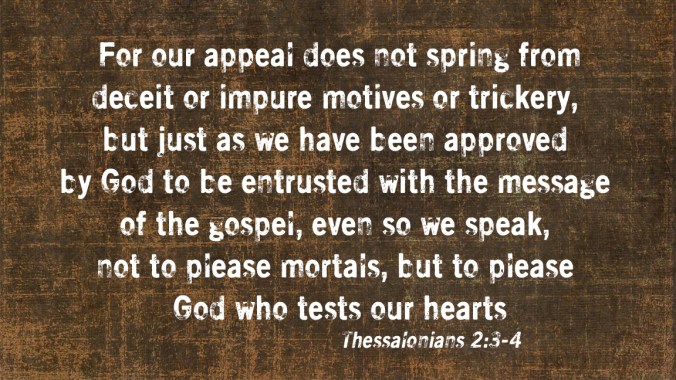
In many ways, our culture teaches us to win at all costs. From underhanded but effective political tactics to reality television featuring treacherous alliances and double-crosses, we can easily find ourselves celebrating victory more than integrity. For Paul it was not so: he trusted the integrity of his message was itself enough to bring people to Christ. Yet even the church can succumb to a little bait and switch, exaggerating joys and minimizing challenges to get people in the doors.

When we try to make ourselves seem better than we are, ironically we undermine the Good News. “Sunday Best” doesn’t refer only to our attire – we bring our best attitudes, best behavior, and best versions of our lives. We often assume that everyone else’s “best” presentation of their lives is the whole truth when in reality they may be struggling as badly or worse than we are. Together we perpetuate the myth that Christians must be eternally cheerful and optimistic. The danger in all this window dressing is the subtle message that Jesus Club is meant for those who have it together, or who can get it together. Not only do we miss opportunities to support one another, we intimidate others from trying to join the body. Eventually the false front crumbles under the weight of our collective repression, and the world sees us as hypocrites.

What a relief it would be to share the gospel as Paul did! He admitted to being exhausted, mistreated, and quarrelsome. He bore his sufferings and flaws as a testament to Christ’s presence in his life. His message spoke to broken people who needed to know Christ … because he admitted he was broken and needed Christ. And not simply past-tense broken, but presently broken and constantly being saved. That friend undergoing an ugly divorce just might be more interested in hearing about how Jesus is with you as you battle depression than about the Jesus who blessed the congregation with the best bake sale turnout ever. When we stop showing people the Jesus we think they want to see, and show them the real Jesus in the trenches with us, the message is more than enough.

Comfort: God already knows your true self, so there’s no sense in hiding it from anyone else.

Challenge: Share your authentic self with your church family or faith community. In what ways does it help you, and in what ways does it help them?

Prayer: God of truth, I present my authentic self to you, knowing you are the answer to all my brokenness, and ask you to use it for your glory. Amen.

Discussion: In what ways does being honest about your life help you, and in what ways does it help others?

Join the discussion! If you enjoyed this post, feel free to join an extended discussion as part of the C+C Facebook group. You’ll be notified of new posts through FB, and have the opportunity to share your thoughts with some lovely people.

Lightly Salted

salt

Today’s readings (click below to open in new tab/window):
Psalms 98; 146, Exodus 32:21-34, 1 Thessalonians 1:1-10, Matthew 5:11-16


Has anyone born in America since 1920 not heard “This Little Light of Mine?” The lyrics are based on Christ’s words to his disciples: “Let your light shine before others, so that they may see your good works and give glory to your Father in heaven.” He tells them a shining city on a hill cannot be hidden, and a lamp hidden under a bushel is useless. He also tells them salt with no flavor has no purpose. Christ wants his followers to let the world see what God has done for and through us.

Progressive Christians can be tempted to put a dimmer switch on that lamp. We don’t want to be confused with “those” Christians who embarrass us (as though they aren’t part of the same body beloved by Christ), and find ourselves preaching only to the progressive choir – who don’t raise their voices too loudly either. We are more comfortable with sentiments like St. Francis’s “Preach the Gospel at all times; use words if you have to,” sometimes clinging to them so tightly any hint of good news is squeezed out. Some strong progressive voices like Sojourners and the United Church of Christ are reaching out to the larger culture, but by and large we are merely … polite.

Of course there is a balance. Light illuminates, but it also blinds. A sprinkling of salt enhances a dish, but an entire mouthful makes us ill. However we share Christ’s message, our intent should never be to overwhelm or obliterate, but to add love and faith to beautifully season what is already there. God has declared His creation good, so it’s not our job to point out what we believe to be everyone’s flaws, but rather to share with them the good news. We all need reminded of how beloved we are, because believing that can be almost impossible for some of us. Once that belief is solid, we shine from the inside out.

Don’t be afraid to let your light shine, because it will kindle the light in others. Don’t let your salt lose its flavor, because once others get a taste they’ll crave more.

Comfort: Your faith is worth showing people!

Challenge: Allow Christ’s light to shine through you into dark places without turning it on people like an interrogation lamp.

Prayer: God of love and light, thank you for all your good works. May others see them shine through me! Amen. 

Discussion: Are you ever tempted to “dim” your light? Or the reverse: blinding people with it? How might you change?

Join the discussion! If you enjoyed this post, feel free to join an extended discussion as part of the C+C Facebook group. You’ll be notified of new posts through FB, and have the opportunity to share your thoughts with some lovely people.

Blessed are those…

1460979157719.jpg

Today’s readings (click below to open in new tab/window):
Psalms 97; 145, Exodus 32:1-20, Colossians 3:18-4:6 (4:7-18), Matthew 5:1-10


Today’s passage from Matthew is commonly known as The Beatitudes. The word “beatitude” means supreme blessedness or happiness. Jesus is telling the people that God does not just sympathize with those who struggle, but places them first.

The words of The Beatitudes are famous well beyond Christian circles. “Blessed are the meek” and “Blessed are the peacemakers”  would be cliché if they weren’t still radical statements.

The Beatitudes describe a world where an oppressive imperial society (Roman or otherwise) is turned upside down by God’s love. We perceive them as blessings, but to anyone holding or seeking power over others, they are almost threatening. No wonder Jesus warns us those who benefit from the status quo or fear God’s justice will revile and persecute and slander the faithful: his message says that not only is their power illusory, they are ultimately irrelevant to us because our only dependence is on God.

Some critics of Christianity use texts like The Beatitudes to paint Christians as passive and long-suffering. The meek, the mournful, the poor, and the hungry – not anyone most of us would aspire to be. Even the merciful, the pure in heart, and the peacemakers can be caricatured as mere do-gooders or pacifiers.

The truth is, each of these states represents an active engagement in the world and a refusal to accept less than the fullness of God. Mourning is not mere sadness, but grappling with a world steeped in pain. Meekness is a choice of community over self. Peacemaking is a dangerous profession – ask any police officer called to a domestic dispute.

The Beatitudes spell out how we are to be in the world but not of it. We are not called to suffer for suffering’s sake, but may be called to do so when life in the kingdom of God clashes with the expectations of the world. How such persecution can be a blessing is a mystery, but no more a mystery than how the world can turn a deaf ear to God’s call to justice and love. Which of these mysteries do we want to live in?

Comfort: God’s ways are not the world’s ways. The poor in spirit have the kingdom of heaven.

Challenge: What do you think it means to be poor “in spirit?” Read this article and have a conversation with friends about it.

Prayer: Lord, I depend only on you for my spiritual wealth, only on you to satisfy my hunger for justice. Amen.

Discussion: How might it be spiritually dangerous to assume we are persecuted simply because we are Christian?

Join the discussion! If you enjoyed this post, feel free to join an extended discussion as part of the C+C Facebook group. You’ll be notified of new posts through FB, and have the opportunity to share your thoughts with some lovely people.

The Seat of Mercy

Today’s readings (click below to open in new tab/window):
Psalms 92; 149, Exodus 25:1-22, Colossians 3:1-17, Matthew 4:18-25


The LORD said to Moses: Tell the Israelites to take for me an offering; from all whose hearts prompt them to give you shall receive the offering for me.
– Exodus 25:1-2

The Ark of the Covenant was a container built to hold the tablets of the Ten Commandments, God’s first laws for Israel. Its golden cover, with grand cherubim sculpted into either end, was called the Mercy Seat. The Mercy Seat was where God was present in the center of his people, and where sacrifices were offered for atonement of the sins of the people. All the gold for the Ark, as well as materials for the tabernacle (portable temple) which housed it – other precious metals, fine fabrics, gems, leather, spices, etc. – were collected voluntarily from people whose hearts were moved to give. This was a special kind of generosity since the people of the nation of Israel had only the possessions they had taken with them when they fled Egypt, and were a wandering, exiled people without other resources or trading partners. Each contribution was a meaningful sacrifice. What a wonderful metaphor: God’s dwelling place is created by the generosity of the community.

The Ark was secured in the innermost part of the tabernacle, and later in the temple at Jersualem, called the Holy of Holies. Only high priests were permitted to be in the presence of the Ark, and each year on the Day of Atonement they would sprinkle sacrificial blood on the Mercy Seat. Flash Forward a few centuries and in the outermost part of the temple we would find the money-changers whose presence offended Jesus so much that he drove them out with a whip. What started with the generosity of the people had become a place for the powerful to exploit the poor.

Offering himself as the ultimate sacrifice, Christ fulfilled the law and made the Mercy Seat obsolete. His was the blood of the new covenant, shed for all. We are no longer separated from God by law, but redeemed to him by love. As Paul taught the Colossians, in Christ there is no male or female, Greek or Jew, slave or free … inside the Holy of Holies or outside; all are equal members of the Body of Christ. Together, through our generosity and love, we are tasked with building a holy place, more precious than gold, with this new covenant at its center.

Comfort: God dwells among us.

Challenge:  When you can, work toward reconciliation.

Prayer: Loving God, I thank you for the sacrifice of Jesus the Christ. Make me a worthy bearer of his covenant. Amen.

Discussion: What divisions do you observe among the body of Christ? Conservative or liberal? Catholic or Protestant? Others?

Join the discussion! If you enjoyed this post, feel free to join an extended discussion as part of the C+C Facebook group. You’ll be notified of new posts through FB, and have the opportunity to share your thoughts with some lovely people.

Temptation Situation

1460687563612.jpg

Today’s readings (click below to open in new tab/window):
Psalms 47; 147:12-20, Exodus 20:1-21, Colossians 1:24-2:7, Matthew 4:1-11


A friend once said no matter how obviously stupid a behavior is, if there’s a law against it someone has tried it. So the Baltimore, Maryland law against taking a lion to the movies really gives one pause. A more sobering example, child labor laws exist because not enough people found it otherwise important not to exploit children. My friend also said if we passed a law against drinking bleach, Clorox speakeasies would pop up everywhere. It can be hard to tell whether rules were made to be broken, or  made for the broken.

After God announced the Ten Commandments at Mount Sinai, the people of Israel fled from the foot of the mountain and begged Moses not to let God speak to them directly. They said they feared hearing God’s voice would kill them, but it probably also shamed them. Indirectly God was saying: “I know what’s in your hearts: murder, adultery, theft. Just don’t.” When Moses said God was trying to put fear into them so they would not sin, he really meant fear. Sometimes it’s all that keeps us in line.

Whether or not we are optimistic about human nature, Jesus demonstrates we can be better. Preceding his ministry, he fasted in the desert for forty days. Afterward, when he was at his weakest, the devil tried to tempt him.

Turn the stones to bread?
Man lives on every word from the mouth of God. 

Prove yourself by leaping off this cliff and letting angels save you?
Don’t test the Lord.

Worship me and rule all you see?
Worship no one but God.

Jesus said these things were written, and they were, but except for the third they weren’t hard and fast rules. There was no law about turning stones to bread, no specific definition of testing the Lord. Christ consistently showed us obedience to the law was only the beginning of being faithful to God. He tells us love is stronger than fear. He invites us to be more than followers of law, but lovers of God and humankind. When love trumps fear, obedience is not a burden but a joy.

Comfort: Everyone is tempted. We can depend on Christ to help us resist.

Challenge: We like to believe willpower should be enough to handle temptation, and can be pretty hard on ourselves when we feel we’ve failed. Read this article on the limitations of willpower and how to make real change.

Prayer: Gracious God, thank you for loving me enough to set rules, and trusting me enough to live beyond them. Teach me to rely on your love to make good and just choices. Amen.

Discussion: How can you implement the principles you read about in the challenge link?

Join the discussion! If you enjoyed this post, feel free to join an extended discussion as part of the C+C Facebook group. You’ll be notified of new posts through FB, and have the opportunity to share your thoughts with some lovely people.
The Message Is The Same

1460600177611.jpg

Today’s readings (click below to open in new tab/window):
Psalms 99; 147:1-11, Exodus 19:16-25, Colossians 1:15-23, Matthew 3:13-17


There’s an old marketing belief that prospective customers need to hear your message seven times before they become interested in your product. Given the scene at Mount Sinai in the days preceding God’s arrival, God may have been a marketing major. As God descended the mountain hidden by a thick cloud, He told Moses to keep the people off the mountain, lest they be destroyed by the very sight of God. Moses seemed a little confused when he replied: “The people are not permitted to come up to Mount Sinai; for you yourself warned us, saying, ‘Set limits around the mountain and keep it holy.'” The gist of God’s response was: “OK. Go get your brother. And keep the people off the mountain.”

God’s warning wasn’t a threat; to the contrary, He was concerned with the welfare of the people. The destruction was not a consequence of His wrath, but His mere presence. If this scene had been written for a movie today it would surely foreshadow someone’s ill-conceived attempt to approach the mountain, but Exodus doesn’t mention anyone disobeying the warning.

When Jesus asked John the Baptist for baptism, John was reluctant because he felt unworthy, but he quickly consented. “And when Jesus had been baptized […] suddenly the heavens were opened to him and he saw the Spirit of God descending like a dove and alighting on him. And a voice from heaven said, ‘This is my Son, the Beloved, with whom I am well pleased.'” Quite the contrast to Sinai, isn’t it?

Hearing from God can be terrifying, or it can be exhilarating. It’s terrifying when we realize charging that mountain may mean, for our own good, utter destruction of life as we live it. But when we’ve submitted ourselves to God, as John the Baptist had, God’s voice is reassuring and life-giving. Our perception depends very much on whether we are open to receiving the message … but the message is the same either way. God is always calling us to new life. Are we being dragged uphill against our will, or are we enjoying the mountain view?

Comfort: God’s message is always one of love…

Challenge: … but we may need to do some work before we can hear it.

Prayer: Loving God, thank you for always reaching out to me. I will do my best to answer your call willingly and enthusiastically. Amen.

Discussion: Do you feel God speaks to you? If so, how?

Join the discussion! If you enjoyed this post, feel free to join an extended discussion as part of the C+C Facebook group. You’ll be notified of new posts through FB, and have the opportunity to share your thoughts with some lovely people.

Shifting Perspective

1460492849198.jpg

Today’s readings (click below to open in new tab/window):
Psalms 98; 146, Exodus 19:1-16, Colossians 1:1-14, Matthew 3:7-12


Many Christian seminaries require students to write a thesis demonstrating they have developed a consistent view of the nature of God and religious belief (systematic theology). This is an important part of preparing students for ordained ministry. Not too many people want to approach their minister with a pressing issue, only to hear: “Well I’ve never really thought about it…” Given the challenges of reading the Bible as a unified and consistent text, developing such a statement is a tall order.

In today’s scriptures we read about multiple understandings of God. In Exodus, God gives the nation of Israel three days to purify themselves for His arrival on Mount Sinai. He descends in a thick cloud and, under pain of death, permits neither man nor beast to approach the mountain while he remains. This God shows power and authority to a nation who doubts.

In Matthew, John the Baptist preparing the way for the coming Messiah. He speaks to the descendant priests of that same nation and tells them they have become like trees bearing rotten fruit and Jesus is on the way with an ax. This God shows his disappointment in a nation where the powerful exploit the weak.

In Corinthians, Paul congratulates the church and encourages them to keep bearing good fruit of the Spirit by holding fast to Christ. This God showers blessing and encouragement on a community of believers.

If we conclude the nature of God changes across time, theology is useless – God could be totally different tomorrow! Better perhaps to think our understanding of and expressions about God change with our personal and community evolution. God is constantly liberating us, and constantly correcting us (whether through supernatural intervention or natural consequences) when we misuse that liberation.

The average age of seminarians is creeping into the 30s and early 40s, an age where certainties from our 20s mature into more questions than answers. Our relationship with God is one we build throughout our lifetime – and beyond. As our vision of God ebbs and flows, we eventually realize God isn’t moving – our perspective changes because we are.

Comfort: God is constant and present to us wherever we may go.

Challenge:  Draw yourself a timeline of your ups and downs, and keep it handy for future updates.

Prayer: Immortal God, thank you for being present to me at all times. Please give me wisdom when I cast my own doubts and limitations on you.  Amen.

Discussion: How has your understanding of God changed over time? When has that been joyful, and when has that been painful?

Join the discussion! If you enjoyed this post, feel free to join an extended discussion as part of the C+C Facebook group. You’ll be notified of new posts through FB, and have the opportunity to share your thoughts with some lovely people.

Between Love and Hate

1460302740659.jpg

Today’s readings (click below to open in new window/tab):
Psalms 93; 150, Exodus 18:1-12, 1 John 2:7-17, Mark 16:9-20


One Sunday after church, my little brother began telling our dog Buffy that he hated her. Buffy was his best friend – what could have happened? When our mother asked why, he said the priest told us to love God and hate the things of this world. Imagine his relief when Mom reassured him it was perfectly OK to love the dog.

If, like my younger brother, we want to take scripture seriously, how are we to deal with texts like 1 John which tell us to love only God and hate the world?

When these passages were written, people thought Christ was returning any minute. All their focus was meant to be on that event. We’ve since realized we need to live in this world a bit longer; hating it is more difficult when you’re in it your whole life.

Are we really to hate it? After all, the Psalms glorify creation, and Christ instructed us to love our neighbors. He also told one young man to abandon all he owned. There’s a lot to sort through to figure out what we’re supposed to be loving and hating.

Maybe the lowest common denominator is this: love God above all else, with a love that makes all other affections seem insignificant – perhaps hateful? – by comparison. We love the beauty of creation because it glorifies God. We love other people because they are first beloved by God. We recognize anything we possess is a gift from God and valuable only in proportion to how we use it to glorify him. This perspective shifts our affection from the things themselves, and directs our love and gratitude where it truly belongs.

As we navigate the world and try to be “in it but not of it,” we find things to love because we are created to love. Specifically, we are created to love God and the things God loves. We will also find things worth hating, such as injustice and oppression. At all times, our benchmark should be love of God, and we can trust God will love the rest for us and through us.

Comfort: Loving God with all your heart, mind, and soul puts everything in perspective.

Challenge:  This week, abandon one thing that distracts you from your faith.

Prayer: God of love and mercy, thank you for the blessings and gifts of this world. Help me to remember they are reflections of your glory, so all my love may be directed toward you. Amen.

Discussion: What things might you “love” too much?

Join the discussion! If you enjoyed this post, feel free to join an extended discussion as part of the C+C Facebook group. You’ll be notified of new posts through FB, and have the opportunity to share your thoughts with some lovely people.