A Thing of Horror?

1469808419621.jpg

Today’s readings (click below to open in new tab/window):
Psalms 88; 148, Judges 5:1-18, Acts 2:1-21, Matthew 28:1-10


“You have caused my companions to shun me;
     you have made me a thing of horror to them.”  – Psalm 88:8

What a jarring statement, to declare oneself a horror to companions and neighbors. Sadly, we can all relate. When we experience an extended personal crisis – a divorce, a job loss, an illness – most of us reach a point where we suspect family and friends must be weary of hearing about it. We notice (or imagine) that people have begun to avoid us. Whatever the situation, even when we feel most alone, God is with us. Like the psalmist, we may feel God’s face is hidden. When that happens, we may need to use prayers like sledgehammers to batter down the barrier a crisis erects between us and God.

And when the tables are turned? Do our neighbors in crisis ever become horrors to us? We grow tired of hearing the minutia of Bill’s family court drama. We have to drag ourselves to the bedside of a formerly vivacious friend we weep to see wasting away. Some days we simply aren’t up to the task. But on better days we honor the Christ of the cross – who had become a physical and social horror to his friends and loved ones – by seeing his face where people suffer. We all know someone who lends the ear, takes someone to chemotherapy, or bakes the casserole. Maybe we are that someone.

If you are that someone, let people who still struggle to serve others know you don’t have superpowers – you rely on the Lord for strength. If you are not that someone and find yourself struggling to serve, understand that you are more capable than you realize. None of us wants to share disease or loss any more than we want to experience it, but we do so because love calls us to. When we serve each other with love, no one – no matter how awful their situation – is a “thing of horror” to God. Each of us is a child of God in need. Let’s not be put off by a matter of degree.

Comfort: God loves us as a child, regardless of circumstance.

Challenge: If you find it easy to serve others, offer to help someone who struggles. If you struggle, find and work with someone who finds it easy.

Prayer: God of strength, I will serve you by serving others. Amen.

Discussion: Have you ever felt like a “thing of horror?”

Join the discussion! If you enjoyed this post, feel free to join an extended discussion as part of the C+C Facebook group. You’ll be notified of new posts through FB, and have the opportunity to share your thoughts with some lovely people. Or feel free to comment here on WordPress, or even re-blog – the more the merrier!

Burying the Body


Today’s readings (click below to open in new tab/window):

Psalms 143; 147:12-20; Judges 4:4-23; Acts 1:15-26; Matthew 27:55-66


Jesus was dead. His disciples, not understanding he would return, were scattered and gutted because their revolution had ended in crucifixion. The Messiah had been killed by enemies among the occupier and the occupied. The evidence of failure was his own lifeless body, hanging on a cross as the Sabbath drew near.

“What now?” they whispered. “What do we do now?”

Joseph of Arimathea and the Marys knew the simple yet devastating answer: bury the body.

Life can go so drastically wrong that we literally don’t know what to do. At these times, the best thing is often to attend to the practical. When life smashes our expectations beyond recovery, the loss can be too overwhelming to process all at once. When this is true, the momentum of responsibilities like a job, cooking dinner, and showering can keep us moving like a bicycle that will topple if it stops. Such distractions help us swallow grief in bite-sized chunks rather than a choking whole. Though we don’t want to turn these responsibilities into a form of denial, engaging in them can help us throttle the grieving process to a manageable pace. Funeral arrangements, for instance, while not routine, serve an important psychological purpose of engaging the grieving parties in activity. They draw us back into the decisions and actions of the living. While it is inevitable that we will have moments when breaking down is the right and necessary thing to do, we need a purpose to rise back up.

Short of clinical issues like depression, we all have the capacity to move on. Parents who care for children with severe disabilities are often asked, “How do you do it?” When the disability is unexpected, a parent may, in a sense, have to bury the body of hopes once held for that child. The future may hold resurrection, or an altered set of expectations, or further disappointment; in any case, these parents pull the extraordinary from the ordinary. Like Joseph and the Marys, they know the enormous healing power of being able to honestly say, “We did what we had to.”

Comfort:  In our greatest losses, God grieves with us.

Challenge: Make a list of the tasks you perform each day. Turn this into a litany of thanks: “God, thank you for the opportunity to …”

Prayer: Merciful and loving God, give me the strength to do what needs doing. Amen.

Discussion: Have you ever been immobilized by grief? What got you moving again?

Join the discussion! If you enjoyed this post, feel free to join an extended discussion as part of the C+C Facebook group. You’ll be notified of new posts through FB, and have the opportunity to share your thoughts with some lovely people. Or feel free to comment here on WordPress, or even re-blog – the more the merrier!

Forsaken

1469571158530.jpg

Today’s readings (click below to open in new tab/window):
Psalms 65; 147:1-11, Judges 3:12-30, Acts 1:1-14, Matthew 27:45-54


“Eli, Eli, lema sabachthani?” That is, “My God, my God, why have you forsaken me?”

Every year during the Passion narrative, this verse moves me more than any other. Although the Gospels tells us Jesus suffered and was tempted like any other person, he seems so wise, so confident, and just so plain good it can be hard to believe. These words, though, contain every bit of despair and doubt I’ve ever felt – and then some. If Jesus, of all beings in creation, can feel abandoned by God, our own doubts and fears condemn us not at all.

All of us sometimes feel forsaken by God. In times of illness, financial hardship, failing relationships, and many other situations, we can feel let down or deserted by God. The last thing we need is a clichéd assurance us of God’s loving presence. Reason tells us everyone suffers, but our distressed hearts may be difficult to convince. We can dispassionately dispense platitudes about someone else’s problem, but our own problems are somehow different.

Doubt, disbelief, and anger at God are almost inevitable. Knowing Jesus felt the same way (at least once) puts us in good company. The psalmists were able to feel faithful and forsaken at the same time. Psalm 119:82 says “My eyes fail with watching for your promise; I ask ‘When will you comfort me?’” How poignant! We must not confuse doubt with the absence or end of faith. Classics of Christian writing like The Dark Night of the Soul by St. John of the Cross help us understand the ways doubt and darkness can transform our faith. While our instinct is often to reject doubt, we need to embrace and explore it. Burying it beneath denial or easy answers undermines the development of true, enduring faith. When we see someone struggling with doubt, offering easy reassurance can actually be a terrible disservice. Better to be present for our struggling friends, and let them reap the benefits of working through their own spiritual struggles.

A moment of doubt did not thwart Jesus’ triumph, and it doesn’t have to destroy our faith.

Comfort: Doubt can be the turn in the road that leads us to new understanding.

Challenge: Invite someone you trust to discuss each other’s doubts.

Prayer: Merciful and loving God, thank you for being bigger than my doubt. Amen.

Discussion: What do you do when you experience doubt?

Join the discussion! If you enjoyed this post, feel free to join an extended discussion as part of the C+C Facebook group. You’ll be notified of new posts through FB, and have the opportunity to share your thoughts with some lovely people. Or feel free to comment here on WordPress, or even re-blog – the more the merrier!
Maybe next time…

1469498503067.jpg

Today’s readings (click below to open in new tab/window):
Psalms 54; 146, Judges 2:1–5, 11–23, Romans 16:17–27, Matthew 27:32–44


The book of Judges recounts the history of Israel between the time of Joshua’s death and the reign of Saul, Israel’s first king. The second chapter begins a cycle that repeats several times: Israel prospers, then grows lax and disobedient and God withdraws his favor; eventually the plight of the Israelites softens his heart and he sends a judge to set them back on the right track. Over a dozen times. We may or may not experience our fortunes and misfortunes proportional to God’s favor, but we can all find lessons in these stories.

One simple, yet important lesson: learn from your mistakes. For two centuries, the Israelites teetered on the brink of ruin multiple times, always for the same reason. It is easy to shake our heads at their stubborn foolishness, but we’ve all been there. Maybe relationship after relationship sours because we can’t change our ways. Maybe our weight boomerangs in a cycle of diet and despair. Maybe we repeatedly sabotage our job or education or finances because we cling to a particular mindset. Everyone has some story of an attitude or habit they had difficulty changing (or still need to). Most of us have more than one. Not everyone needs a twelve step program, but sometimes we all need to surrender to the higher power integral to success.

Another related lesson: neglecting our relationship with God has consequences. Perhaps not direct punishment, but consequences intrinsic to our behavior – a sort of “built-in” system of moral checks and balances. Christ and the prophets teach us to put God and our neighbor above materialistic concerns, yet advertising and other influential aspects of our culture tell us exactly the opposite. However, our novels and films abound with morality tales about the dangers of prioritizing wealth, popularity, vanity, etc. In these tales, people nearly always either arrive at a bad end or save themselves by repenting. Could these stories be popular because they strike a chord of truth within us? By nurturing our relationship with God, we can focus on priorities that deliver a true abundance, an abundance of the spirit.

Comfort: Like the north star, God helps our path stay true if we follow him.

Challenge: Change one part of your routine today and observe the effects.

Prayer: Merciful and loving God, my heart is set on you. Amen.

Discussion: What habits have you found hard to break?

Join the discussion! If you enjoyed this post, feel free to join an extended discussion as part of the C+C Facebook group. You’ll be notified of new posts through FB, and have the opportunity to share your thoughts with some lovely people. Or feel free to comment here on WordPress, or even re-blog – the more the merrier!

Flavor of the Weak

1469444195207.jpg

Today’s readings (click below to open in new tab/window):
Psalms 56, 57, 58; 145, Joshua 24:16-33, Romans 16:1-16, Matthew 27:24-31


What is it about humiliating others that appeals to so many? Words that should be bitter on the tongue are savored like sweets. We see or hear examples every day: children (and adults) bullying each other, politicians launching personal attacks, reality television, petty vindictiveness as couples separate, and on and on. On the world stage, terrorism aims not simply to overcome the enemy, but to demoralize and spiritually destroy it. In Matthew’s gospel, after Jesus is sentenced, soldiers make sport of him by dressing him in a mockery of royal attire, including a bloody crown of thorns. Yet at no point does Jesus so much as belittle those who persecute him. To the end of his life, he prays for them and asks God to forgive them (Luke 23:34). People truly working for justice and righteousness do not stoop to humiliation as a tactic. Without oversimplifying the psychology of such behavior, can we see a correlation between the need to humiliate an enemy, and an awareness on some level that one’s cause is unjust?

People of faith are not immune to desires for humiliation or vengeance. The author of Psalm 58 uses such vicious imagery it has been dropped from most recent lectionaries. The psalmist wants God, among other things, to: break the enemies teeth in their mouths, let them be trodden down like grass, and let them dissolve into slime. He yearns for the righteous to bathe their feet in the blood of the wicked. These examples are specific and extreme, but modern equivalents exist. Fortunately God is not obligated to grant everything we – or the psalmists – wish for.

A desire to see one’s enemies humiliated may be part of the human experience, but Christians are called to a higher path of resisting such temptation, and following the example set by Jesus. Owning up to our own vindictive tendencies can be enough to give us pause before we act on them. Perhaps such temptation may indicate our own motives are less than noble. While humiliation is a tool of the weak and immoral, love and justice are always positions of strength.

Comfort: Humiliation is rendered powerless in the light of God’s love.

Challenge: As you go through the week, watch for examples of humiliation or vindictiveness. When you see or hear them, reflect on what these tools say about the cause or person using them.

Prayer: Merciful and loving God, may my words and actions be worthy of you. Amen.

Discussion: Has anyone humiliated you? Have you humiliated anyone else? What were the effects?

Join the discussion! If you enjoyed this post, feel free to join an extended discussion as part of the C+C Facebook group. You’ll be notified of new posts through FB, and have the opportunity to share your thoughts with some lovely people. Or feel free to comment here on WordPress, or even re-blog – the more the merrier!

Hear to Understand

1469404706685.jpg

Today’s readings (click below to open in new tab/window):
Psalms 67; 150, Joshua 24:1-15, Acts 28:23-31, Mark 2:23-28


We all like to think we are open-minded – that our beliefs and attitudes are the result of well-informed reasoning and thoughtful consideration. Unfortunately there are at least a dozen types of cognitive bias to which we are prone, and another three dozen types of logical fallacy which our biases urge us to ignore. Since human beings are largely irrational creatures, being an expert in bias and logic is no guarantee of solid reasoning; actually the smarter we are, the more easily we can justify our own biases by manipulating those very laws of logic.

When Paul went to Rome, many Jewish leaders there were willing to hear him out regarding the teachings of Jesus. He talked with them an entire day, into the evening, and when he was finished some believed and some did not. For those who did not, he shared these words from the Holy Spirit:

“You will be ever hearing but never understanding;
you will be ever seeing but never perceiving.”

These leaders were not evil, or – like the ones in Jerusalem who had driven him to seek sanctuary in Rome – even hostile. They simply felt no compelling reason to change their minds. What was the difference between those who believed Paul and those who didn’t? One possibility: they couldn’t imagine being wrong about the faith they had been taught and known all their lives.

Flash forward two thousand years, and people are basically the same. We believe God is moving among us, but in ways tradition has taught us to expect. When the Holy Spirit inspires prophets to declare Christians must grow to be more inclusive and just … some people believe and some do not. Few people today justify racial, gender, or ethnic discrimination on religious grounds, but once it was more common than not. Forces seeking justice and inclusion endure, and those that focus on condemnation and exclusion are judged unfavorably by history. When we consider such divisions in the church today, we must prayerfully consider whether we are biased toward merely hearing and seeing, or whether we are truly open to understanding and perceiving.

Comfort: The Spirit is still moving us toward justice.

Challenge: Follow the links in the first paragraph of today’s post – they may just teach you to be a better thinker.

Prayer: Lord of Truth and Light, teach me to be humble and bold enough to hear your word anew, even when I think I already understand it. Amen.

Discussion: When is the last time you changed you mind about something important to you? What prompted the change?

Join the discussion! If you enjoyed this post, feel free to join an extended discussion as part of the C+C Facebook group. You’ll be notified of new posts through FB, and have the opportunity to share your thoughts with some lovely people. Or feel free to comment here on WordPress, or even re-blog – the more the merrier!

Sons of the Father

1469309011146.jpg

Today’s readings (click below to open in new tab/window):
Psalms 56; 149, Joshua 23:1-16, Romans 15:25-33, Matthew 27:11-23


The character Barabbas is found in all four Gospels. During the Passover, Pilate had a tradition of pardoning one Jewish prisoner condemned to death. He gives the crowd a choice: they can free either Jesus the Messiah or a notorious prisoner. The crowd infamously chooses the prisoner.

Do you know the translation of the Greek name Barabbas is “son of the father?” The crowd literally chose between one Son and another. Because it seems we should condemn their choice, this story has been wrongly used to blame the Jewish people for Christ’s crucifixion. Had they chosen to free Jesus, the whole salvation story of the cross might never have happened. Whatever one’s theology regarding the cross and atonement, the story of Barabbas illustrates how God’s plan for salvation does not depend on the goodness of people, but unfolds despite our flawed nature.

Jesus (or more accurately, the Hebrew “Yeshua”) was not an uncommon name at the time, and some of the earliest versions of Matthew give the notorious prisoner’s full name as Jesus Barabbas. This makes the choice sound even more poignant. How many times, rather than choosing to let Jesus freely roam our minds and hearts, have we settled for a less-perfect substitute? In the 1961 film, Barabbas commits arson because he mistakenly believes it’s the end of the world and someone tells him Christians set Rome ablaze. How often do we mistakenly embrace a Christianity that would rather burn the world than die for it? We do it when we rationalize choosing the Jesus who allows us to value comfort over mercy, common sense over charity, or fear over faith, instead of the Jesus who sacrificed himself on a cross.

Yet these choices do not cause God to abandon us. We follow a risen Christ who seeks us; a shepherd who leaves ninety-nine sheep to redeem a lost one. The gospels don’t tell us the fate of the Biblical Barabbas, but Christ’s sacrifice was for him as much as for any of us. Like Barabbas, we live because Christ loved us unto death. May our choices reflect that love.

Comfort: Salvation unfolds regardless of our mistakes.

Challenge: Watch and discuss either the 1961 or 2012 version of Barabbas with friends.

Prayer: Merciful and Loving God, I will seek you above all things. Amen.

Discussion: The crowd thought it was making the right choice. When have you had to break from the crowd – especially a Christian crowd – to do the right thing?

Join the discussion! If you enjoyed this post, feel free to join an extended discussion as part of the C+C Facebook group. You’ll be notified of new posts through FB, and have the opportunity to share your thoughts with some lovely people. Or feel free to comment here on WordPress, or even re-blog – the more the merrier!

Forgoing Forgiving

Today’s readings (click below to open in new tab/window):
Psalms 130; 148, Joshua 9:22-10:15, Romans 15:14-24, Matthew 27:1-10


“Woe to that one by whom the Son of Man is betrayed! It would have been better for that one not to have been born!” Jesus spoke these words about the impending betrayal by Judas. When someone says, “So-and-so will wish he’d never been born!” they are usually referring to a desire for revenge. Should we assume the same about Jesus? If we do, we are declaring Judas the one person Jesus refused to forgive. As our ultimate example of compassion and mercy, does it seem more likely Jesus spoke words of vengeance, or of profound sadness over his friend’s fate?

Other than the betrayal itself, perhaps Judas’ biggest mistake was seeking forgiveness from no one but the same religious leaders who funded his wicked purpose. Not knowing Jesus would rise in three days, he saw no opportunity to ask Jesus directly. Though he flirted with repentance, Judas ultimately decided he was beyond redemption, and set his sights on the hanging tree. In the most immediate possible sense, he was unable to know the forgiveness of Christ.

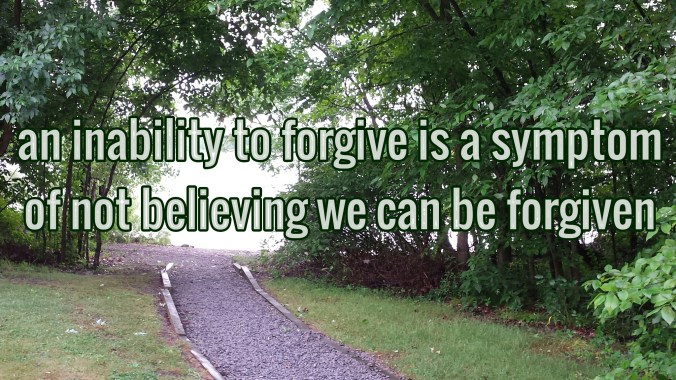
How do we imagine the Christ of the gospels would have responded if Judas had survived to ask forgiveness of him? We’ll never know, because Judas settled for the verdict of the chief priests. Sometimes when we do terrible things, our guilt convinces us we have committed the one unforgivable sin in all the world. We accept the verdict of our own religious leaders, families, or hearts. We decide we are beyond redemption, and follow a path validating that decision. We believe we are unworthy to even ask for redemption. We go through the motions of church and life, all the while feeling filthy and hollow. But what if we dared to ask Christ for forgiveness? More unthinkable, what if he forgave us? Then we might have no choice but to forgive ourselves.

What an overblown opinion of ourselves to say to Christ, “My sin is greater than your grace.” It is our understanding of mercy that is too small, never Christ’s. The only thing really standing between Christ and us… is us.

Comfort: It is never too late to experience God’s forgiveness.

Challenge: On one side of a sheet of paper, write down things you have trouble forgiving yourself for. On the other side write “God forgives me.” Burn the paper while offering a prayer of thanks.

Prayer: God of all Creation, thank you for your endless mercy. Amen.

Discussion: How difficult do you find it to forgive yourself?

Join the discussion! If you enjoyed this post, feel free to join an extended discussion as part of the C+C Facebook group. You’ll be notified of new posts through FB, and have the opportunity to share your thoughts with some lovely people. Or feel free to comment here on WordPress, or even re-blog – the more the merrier!
The Peter Principle

1469066900563.jpgToday’s readings (click below to open in new tab/window):

Psalms 36; 147:12-20, Joshua 9:3-21, Romans 15:1-13, Matthew 26:69-75


Have you ever been asked to provide an employment reference? One of the most common questions is: “Would you hire this person again?” Based on today’s reading from Matthew, if you were Jesus, would you hire Peter again? After all, he fell asleep on the job several times, and when the pressure was high he denied even knowing his boss. Yet Jesus named Peter the rock solid enough to found his church.

How do we feel about Peter denying Christ three times? We might like to think we would have been stronger, but we have the advantage of hindsight. More humbly, we might be grateful our performance hasn’t been similarly tested. We might find relief that, rather than place his trust in the perfect, Jesus placed it in those who loved him and whom he loved.

This was not the first or last time Peter would stumble. When an authority figure fails (or merely fails to please us), our reaction can be disproportionate. We expect them to know more, do better, and be stronger than we ourselves are. If they have purposely projected such an image, their failings invite that much more criticism. Maybe we become silently resentful of a minister who hasn’t provided as much attention as we feel we deserve. Maybe we gossip to our co-workers when our boss makes a mistake we could just as easily have made. Maybe we resent our parents because we simply know we could have done a better job.

No one is above honest criticism, but our standards should be fair to everyone. If today Jesus appointed any one of us to lead his church, that person would be a fool not to be more intimidated than honored. Positions of authority, handled responsibly, are enormous burdens. Yet the people who hold them are only people. Let us be at least as forgiving of them as we would like them to be of us. Our minister has overwhelming priorities. Our boss needs support more than criticism. Our parents are still growing as people. Peter needed a lifetime to grow into his job too.

Comfort: Jesus never expects perfection, only love.

Challenge: Ask a minister, employer, parent or other authority figure to describe their responsibilities to you.

Prayer: God of all Creation, thank you for the gift of forgiveness. Amen.

Discussion: Are you more, less, or equally critical of authority figures as you are of others?

Join the discussion! If you enjoyed this post, feel free to join an extended discussion as part of the C+C Facebook group. You’ll be notified of new posts through FB, and have the opportunity to share your thoughts with some lovely people. Or feel free to comment here on WordPress, or even re-blog – the more the merrier!